

Career profile

Allergist and Immunologist

Allergists and immunologists investigate allergies, manage asthma and treat immune systems that do not protect.

One skin or lab result is never the whole story. Allergists weigh it against the patient's experience, and only then choose more testing or treatment.

An allergist examining an adult patient's forearm during an allergy assessment in a clinic.

A day in the life

1An allergist listens to a seated man describe a reaction and records the sequence of exposures and symptoms.

Hear the patient's reaction story

Ask what they ate or touched, when symptoms began and what followed, then examine them to choose tests.

2An allergist compares small skin-test reactions on a man's forearm with his symptom history while explaining the findings.

Match test results to symptoms

Compare skin reactions or blood work with symptoms, and explain a positive alone does not prove allergy.

3An allergist discusses medication response with a man and records a revised treatment plan at a computer.

Rework the plan when symptoms persist

Review how the medicines worked, discuss alternatives and record the new plan for the patient and other clinicians.
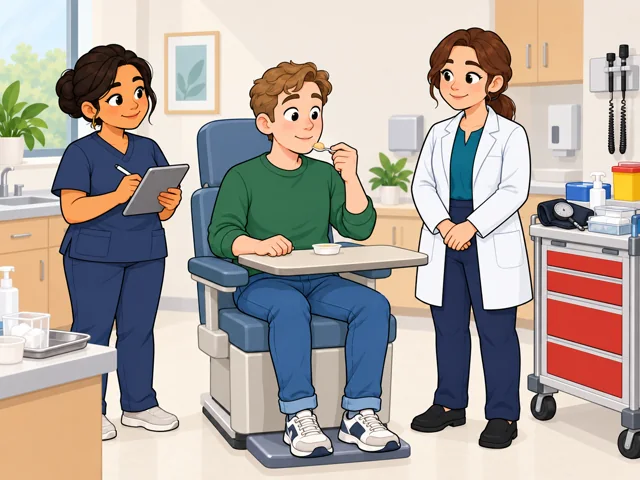
4An allergist watches a man take a small bite during a supervised food challenge while a coworker records observations and treatment equipment remains nearby.

Supervise a food challenge in clinic

For selected patients, watch for symptoms as they eat the food, with treatment ready if they react.

Quick facts

Preparation

Medical school + specialty training

United States

Pay

Not displayed

Pay depends on the position, experience, and working hours.

Outlook

Not displayed

National physician projections cover many specialties together.

Quick orientation

Preparation, pay & outlook

Preparation

Medical school + specialty training

Typically a bachelor's degree, four years of medical school, three years of residency, and at least two years of allergy and immunology fellowship.

Geography
United States
Period
Not applicable

Pay

Not displayed

Pay depends on the position, experience, and working hours.

Geography
United States
Period
May 2025

Outlook

Not displayed

National physician projections cover many specialties together.

Geography
United States
Period
2025–2035

Fit, tradeoffs & changing tools

Things to weigh

  • Some tests can provoke reactions. You need to stay attentive even when the appointment begins calmly.
  • The training takes years, and studying continues after it. Patient visits also leave charts to update and results to review.

Where AI may help

Software that searches medical records for patterns may help flag possible immune disorders or support treatment decisions. These artificial intelligence tools need validation for their intended patients.

What people still lead

You judge whether a suggested pattern fits the person in front of you and weigh the consequences of further testing or treatment.

What we can’t predict yet

How much diagnostic work these tools can take over depends on whether they remain reliable across different patients and clinics.

Pay in context

Earnings

Specialty pay ranges below show the terms of academic and outpatient jobs. The national median and hiring outlook cover a broader physician group.

National physician pay context

Physicians, All Other had a May 2025 median of $265,930 annually—about $127.85 an hour using 2,080 hours per year. Its 10th and 90th percentile wages were $69,170 and $452,360. These figures span multiple specialties; they are not allergist-only pay, career stages, or an actual hourly schedule.

Geography
United States
Period
May 2025
Pay basis
Employee wage median and percentiles for SOC 29-1229; calculated hourly equivalent

Academic clinical appointments

In Los Angeles, full-time academic allergy and immunology appointments offer a salary range of $146,700–$442,800 across Instructor through Professor ranks. Rank and step affect pay, and additional compensation may be available. This is an appointment range, not a starting salary.

Geography
Los Angeles, California
Period
2026–2027 recruitment
Pay basis
Annual salary range for full-time UCLA academic clinical appointments; additional compensation eligibility

Outpatient medical-group work

For an outpatient allergist role in Southborough, Massachusetts, the specialty compensation range is $254,000–$480,500, including base pay and bonus. Experience and local labor markets affect compensation; productivity and performance may increase it over time. Compare bonus terms as well as salary.

Geography
Southborough, Massachusetts
Period
2026 recruitment
Pay basis
Employer specialty total cash compensation range, including base pay and bonus

Broader hiring context

Physicians, All Other is projected to grow 3.4% from 2025 to 2035, with about 9,400 openings annually from growth and replacement combined. Those openings span multiple specialties.

Geography
United States
Period
2025–2035
Pay basis
Employment projection, not compensation

Getting started

Begin with internal medicine

What the route involves
Complete a three-year internal medicine residency, building experience in adult medical care.
What it can lead to
You can pursue allergy and immunology fellowship. Internal medicine board certification supplies one prerequisite for the later specialty certification exam.

Begin with pediatrics

What the route involves
Complete a three-year pediatrics residency, building experience caring for children.
What it can lead to
You can pursue allergy and immunology fellowship. Pediatrics board certification supplies the alternative prerequisite for the later specialty certification exam.

First complete college preparation and earn a Doctor of Medicine or Doctor of Osteopathic Medicine degree. The two main residency routes below lead toward the same specialty fellowship; residency and fellowship involve supervised patient care.

After entry

Career paths

This starts where the entry routes leave off: early work, growing capability, and advancement or specialization. This path also has a credential or licensing boundary; see the requirements and limits.

  1. Get established

    Build a follow-up routine for your patients and keep referring clinicians informed about diagnoses and treatment changes.

  2. Improve your decisions

    Use continuing education and reviews of your own care to spot what needs improvement, then check whether your changes help.

  3. Develop a focus

    Build expertise in complex immune disorders or food allergy. In academic practice, you may progress into teaching fellows or leading clinical or research work.

Where you can work

Outpatient allergy office

Your work centers on consultations, testing, and return visits. The office needs both space for planned appointments and equipment to respond to a testing reaction.

  • Indoors
  • Office
  • Safety-sensitive

Academic children's medical center

You may share complex cases with other specialists and teach medical students, residents, and fellows. Some appointments also include research and leadership responsibilities.

  • Indoors
  • Safety-sensitive

Try it

See whether the job clicks before you commit to the path.

Imagine someone reports an itchy rash after lunch. Write five questions you would ask before blaming a particular food, then arrange the answers you would need on a timeline. Notice whether you enjoy finding missing information before choosing an explanation.

Stay safe: Keep this fictional. Do not test foods, medicines, or suspected allergens on yourself or anyone else.

Explore more careers

Sources

  1. O*NET OnLine. Allergists and Immunologists — 29-1229.01. Accessed 2026-10-03.
  2. U.S. Bureau of Labor Statistics. Occupational projections and worker characteristics. Accessed 2026-10-03.
  3. U.S. Bureau of Labor Statistics. Physicians and Surgeons. Accessed 2026-10-03.
  4. American Academy of Allergy, Asthma & Immunology. About Allergy and Immunology. Accessed 2026-10-03.
  5. American Academy of Allergy, Asthma & Immunology. Allergy Testing. Accessed 2026-10-03.
  6. American Academy of Allergy, Asthma & Immunology. Food Allergy. Accessed 2026-10-03.
  7. American Academy of Allergy, Asthma & Immunology. A Framework for Augmented Intelligence in Allergy and Immunology Practice and Research. Accessed 2026-10-03.
  8. American Board of Allergy and Immunology. Policies and Procedures: Certification Candidate Requirements. Accessed 2026-10-03.
  9. Medical Board of California. Physicians and Surgeons. Accessed 2026-10-03.
  10. American Board of Allergy and Immunology. Requirements of Maintenance of Certification. Accessed 2026-10-03.
  11. Mayo Clinic. Pediatric Allergist/Immunologist — Job 389251. Accessed 2026-10-03.
  12. O*NET OnLine. National Wages: Allergists and Immunologists. Accessed 2026-10-03.
  13. University of California, Los Angeles. Clinical Positions in Clinical Immunology and Allergy 2026-2027. Accessed 2026-10-03.
  14. UnitedHealth Group. Allergist — Reliant Medical Group — Southborough, MA. Accessed 2026-10-03.
  15. American College of Allergy, Asthma & Immunology. Find out how your compensation and practice revenue and expenses compare with other allergists. Accessed 2026-10-03.

Your message goes to the Great Jobs team. How we use your information