
Career profile

Animal Caretaker

Animal caretakers feed animals, keep their living spaces clean, and spot changes in the animals.

Day by day, you learn each animal by watching how it eats, how it moves, and how it reacts to you.
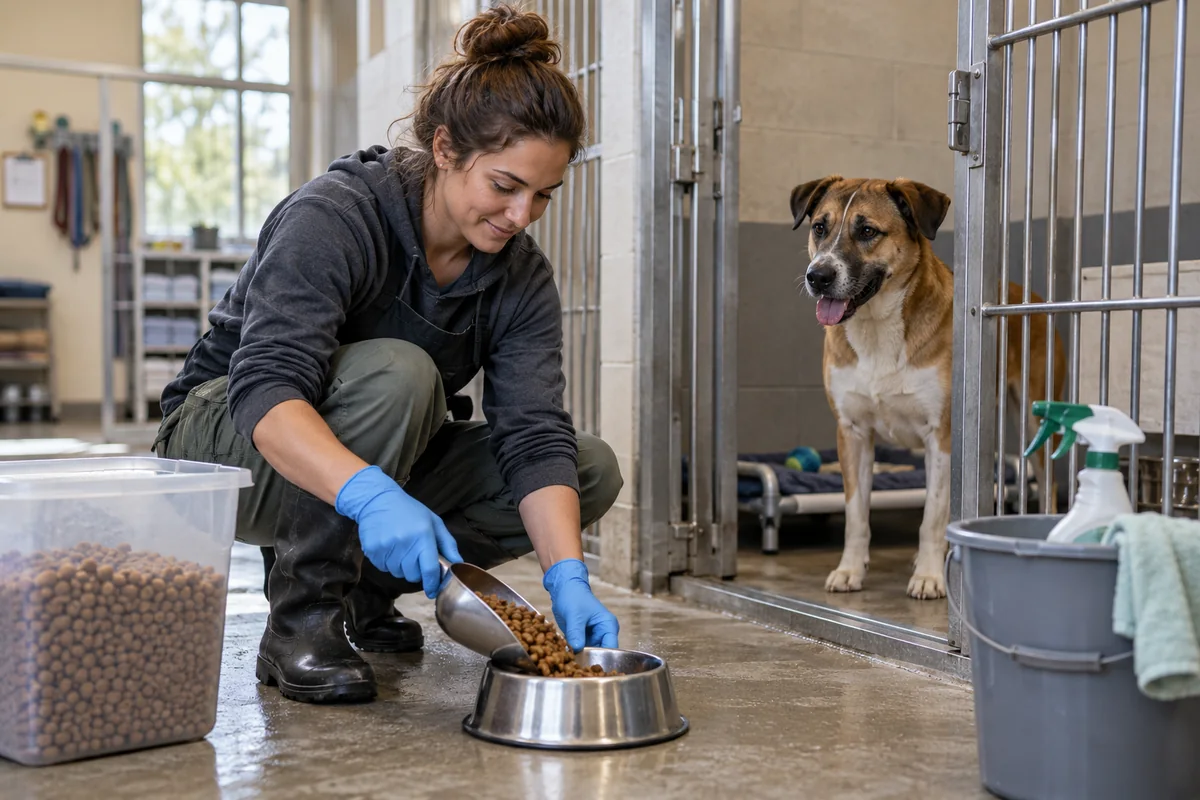
An adult animal shelter caretaker preparing food and cleaning a dog's kennel while the dog waits safely nearby.

A day in the life

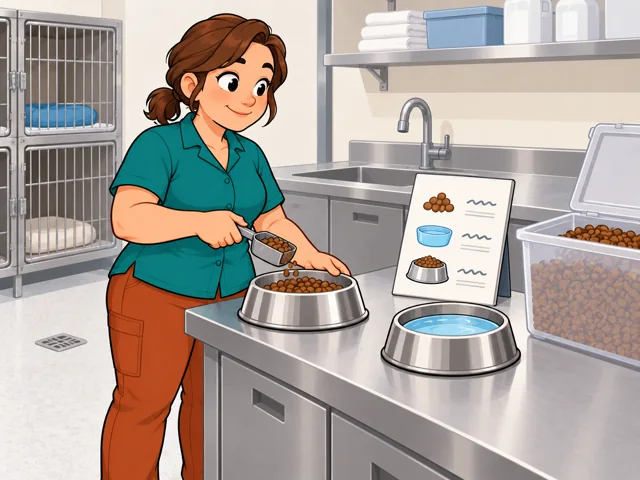
1An animal caretaker checks feeding instructions while measuring food into a bowl, with fresh water ready beside it.

Fix each animal's own meal

Follow each animal's feeding instructions, measure out its portion of food, and refill its water bowls.

2An animal caretaker cleans an empty kennel while removed bedding waits in a laundry cart beside a washing machine.

Clean one kennel, then the next

Working kennel by kennel, you pull out dirty bedding, disinfect the pen and equipment, and run the laundry.
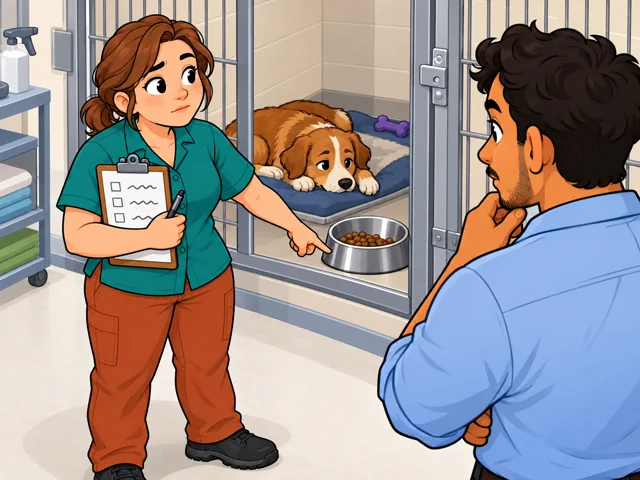
3An animal caretaker records uneaten food and alerts the shift lead while a dog rests inside its enclosure.

Note food left in bowls

Write down any food an animal didn't eat, and tell your shift lead when an animal's condition changes.
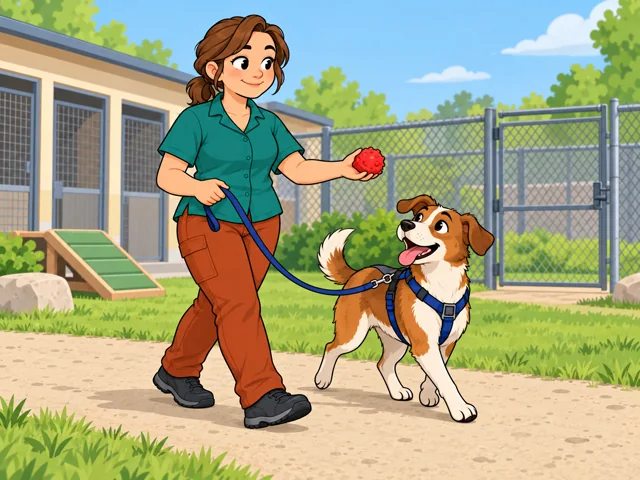
4An animal caretaker walks a dog through a fenced exercise yard and invites it to play with a toy.

Take dogs out to play

In kennel jobs, you walk dogs and play with them outside their pens between stretches indoors.

Quick facts

Preparation

High school + workplace training

United States · 2025–2035

Pay

$35,360/year

United States · May 2025

Outlook

12.1% projected growth

United States · 2025–2035

Quick orientation

Preparation, pay & outlook

Preparation

High school + workplace training

Typical preparation is a high school diploma or equivalent and short-term on-the-job training.

Geography
United States
Period
2025–2035

Pay

$35,360/year

National median for animal caretakers, equivalent to $17.00 an hour.

Geography
United States
Period
May 2025

Outlook

12.1% projected growth

About 62,800 openings a year are projected for animal caretakers nationally.

Geography
United States
Period
2025–2035

Fit, tradeoffs & changing tools

Things to weigh

  • Animals need holiday and weekend care. Shelter work can also mean seeing suffering or helping with euthanasia.
  • Cleaning, lifting, and repeated bending are part of the work. Handling animals carries injury risk.

Where AI may help

Scheduling programs organize appointments; shelter software keeps animal records together.

What people still lead

You still handle animals and notice changes that need attention.

What we can’t predict yet

How much observation future tools can take over remains uncertain, especially when an animal’s behavior is ambiguous.

Pay in context

Earnings

The national midpoint is $17.00 an hour. It is a comparison point, not a starting offer.

The national spread

In May 2025, the median was $35,360 annually. The 10th and 90th percentiles were $27,250 and $50,060—about $13.10 and $24.07 hourly. These describe the wage distribution, not beginner and experienced pay.

Geography
United States
Period
May 2025
Pay basis
Employee annual and hourly wage percentiles; animal caretakers, 39-2021

Setting and hours matter

Annual medians were $37,460 in arts, entertainment, and recreation and $33,350 in professional, scientific, and technical services. These are broad industry groups. Part-time work is common; annual earnings depend on hours. Self-employed income is excluded.

Geography
United States
Period
May 2025
Pay basis
Median annual employee wages by industry; animal caretakers, 39-2021

Openings include replacement hiring

Employment is projected to grow from 365,300 to 409,400 during 2025–2035. The 62,800 average annual openings include replacement needs as well as growth; they are not all newly created jobs or current vacancies.

Geography
United States
Period
2025–2035
Pay basis
Employment projections and average annual openings; animal caretakers, 39-2021

Getting started

Learn in a kennel job

What the route involves
Learn feeding, cleaning, and handling routines on the job.
What it can lead to
Build experience for broader kennel-care responsibilities, including bathing and grooming.
What to check
Employers may prefer previous animal experience.

Prepare for zoo care

What the route involves
Combine a bachelor’s degree in biology, animal science, or a related field with hands-on animal experience.
What it can lead to
Build the science background and practical experience sought for wildlife-care positions.
What to check
Check each zoo’s requirements. Education and experience do not guarantee a place in a competitive hiring process.

Many roles begin with workplace training. Zoo care usually calls for more preparation.

After entry

Career paths

This starts where the entry routes leave off: early work, growing capability, and advancement or specialization.

  1. Get reliable

    Learn the feeding schedule, cleaning routine, and care records.

  2. Handle more situations

    In shelter work, develop your handling skills and learn to explain an animal’s needs to potential adopters.

  3. Teach others

    Seek responsibility for showing new staff or volunteers how to care for animals.

Where you can work

Boarding kennels

Pets stay while owners are away, often overnight. Care schedules continue beyond ordinary business hours.

  • Indoors
  • Shift work
  • Physical demands

Shelters and adoption centers

You may work alongside volunteers and help adopters understand animals’ needs. Public conversations share the day with cleaning and handling.

  • Indoors
  • Outdoors
  • Shift work
  • Physical demands

Zoos

Wildlife care calls for species knowledge, ways to keep animals stimulated, and careful safety routines. The work can be dirty and repetitive.

  • Physical demands
  • Safety-sensitive

Try it

See whether the job clicks before you commit to the path.

With an owner’s permission, observe a familiar pet during its normal feeding routine. Write a short log of what it ate and how it behaved. Would you enjoy noticing and recording these details every day?

Stay safe: Let the owner handle the animal and keep its usual food and routine unchanged.

Explore more careers

Sources

  1. U.S. Bureau of Labor Statistics. Occupational projections and worker characteristics. Accessed 2026-10-03.
  2. O*NET OnLine / U.S. Bureau of Labor Statistics. National Wages: Animal Caretakers. Accessed 2026-10-03.
  3. O*NET OnLine. Animal Caretakers — 39-2021.00. Accessed 2026-10-03.
  4. U.S. Bureau of Labor Statistics. Animal Care and Service Workers. Accessed 2026-10-03.
  5. Best Friends Animal Society. Animal Care and Adoptions Specialist — New York, NY. Accessed 2026-10-03.
  6. San Diego Zoo Wildlife Alliance. Wildlife Care Specialist FAQ. Accessed 2026-10-03.

Your message goes to the Great Jobs team. How we use your information