
Career profile

Archivist

Archivists keep old records usable, from handwritten letters to computer files.

A shelved box of documents isn't finished. Archivists identify its maker, pick what to keep long term, and plan how later readers find its facts.
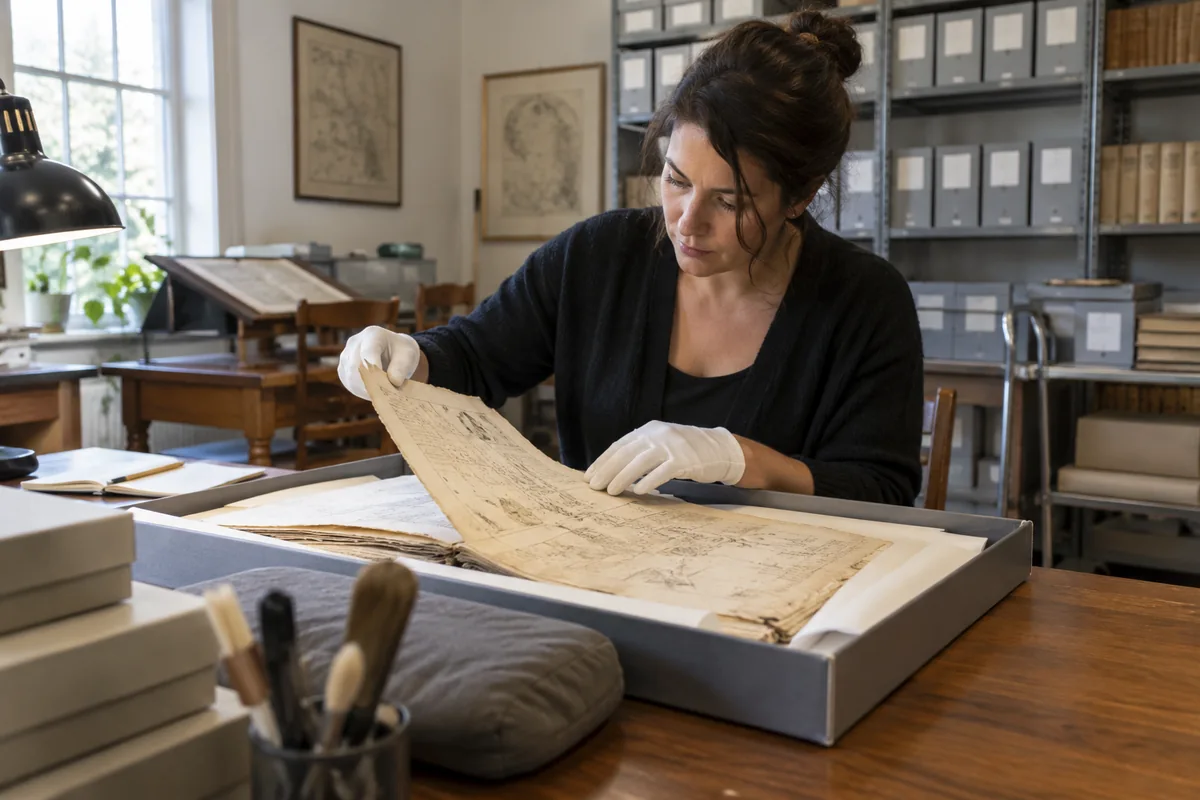
Archivist handling a historical document with protective gloves.

A day in the life

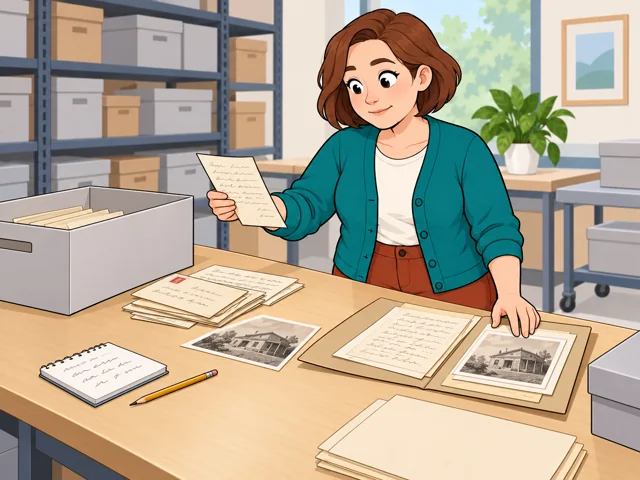
1An archivist compares incoming letters with related records already held, considering what distinctive evidence the collection preserves.

Judge a collection's lasting worth

Look at who created the records, what activities or events they cover, and whether the proof survives elsewhere.
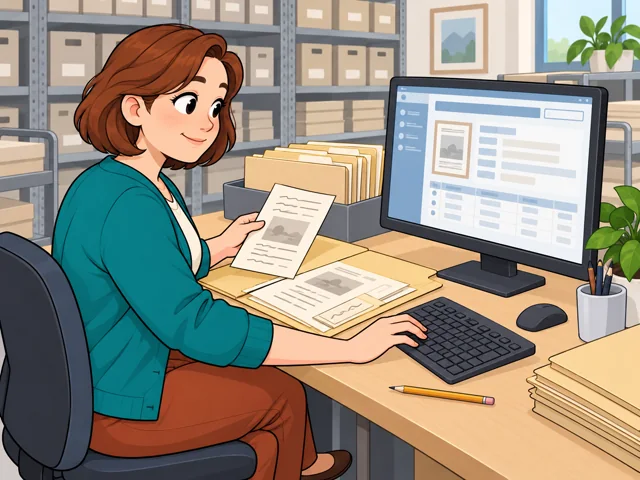
2The archivist organizes records into folders and enters descriptions into a database so researchers can find them.

Arrange and describe the folders

Put the records in order and enter folder dates, topics, and summaries in a database researchers search.
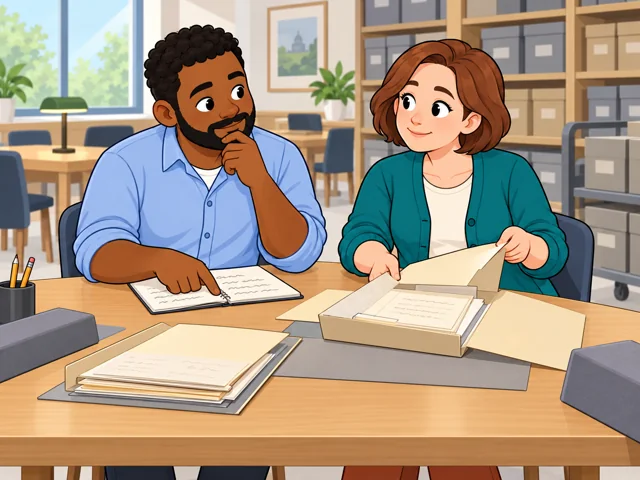
3The archivist listens to a researcher's question and suggests a different folder after the first records do not address it.

Help a researcher find evidence

Ask what they want to prove or confirm, suggest fitting records, and switch collections if the first fails.
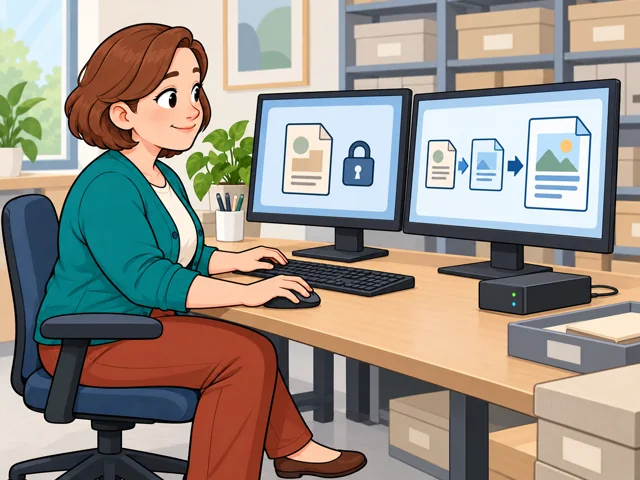
4The archivist preserves an original digital file and checks a separate access copy prepared for researchers.

Keep digital files usable

Leave digital files in their original format and make separate access copies if researchers need another way in.

Quick facts

Preparation

Master’s degree typical

United States

Pay

$64,550/year

United States · May 2025

Outlook

3.4% projected growth

United States · 2025–2035

Quick orientation

Preparation, pay & outlook

Preparation

Master’s degree typical

Relevant graduate study and hands-on archival experience are common preparation.

Geography
United States
Period
Not applicable

Pay

$64,550/year

National median for archivists, equivalent to $31.03 an hour.

Geography
United States
Period
May 2025

Outlook

3.4% projected growth

About 1,100 openings a year nationally, including openings to replace workers who leave.

Geography
United States
Period
2025–2035

Fit, tradeoffs & changing tools

Things to weigh

  • Describing records can mean long stretches of similar entries.
  • You help judge what deserves preservation without knowing every question future researchers will ask.

Where AI may help

Software can turn scanned handwriting or typing into searchable text. This is optical character recognition, or OCR; the National Archives uses it in its catalog.

What people still lead

You still weigh a record’s origins, uniqueness, and likely research value when assessing what belongs in an archive.

What we can’t predict yet

How much transcription checking software can remove remains uncertain: machine text can contain errors, so faster searching does not automatically mean less review.

Pay in context

Earnings

Use the national figures as a comparison point when reading job offers, not as a starting-salary promise.

The midpoint

Archivists had a median annual wage of $64,550, with an hourly equivalent of $31.03.

Geography
United States
Period
May 2025
Pay basis
National employee wages; annual median and hourly equivalent

The national spread

The 10th-percentile wage was $39,970 and the 90th-percentile wage was $110,550 a year. These mark the lower and upper ends of the middle 80% of wages, not beginner and senior salaries.

Geography
United States
Period
May 2025
Pay basis
National employee wages; annual 10th and 90th percentiles

Openings include replacement

Employment is projected to grow 3.4%, with about 1,100 openings per year on average. That includes replacing people who change occupations or leave the workforce, not just newly created jobs.

Geography
United States
Period
2025–2035
Pay basis
Employment projection and average annual openings; not compensation

Getting started

Combine graduate study with archival experience

What the route involves
Complete a master’s degree in a relevant field such as archival studies, library science, or history, and build practical experience through archival internships or volunteering.
What it can lead to
This matches the typical educational preparation for archivist positions and gives you experience working with collections.

Meet federal archivist coursework requirements

What the route involves
Earn a bachelor’s degree in archival science, or a bachelor’s with a major containing 18 semester hours in archival science, history, political science, or government, plus 12 in the listed fields, American civilization, economics, or public administration.
What it can lead to
You meet the basic education requirement for federal Archivist Series 1420 positions. The standard also allows the specified 30 semester hours combined with appropriate experience or additional education.
What to check
This is a federal qualification route, not a rule for every archive. Meeting the basic requirement does not satisfy every vacancy’s additional qualifications.

Graduate study is the usual route, but federal archivist jobs also have a defined undergraduate qualification route.

After entry

Career paths

This starts where the entry routes leave off: early work, growing capability, and advancement or specialization.

  1. Get established

    Learn your archive’s collections and description practices while organizing records and answering routine requests.

  2. Build digital capability

    Learn to preserve files in their original formats and choose access copies that work for researchers and the archive’s resources.

  3. Lead or specialize

    Lead collection work and staff, or specialize in a historical subject or archival technology.

Where you can work

Federal archives

In appraisal roles, you work with agency staff on which government records merit permanent preservation. Recommendations move through formal decisions. Government archivists generally work regular business hours.

  • Indoors
  • Office

University archives

You connect campus offices that create records with students, faculty, and staff who need them later. The collection can mix paper records with files transferred from university departments.

  • Indoors
  • Office

Try it

See whether the job clicks before you commit to the path.

Choose ten copies of your own school or club records. Write what the collection documents, which items you would preserve and why, and a short guide someone else could use to find them. Notice whether deciding what matters and explaining the context interests you.

Stay safe: Use copies, keep private information out, and do not discard originals.

Explore more careers

Sources

  1. O*NET OnLine. 25-4011.00 — Archivists. Accessed 2026-10-10.
  2. U.S. Bureau of Labor Statistics. Archivists, Curators, and Museum Workers — archivist-specific passages. Accessed 2026-10-10.
  3. U.S. Bureau of Labor Statistics. May 2025 Occupational Employment and Wage Statistics — Archivists, SOC 25-4011; supplied facts binding. Accessed 2026-09-29.
  4. U.S. Bureau of Labor Statistics. Employment Projections Table 1.2, 2025–2035 — Archivists, SOC 25-4011; supplied facts binding. Accessed 2026-09-29.
  5. U.S. Office of Personnel Management. Archivist Series 1420 — Individual Occupational Requirements. Accessed 2026-10-10.
  6. National Archives and Records Administration. Appraisal Policy of the National Archives. Accessed 2026-10-10.
  7. National Archives and Records Administration. Contribution Type: Optical Character Recognition (OCR) Transcription. Accessed 2026-10-10.
  8. Yale University Library. Born digital. Accessed 2026-10-10.
  9. Yale Library. University Archivist Michael Lotstein takes Yale’s history very seriously. Accessed 2026-10-10.

Your message goes to the Great Jobs team. How we use your information