
Career profile

Chemical Technician

Chemical technicians prepare chemical samples, run tests, and check whether materials meet specifications.

A production batch can look fine and still fail testing. Reading its measured values, you help spot what is different.
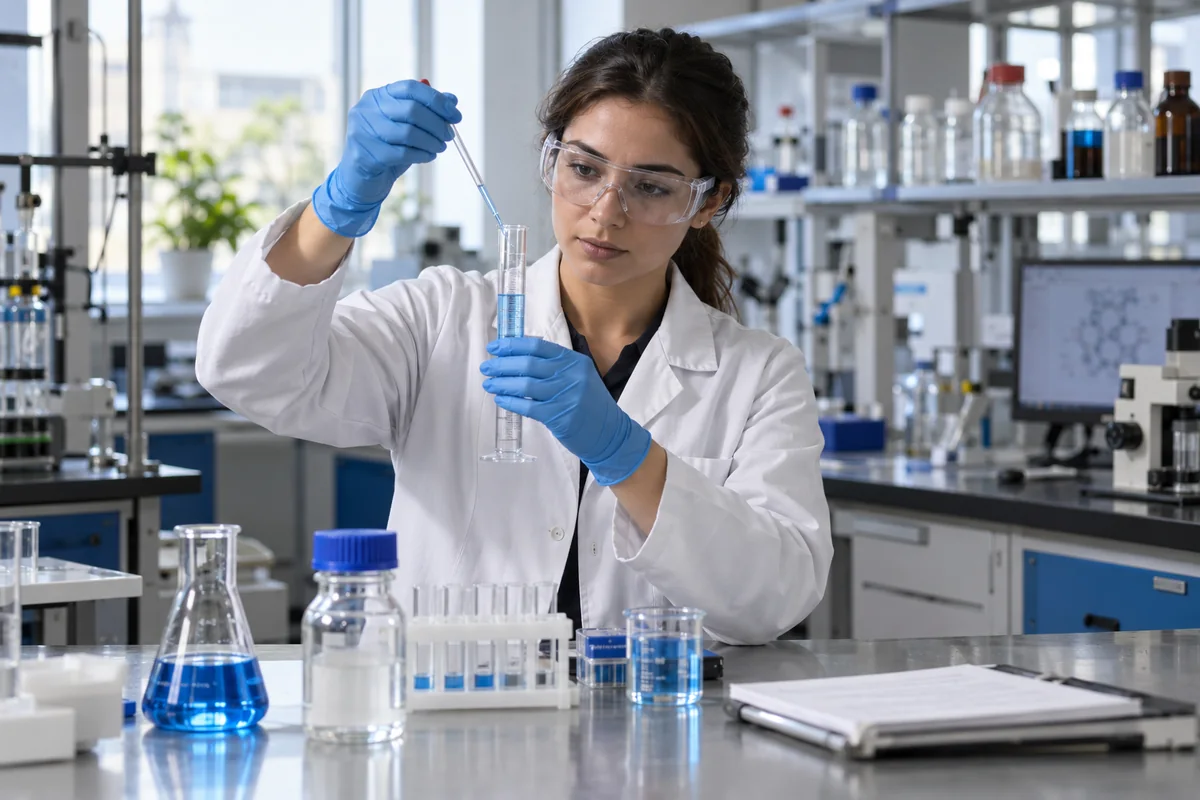
An adult chemical technician preparing a sample and measuring liquid in a laboratory with protective glasses and gloves.

A day in the life

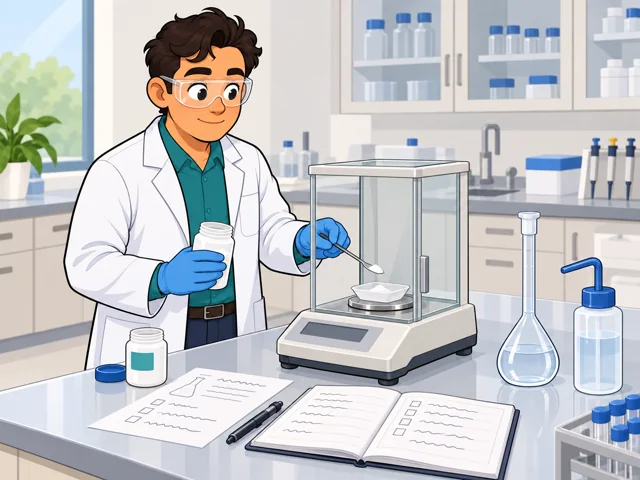
1A chemical technician carefully measures a solid ingredient on a laboratory balance beside a flask, formula sheet, and amounts record.

Mix a solution from a formula

Follow the formula, measure each ingredient, and write down exactly how much of each you used.
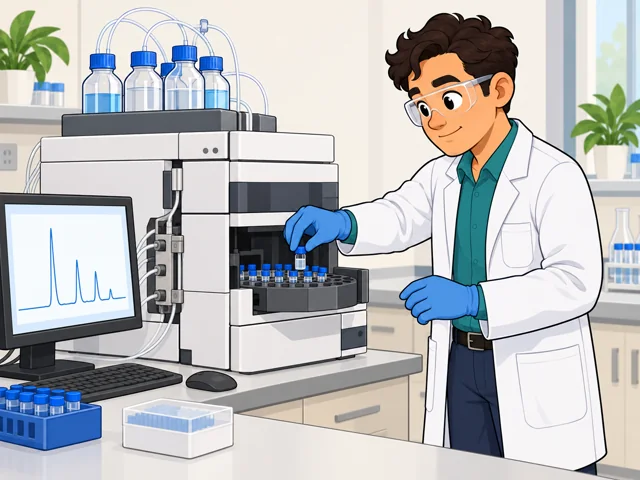
2The technician places a capped sample vial into a chromatograph's autosampler to separate the mixture's components for analysis.

Run samples through a chromatograph

In certain labs, you run a chromatograph, which splits a mixture into its parts for analysis.
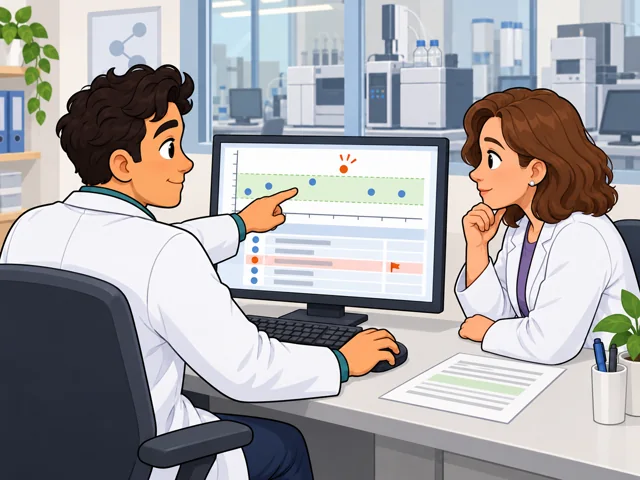
3At a computer, the technician flags a measurement outside the acceptable range while a woman coworker reviews the discrepancy.

Flag results outside the spec

Check each measured value against the product's spec and mark any result that falls outside the allowed range.
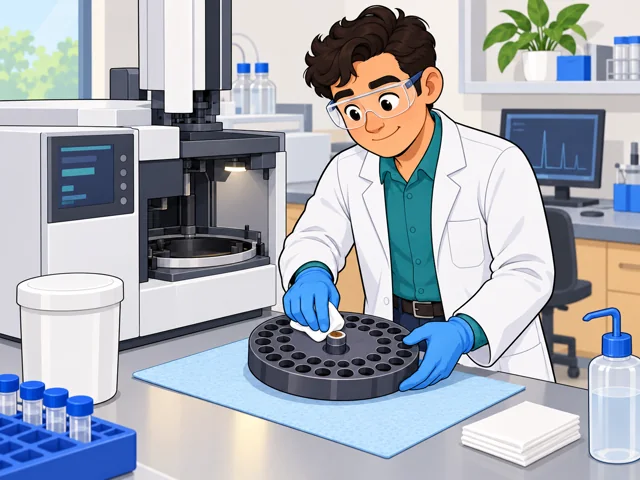
4The technician cleans an autosampler tray and inspects its vial recesses for residue before the next laboratory test.

Clean equipment and hunt for problems

Clean the lab equipment and look into any problem that could skew the test that follows.

Quick facts

Preparation

Usually an associate's degree

United States · 2025–2035

Pay

$60,390 a year

United States · May 2025

Outlook

4.9% projected growth

United States · 2025–2035

Quick orientation

Preparation, pay & outlook

Preparation

Usually an associate's degree

Expect workplace training after entry; requirements vary by employer.

Geography
United States
Period
2025–2035

Pay

$60,390 a year

National median for chemical technicians, equivalent to $29.03 an hour.

Geography
United States
Period
May 2025

Outlook

4.9% projected growth

About 7,600 openings annually, including replacement needs—not just new jobs.

Geography
United States
Period
2025–2035

Fit, tradeoffs & changing tools

Things to weigh

  • Expect standing at the bench and wearing protective equipment.
  • Experiments and production problems can mean irregular hours or longer days.

Where AI may help

Laboratory databases and spreadsheets help organize results and calculate comparisons.

What people still lead

You still investigate equipment problems and explain what a result means.

What we can’t predict yet

How much hands-on testing will move into automated systems—and how much troubleshooting that creates—remains uncertain.

Pay in context

Earnings

Use the national figures as a reference when comparing offers.

The middle and the spread

The median was $60,390 a year, or $29.03 an hour. The 10th and 90th percentiles were $41,740 and $92,040 annually. These describe the workforce, not beginner and experienced pay grades.

Geography
United States
Period
May 2025
Pay basis
Annual and hourly employee wage medians; annual 10th and 90th percentiles

Workplace type matters

Annual medians were $65,960 in wholesale trade, $63,040 in chemical manufacturing, and $49,050 in testing laboratories and services. These are industry comparisons, not promised offers.

Geography
United States
Period
May 2025
Pay basis
Industry-specific median annual employee wages for chemical technicians

Getting started

Study chemical technology

Typically two years
What the route involves
Complete an associate's program with applied chemistry, mathematics, and hands-on laboratory practice.
What it can lead to
Build the laboratory foundation for technician applications; some employers seek a bachelor's degree.

Enter through an employer's training

What the route involves
Some employers consider high-school graduates and teach laboratory methods on the job.
What it can lead to
Develop the equipment skills needed for that workplace.
What to check
Check each vacancy's education requirements; this route is employer-dependent.

Chemists or chemical engineers typically direct your work and evaluate results.

After entry

Career paths

This starts where the entry routes leave off: early work, growing capability, and advancement or specialization.

  1. Learn the lab's methods

    Practice procedures with an experienced technician.

  2. Troubleshoot harder tests

    Build skill in finding why an analytical procedure is not working as expected.

  3. Teach other technicians

    With experience, train colleagues to operate laboratory equipment.

Where you can work

Chemical manufacturing

Your tests track product quality. Production problems may pull you into troubleshooting or irregular hours.

  • Indoors
  • Lab
  • Shift work

Research laboratories

Work alongside researchers, setting up experiments and helping troubleshoot analytical procedures.

  • Indoors
  • Lab

Pilot plants

Help engineers run experiments in a smaller version of a manufacturing process.

  • Indoors

Try it

See whether the job clicks before you commit to the path.

Try a paper-only quality check. Use an invented acceptable range of 10–12 units and sample readings of 10.4, 11.2, and 12.6. Make a results table, flag the exception, and write what you would check before trusting it. Notice whether careful records and investigating an odd result appeal to you.

Explore more careers

Sources

  1. O*NET OnLine. Chemical Technicians — 19-4031.00. Accessed 2026-10-03.
  2. U.S. Bureau of Labor Statistics. Occupational projections and worker characteristics. Accessed 2026-10-03.
  3. O*NET OnLine / U.S. Bureau of Labor Statistics. National Wages: Chemical Technicians. Accessed 2026-10-03.
  4. U.S. Bureau of Labor Statistics. Chemical Technicians — Occupational Outlook Handbook. Accessed 2026-10-03.
  5. American Chemical Society. Chemical Technology. Accessed 2026-10-03.

Your message goes to the Great Jobs team. How we use your information