

Clarify an inventory low-stock alert
Work through the spec, confirm what an ambiguous rule means with a developer, then write the code.
Career profile
Computer programmers turn software plans into working code, then hunt for its errors.
You start from specifications describing a program's intended behavior. Debugging may be your favorite part if you love finding exactly why a result is wrong.

Work through the spec, confirm what an ambiguous rule means with a developer, then write the code.
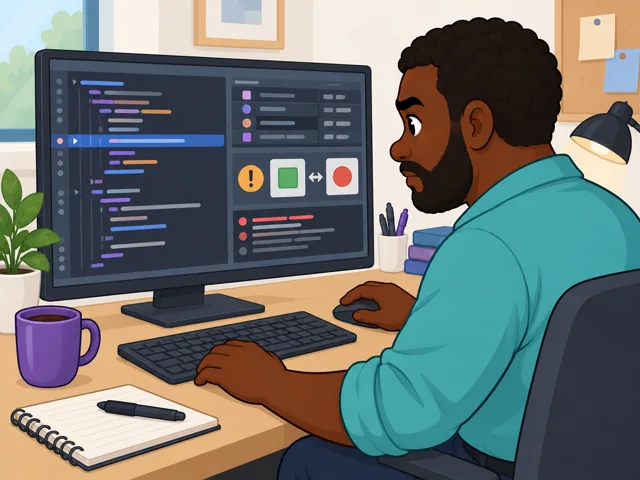
Step through the program in a debugger, fix the faulty code, then rerun the test that exposed it.
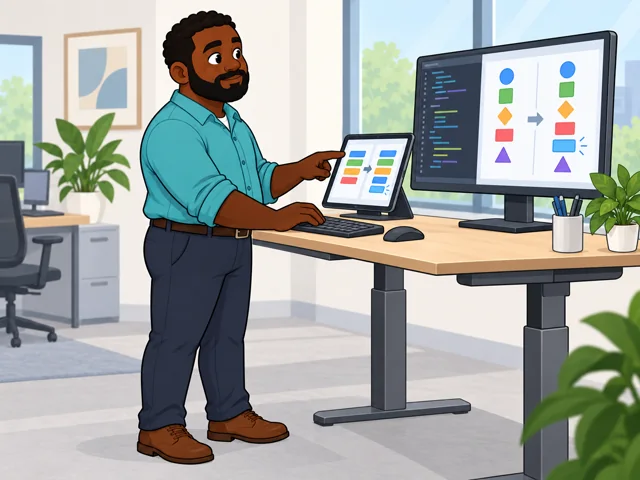
Change how an existing program reads records for the revised layout, then confirm its output still matches expectations.

Write revision notes and comments in the code so another programmer can see why the logic changed.
United States
United States · May 2025
United States · 2025–2035
Quick orientation
Some employers accept other degrees or specific programming experience.
National median; the hourly equivalent is $48.26.
About 4,400 openings a year are projected despite the decline.
Artificial intelligence (AI) coding assistants can suggest code changes and flag possible problems during review.
You still need to check whether a suggestion solves the actual problem and test it. Plausible-looking code can be incorrect or insecure.
How much work can move from writing code to checking generated changes depends on the language, the program, and how reliably tools handle unfamiliar problems.
Pay in context
The national median is a midpoint across workers, not a starting salary.
In May 2025, median pay was $100,390 a year, or $48.26 an hour. The 10th and 90th percentile annual wages were $57,710 and $160,460. These are wage-distribution markers, not beginner and senior salaries.
Annual medians were $111,710 at software publishers and $98,360 in computer systems design and related services. These describe groups of workers, not offers.
Employment is projected to fall 7.3% from 2025 to 2035, with about 4,400 openings annually on average. Openings are a projection, not currently advertised jobs.
A degree is the usual route; alternatives depend on the employer.
After entry
This starts where the entry routes leave off: early work, growing capability, and advancement or specialization.
Learn how the existing program works. Make a small change, check its output, and leave clear notes for the next person.
Take a modest request from the user's explanation through coding and acceptance testing, where the user checks that it meets the need.
With experience, you may handle more complicated changes and guide other programmers as a senior programmer analyst or technical lead.
In a city technology department, you may maintain applications and databases used by staff, produce reports, and teach users how changes work. Keeping existing services usable shapes the work.
In health research, you may write code that cleans and links large datasets. You work with researchers and senior programmers, and may troubleshoot jobs running on shared computing systems.
Experienced programmers supporting colleges may connect administrative systems, move data, and help roll out updates. You coordinate with the client's technical staff and the people who use those systems.
Try it
Write a tiny inventory program with this rule: flag an item when its quantity is below five. Test quantities of four, five, and six, then change the rule to include five. Notice whether you enjoy turning a precise request into code and proving the change works.