
Career profile

Computer Research Scientist

Computer research scientists invent computing methods, then test whether machines can do more or better.

Could a different set of instructions reach the same answer with less effort? Your job is turning questions like that into models, prototypes and evidence.
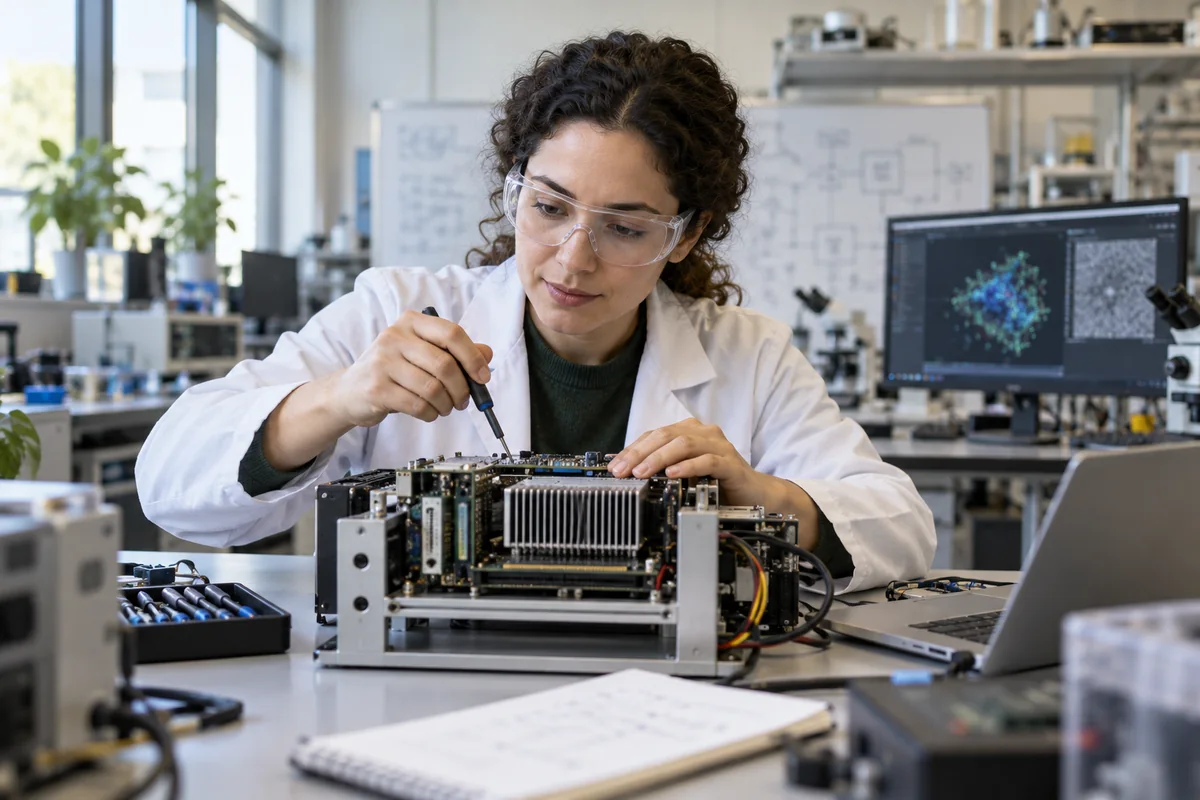
An adult computer research scientist experimenting with a prototype computing system in a university laboratory.

A day in the life

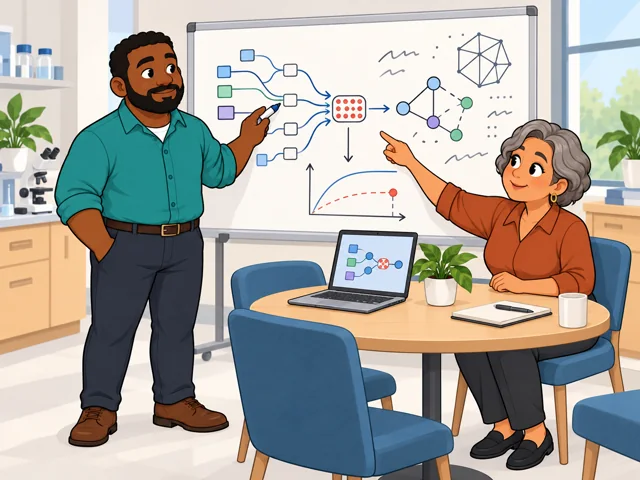
1A computer research scientist and an engineer examine a congested process diagram and discuss a mathematical model and performance target.

Turn a slowdown into math

With an engineer, find a computing slowdown, write it as math, and set what gain counts as success.

2The scientist codes a proposed method and checks matching expected and actual outputs on his monitor.

Prove the prototype is correct

Code a small version of the method and confirm its answers are right before measuring it against others.

3The scientist and a colleague compare methods on identical inputs and inspect why the speed advantage disappears on larger cases.

Race rival methods head to head

Run competing methods on the same inputs and dig into why if your lead vanishes as inputs grow.

4The scientist rehearses a research talk for two colleagues, explaining his method, comparison results, and limits on larger inputs.

Share results, limits included

Draft a paper or a conference talk that covers the method, the results and where it falls short.

Quick facts

Preparation

Usually a master's degree

United States

Pay

$140,300/year

United States · May 2025

Outlook

21.8% projected growth

United States · 2025–2035

Quick orientation

Preparation, pay & outlook

Preparation

Usually a master's degree

Computer science or a related field.

Geography
United States
Period
Not applicable

Pay

$140,300/year

National median; equivalent to $67.45/hour.

Geography
United States
Period
May 2025

Outlook

21.8% projected growth

About 2,900 openings per year, on average.

Geography
United States
Period
2025–2035

Fit, tradeoffs & changing tools

Things to weigh

  • A careful experiment can leave you with evidence that your favorite idea does not work.
  • Writing and explaining results take time alongside programming.

Where AI may help

In algorithm research, artificial intelligence (AI) tools can propose code, run tests, and score candidate solutions. AlphaEvolve demonstrates this approach.

What people still lead

Researchers frame the problem and choose what the tests should reward. A better score still needs an explanation of what improved.

What we can’t predict yet

How far automated discovery can go when success is difficult to measure remains an open question. More of the work may shift toward designing evaluations and interpreting machine-generated ideas.

Pay in context

Earnings

These national figures cover computer and information research scientists across experience levels.

The middle and the spread

The median was $140,300 a year, or $67.45 an hour. The 10th and 90th percentiles were $82,200 and $230,630 annually. Those are positions in the wage distribution, not starting and senior salaries.

Geography
United States
Period
May 2025
Pay basis
Employee wages; annual and hourly medians and annual percentiles

Workplace type matters

Annual medians were $211,270 at software publishers and $85,460 at state colleges, universities, and professional schools. These describe groups, not individual offers.

Geography
United States
Period
May 2025
Pay basis
Industry median annual employee wages

Growth and openings

Employment is projected to grow 21.8%, with about 2,900 openings annually, including replacements. A national projection does not guarantee a vacancy where you want to live.

Geography
United States
Period
2025–2035
Pay basis
Employment projection; annual-average openings, not compensation

Getting started

Continue into graduate study

What the route involves
Earn a bachelor's degree, then study computer science or a related field at master's level.
What it can lead to
Meet the typical education level for entry.
What to check
Some employers prefer a Doctor of Philosophy (PhD).

Target qualifying federal positions

What the route involves
Earn an accredited computer science bachelor's degree and compare your preparation with federal Computer Science Series 1550 vacancies.
What it can lead to
Meet that series' basic education requirement; some federal research jobs accept bachelor's graduates.
What to check
Additional qualifications depend on the position and grade. Series 1550 also includes work outside research, so read the duties carefully.

Graduate study is the usual route; some federal jobs accept a bachelor's degree.

After entry

Career paths

This starts where the entry routes leave off: early work, growing capability, and advancement or specialization.

  1. Get established

    Reproduce an existing experiment before proposing changes.

  2. Own a study

    Develop a focused research question and carry it through experiments, interpretation, and discussion with collaborators.

  3. Set the research direction

    Build a research agenda in a specialty and guide connected projects.

    • Move into computing management.

Where you can work

Company research labs

Some company labs bring researchers together with engineers, designers, and program managers. You can publish findings while exploring how the work could become a product or service.

  • Indoors
  • Office

Federal measurement labs

In labs focused on measurement and standards, your research helps establish how to test computing systems reliably. You work across computer science, mathematics, and engineering, with industry and other agencies involved in standards development.

  • Indoors
  • Lab

Try it

See whether the job clicks before you commit to the path.

Write 16 names in alphabetical order. Compare finding a name by checking each in turn with repeatedly halving the remaining list. Predict which takes fewer checks, test several names, and record the counts. What changes for a missing name? Notice whether explaining the results interests you as much as getting the answer.

Explore more careers

Sources

  1. U.S. Bureau of Labor Statistics. Computer and Information Research Scientists. Accessed 2026-10-03.
  2. O*NET OnLine. 15-1221.00 — Computer and Information Research Scientists. Accessed 2026-10-03.
  3. O*NET OnLine / U.S. Bureau of Labor Statistics. National Wages: Computer and Information Research Scientists. Accessed 2026-10-03.
  4. U.S. Bureau of Labor Statistics. Occupational projections and worker characteristics. Accessed 2026-10-03.
  5. U.S. Office of Personnel Management. Computer Science Series 1550. Accessed 2026-10-03.
  6. Microsoft Research. Research Careers. Accessed 2026-10-03.
  7. National Institute of Standards and Technology. About ITL. Accessed 2026-10-03.
  8. Google DeepMind. AlphaEvolve: A Gemini-powered coding agent for designing advanced algorithms. Accessed 2026-10-03.

Your message goes to the Great Jobs team. How we use your information