
Career profile

Continuous Mining Machine Operator

Continuous miner operators cut coal or other minerals from the mine face for hauling away.

Steering the cutter, watching the loosened material flow away, and catching signs that the machine needs care all fall to you.
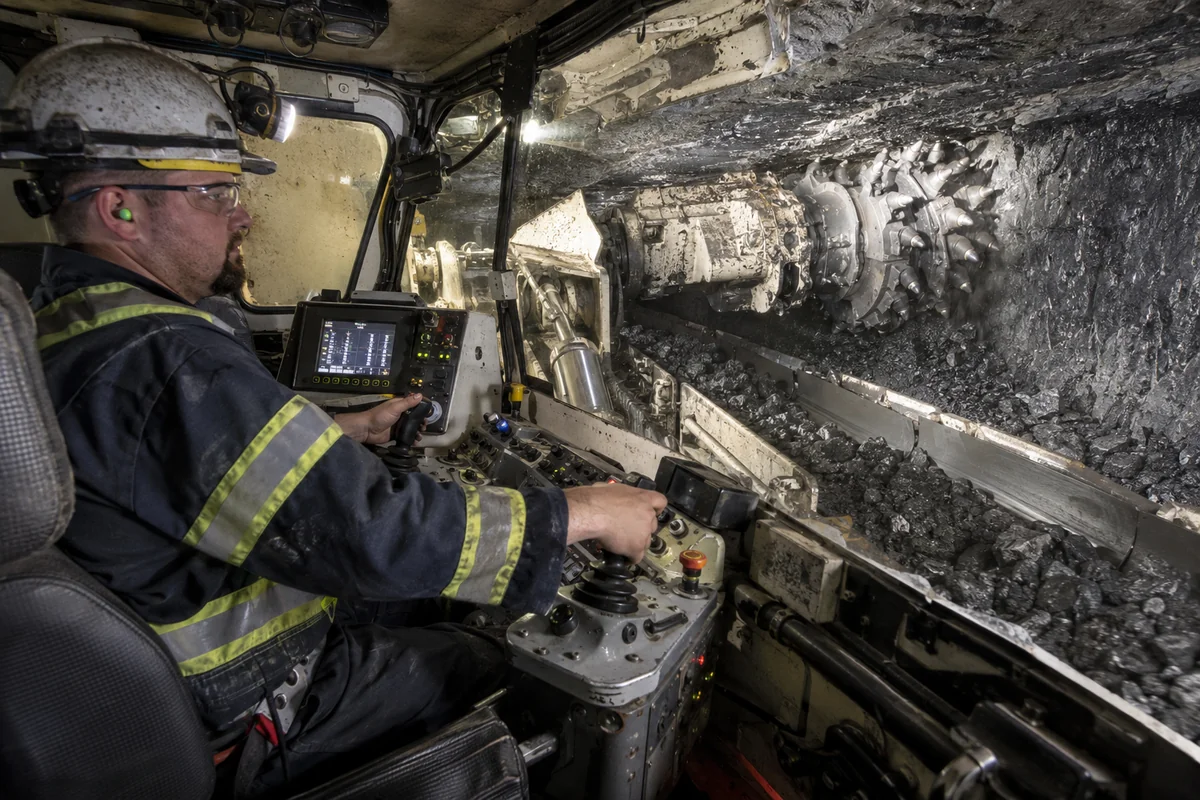
Mining machine operator controls a continuous miner underground.

A day in the life

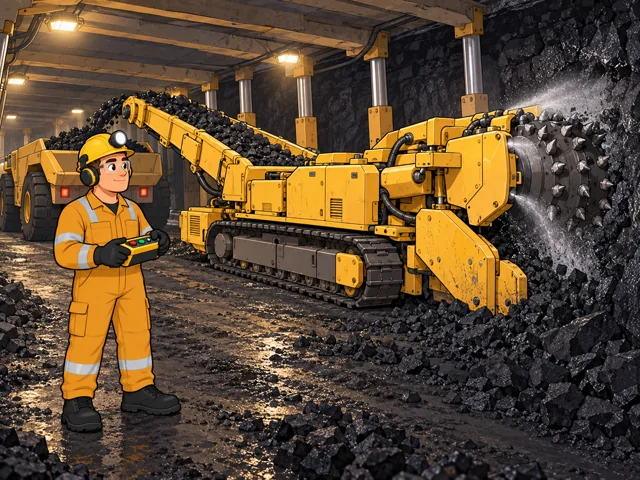
1A mining machine operator uses a remote control from beside the machine as its cutting head works the coal face and its conveyor loads broken coal into haulage equipment.

Drive the miner to the face

You drive the machine to the working face, steer its cutting head, and control the conveyor loading haulage.
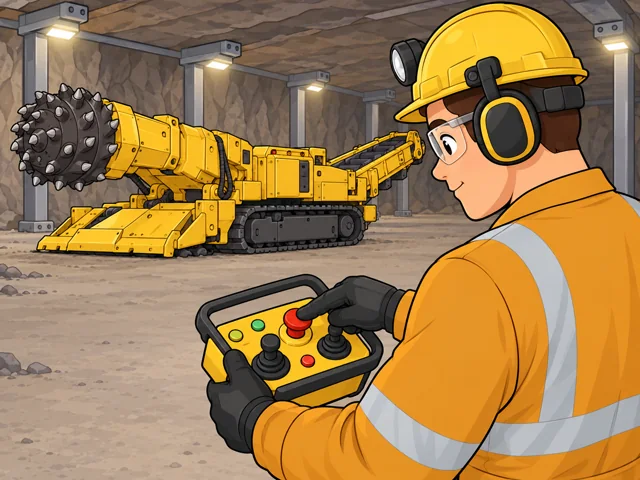
2The operator checks the remote controls and emergency-stop button before moving or cutting with the stationary continuous miner.

Test controls and emergency stop

Try each of its controls, including the emergency stop, before the machine moves or cuts anything.
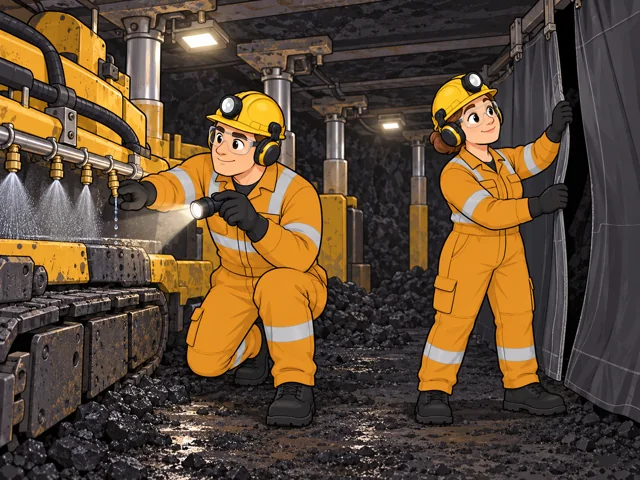
3The operator inspects the stopped miner's water spray assembly while a woman coworker checks a displaced ventilation curtain before production continues.

Check dust sprays and airflow

In coal mines, check sprays and airflow before cutting, and handle any spray or curtain problem before production.
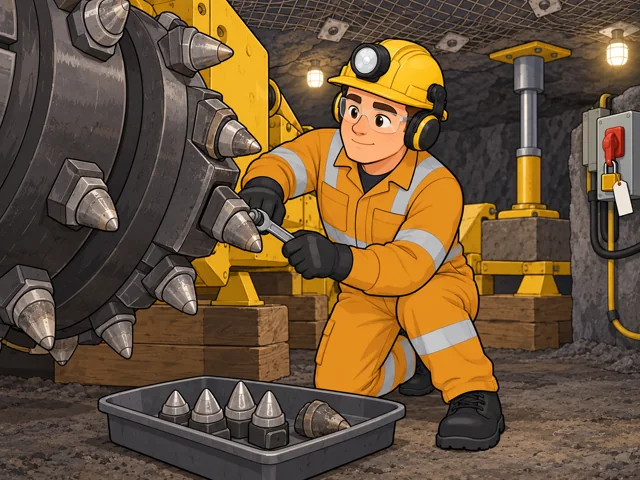
4With the miner's electrical power isolated and locked out, the operator kneels beside the secured cutting drum and uses a wrench to replace a worn cutting tooth.

Change worn cutting teeth

With electric power off for maintenance, use wrenches to swap worn cutting teeth and make machine adjustments.

Quick facts

Preparation

Learn on the job

United States · 2025

Pay

$61,810 a year

United States · 2025

Outlook

3.2% projected growth

United States · 2025–2035

Quick orientation

Preparation, pay & outlook

Preparation

Learn on the job

No formal educational credential is typical nationally; employer hiring requirements can differ.

Geography
United States
Period
2025

Pay

$61,810 a year

National median for continuous mining machine operators, equivalent to $29.72 an hour.

Geography
United States
Period
2025

Outlook

3.2% projected growth

About 1,400 openings a year nationwide, including replacement openings.

Geography
United States
Period
2025–2035

Fit, tradeoffs & changing tools

Things to weigh

  • Noise and cramped spaces can make a shift physically tiring.
  • In coal mines, dust can cause serious lung disease. Moving machinery also makes your position around the miner a constant safety concern.

Where AI may help

Some continuous miners can repeat preset cutting sequences and display machine faults, reducing repeated control movements and helping troubleshoot problems.

What people still lead

You still match the cutting cycle to conditions and check the work area, dust controls, and safe operating position.

What we can’t predict yet

How much cutting becomes automatic will depend on the machine and mine conditions. The balance between hands-on control and monitoring may change.

Pay in context

Earnings

The national median is a useful comparison point, not a starting-pay offer.

The middle and the spread

In 2025, median pay was $61,810 a year, or $29.72 an hour. The lowest-paid 10% earned $46,770 or less; the highest-paid 10% earned $86,210 or more. Those groups are not career stages.

Geography
United States
Period
2025
Pay basis
National occupational wage estimates; annual and hourly median, annual 10th and 90th percentiles

Openings beyond growth

Employment is projected to grow 3.2% from 2025 to 2035, with about 1,400 openings annually. Openings include replacing workers who leave the occupation, so they outnumber newly created jobs.

Geography
United States
Period
2025–2035
Pay basis
Employment projection, not compensation

Getting started

Enter through a mining job

What the route involves
Seek an entry mining position with training. New underground miners complete at least 40 hours of safety training, including mine-site instruction, before work duties.
What it can lead to
Safety preparation lets you begin mine work; machine-specific task training then develops the skills needed to operate a continuous miner.
What to check
You must demonstrate safe machine operation before working without immediate supervision. New-miner training alone does not establish that ability, and states may add requirements.

Study mining before applying

What the route involves
A coal-mining certificate program can teach ventilation, machinery, and mine safety through practical work. Southeastern Illinois College includes simulated-mine experience and hydraulic troubleshooting.
What it can lead to
You gain preparation for miner and mine-technician jobs, plus mechanical skills that can support later maintenance work.
What to check
School preparation does not replace the mine's required machine task training.

Underground mining employment starts at 18 or older. You can pursue an entry mining job or build relevant skills in a mining program first.

After entry

Career paths

This starts where the entry routes leave off: early work, growing capability, and advancement or specialization.

  1. Build a reliable routine

    Get consistent at checking controls and spotting dust-control problems before cutting begins.

  2. Learn the machine's feedback

    On equipped miners, learn to interpret fault displays and choose automated cutting cycles that suit the conditions.

  3. Help train another operator

    With experience in the task, you may help deliver machine task training and coach a newer operator through supervised practice.

Where you can work

Underground coal mines

Ventilation curtains and water sprays shape where you work around the cutter. Keeping coal dust away from you and coworkers is part of the production routine.

  • Physical demands
  • Safety-sensitive

Industrial-mineral mines

Salt, gypsum, potash, and trona operations can use continuous miners in larger openings. Equipment may have larger dust collectors and components designed for corrosive conditions.

  • Physical demands
  • Safety-sensitive

Try it

See whether the job clicks before you commit to the path.

Find a manufacturer's continuous-miner diagram. Trace the material from the cutting head through the gathering area to the rear conveyor, then mark where you would want a better view. Notice whether following the machine's moving parts interests you.

Stay safe: Keep this a diagram exercise; it is not practice operating mining equipment.

Explore more careers

Sources

  1. O*NET OnLine. Continuous Mining Machine Operators — 47-5041.00. Accessed 2026-10-05.
  2. O*NET OnLine / U.S. Bureau of Labor Statistics. National Wages: Continuous Mining Machine Operators. Accessed 2026-10-05.
  3. U.S. Bureau of Labor Statistics. Occupational projections and worker characteristics, 2025–2035. Accessed 2026-10-05.
  4. Mine Safety and Health Administration. Remote Control Continuous Mining Machine Safety Alert. Accessed 2026-10-05.
  5. Mine Safety and Health Administration. Continuous Miner Operator — Health Hazard Information Sheet HH-42. Accessed 2026-10-05.
  6. Komatsu. 12HM Series Continuous Miner. Accessed 2026-10-05.
  7. Mine Safety and Health Administration / eCFR. 30 CFR 48.5 — Training of new miners. Accessed 2026-10-05.
  8. Mine Safety and Health Administration / eCFR. 30 CFR 48.7 — Training of miners assigned to new tasks. Accessed 2026-10-05.
  9. Mine Safety and Health Administration. Training FAQs for Miners. Accessed 2026-10-05.
  10. Southeastern Illinois College. Coal Mining Technology. Accessed 2026-10-05.
  11. U.S. Department of Labor. What jobs are off-limits for kids?. Accessed 2026-10-05.

Your message goes to the Great Jobs team. How we use your information