
Career profile

Crematory Operator

Crematory operators run cremation equipment and care for each person throughout the cremation.

This job pairs machinery with exact record checks. You confirm who is in your care and that every form is complete before any cremation starts.
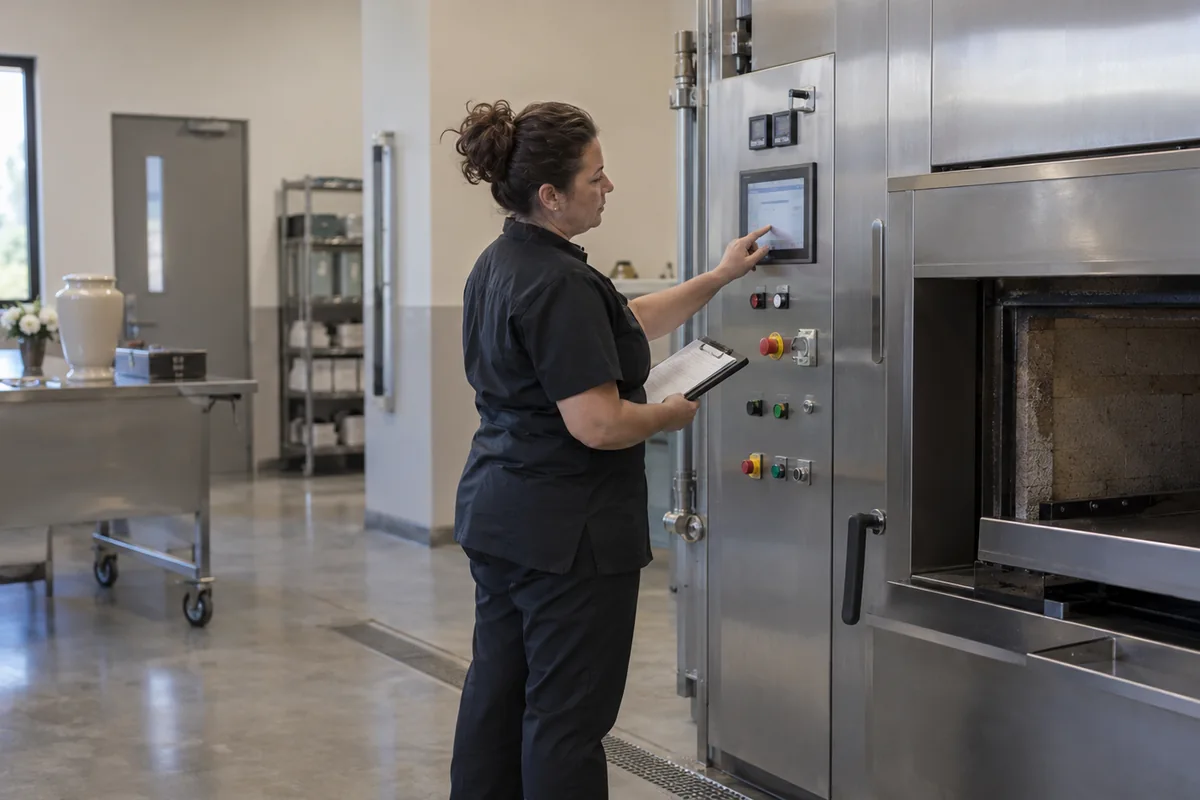
A crematory operator checking a cremation chamber control panel and equipment in a clean crematory facility, respectful and non-graphic.

A day in the life

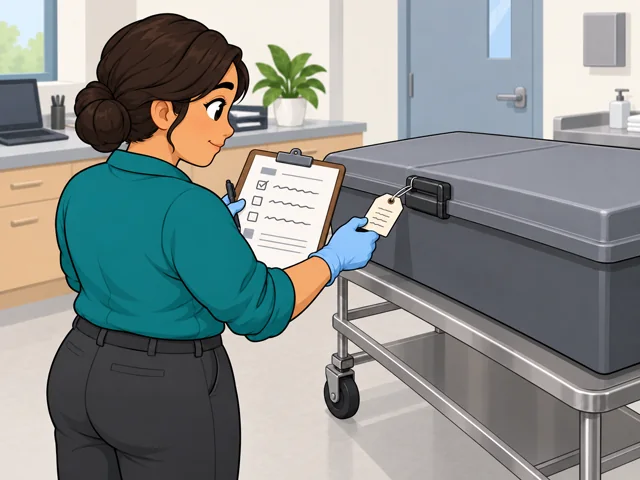
1A crematory operator carefully compares a closed transfer container's identification tag with receiving documents.

Match identification to records

Hold the person's identification against the receiving records and make sure no document is missing.
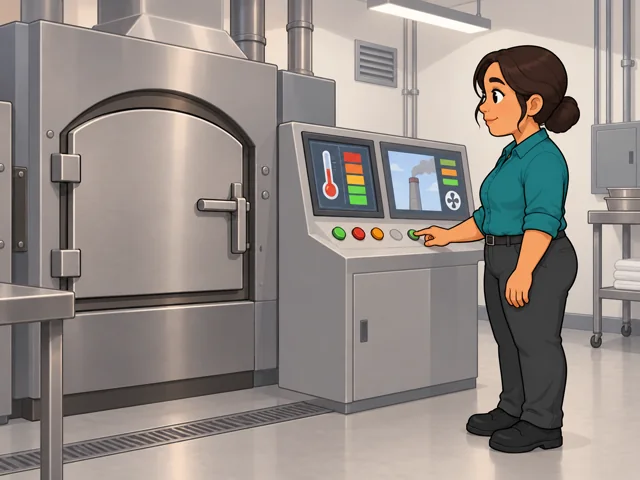
2The operator monitors temperature controls and an exhaust view beside the closed cremation chamber.

Monitor heat and exhaust

Watch the temperature controls and exhaust, and if unexpected smoke appears, check the burn and correct it.
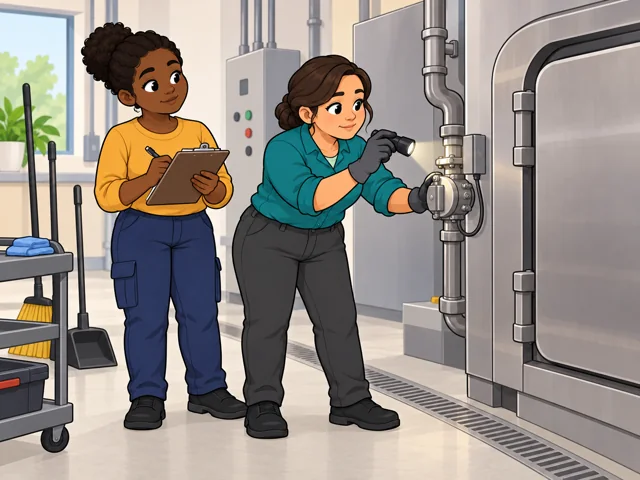
3The operator examines an exterior fitting on the idle cremation unit while a coworker records maintenance beside cleaning tools.

Care for the cremation unit

Inspect the cremation unit, tidy the work area, log upkeep, and flag faults needing a repair technician.

4The operator completes the custody record and passes a closed cremated-remains container to an authorized adult recipient.

Release the cremated remains

Update the custody record and hand the cremated remains to an authorized collector or the funeral home.

Quick facts

Preparation

High school diploma or equivalent

United States · 2025–2035

Pay

$43,650 per year

United States · May 2025

Outlook

3.1% projected growth

United States · 2025–2035

Quick orientation

Preparation, pay & outlook

Preparation

High school diploma or equivalent

The typical starting education; equipment training and local requirements come next.

Geography
United States
Period
2025–2035

Pay

$43,650 per year

National median for crematory operators, equivalent to $20.98 per hour.

Geography
United States
Period
May 2025

Outlook

3.1% projected growth

About 500 openings per year nationwide, including openings from workers leaving the occupation.

Geography
United States
Period
2025–2035

Fit, tradeoffs & changing tools

Things to weigh

  • You work directly with deceased people. That can be emotionally difficult even when the tasks become familiar.
  • Hot equipment and routine cleaning are part of the day; this is hands-on industrial work.
  • The record checks can feel repetitive, but each handoff still needs your full attention.

Where AI may help

Some cremators use computer controls that simplify manual settings. These systems can reduce the time spent adjusting the machine.

What people still lead

You still verify identities, handle remains respectfully, and respond when the equipment needs attention.

What we can’t predict yet

How far automatic controls can take over monitoring—and when an operator must intervene—will depend on the equipment and the situation.

Pay in context

Earnings

The national median is a useful comparison point when you read a job offer.

The middle of the wage distribution

Crematory operators earned a median $43,650 a year, or $20.98 an hour. Half earned less and half earned more.

Geography
United States
Period
May 2025
Pay basis
National employee wages; annual and hourly medians

The national spread

The 10th-to-90th-percentile range was $33,270–$62,460 a year, or $16.00–$30.03 an hour. These are wage percentiles, not starting and experienced pay levels.

Geography
United States
Period
May 2025
Pay basis
National employee wages; 10th and 90th percentiles

Openings across the country

Employment is projected to grow 3.1% from 2025 to 2035, with about 500 openings annually. Openings include replacement needs as well as growth; local hiring can look different.

Geography
United States
Period
2025–2035
Pay basis
Employment projection and annual average openings, not compensation

Getting started

Build experience in a funeral-home support job

What the route involves
With a high school diploma or equivalent, look for an assistant role that includes crematory work. Learn the equipment with an employer or manufacturer trainer.
What it can lead to
You can gain experience with cremation paperwork and handling remains while working toward an operator role.
What to check
Confirm that the job includes crematory training; assistant duties and permission to operate equipment vary.

Complete an operator certification course

What the route involves
Take the Cremation Association of North America (CANA) Crematory Operations Certification Program. Enrollment is open, though the teaching assumes some funeral-service familiarity.
What it can lead to
Completing the coursework and passing the exam earns CANA's Crematory Operator Certificate.

Workplace training and a certification course can complement each other. Check your state's requirements before choosing a route.

After entry

Career paths

This starts where the entry routes leave off: early work, growing capability, and advancement or specialization. This path also has a credential or licensing boundary; see the requirements and limits.

  1. Get consistent

    Build a dependable routine for receiving remains and completing custody records.

  2. Understand the machine

    Learn to recognize abnormal temperature or exhaust behavior and distinguish routine maintenance from faults needing a specialist.

  3. Work toward managing a crematory

    A later direction is responsibility for the crematory's operation. Check management requirements separately: California, for example, has a Crematory Manager license and examination.

Where you can work

A crematory serving several funeral homes

At a trade crematory, your contacts include staff from separate funeral homes. Clear receiving records and return arrangements matter across those business boundaries.

  • Indoors
  • Safety-sensitive

A funeral home with its own crematory

Cremation happens alongside the funeral home's other services. Some facilities have a viewing room where families can watch the container enter the chamber, bringing your work closer to their farewell.

  • Indoors
  • Safety-sensitive

Try it

See whether the job clicks before you commit to the path.

Make three fictional cremation case folders, each with an identification card and a handoff log. Deliberately mismatch one identifier, then check every folder. Notice whether you stay patient with repeated checks—the habit matters in this work.

Stay safe: Use invented information only; this paper exercise is not operator training.

Explore more careers

Sources

  1. O*NET OnLine. 39-4012.00 — Crematory Operators. Accessed 2026-10-10.
  2. U.S. Bureau of Labor Statistics. Occupational Employment and Wage Statistics, May 2025 national estimates. Accessed 2026-09-29.
  3. U.S. Bureau of Labor Statistics. Employment Projections, Table 1.2, 2025–2035. Accessed 2026-09-29.
  4. Service Corporation International. Crematory Operator — Falls Church, Virginia. Accessed 2026-10-10.
  5. Service Corporation International. Funeral Service Assistant, part-time — Falls Church, Virginia. Accessed 2026-10-10.
  6. Cremation Association of North America. Crematory Operations Certification Program. Accessed 2026-10-10.
  7. New York State Department of Environmental Conservation. Crematory Operator Training Manual. Accessed 2026-10-10.
  8. Matthews Environmental Solutions. Human Cremation Equipment and Crematory Systems. Accessed 2026-10-10.
  9. California Cemetery and Funeral Bureau. Information and Instructions for Crematory Manager Licensure. Accessed 2026-10-10.
  10. Southwest Crematory. Trade Cremation Services. Accessed 2026-10-10.
  11. Legacy Options Funeral and Cremation Services. Funeral Facility in Naples, Florida. Accessed 2026-10-10.

Your message goes to the Great Jobs team. How we use your information