
Career profile

Dental Assistant

Dental assistants prepare treatment rooms, assist dentists chairside and help patients relax during unfamiliar visits.

In a filling, you hand the dentist tools and hold the suction hose. Consider it if you enjoy exact handwork and lots of patient contact.
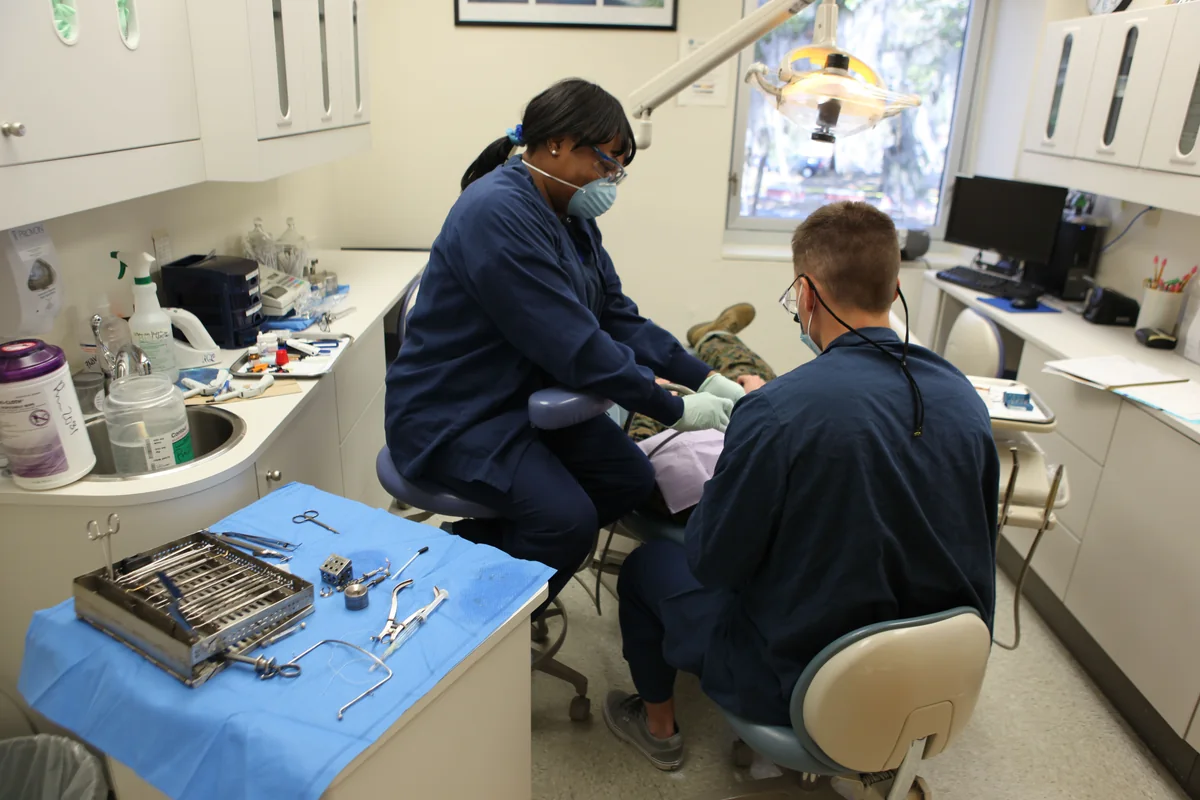
A dental assistant prepares a patient for treatment in a clinic.
U.S. government. US Government Work

A day in the life

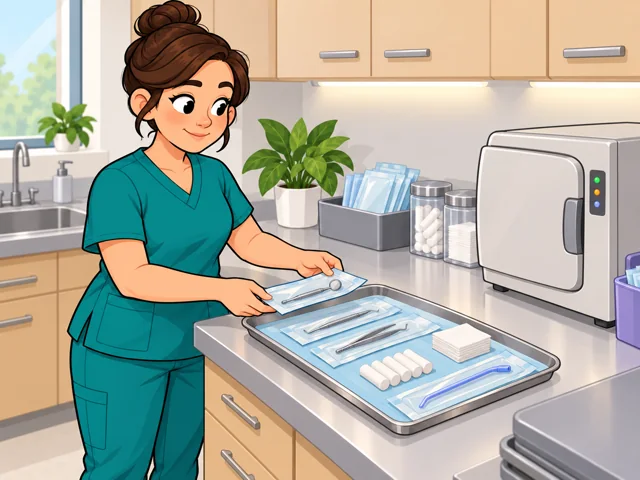
1A dental assistant carefully arranges packaged sterilized instruments and supplies on a clean tray beside a tabletop sterilizer.

Lay out the next tray

Between patients, lay out an instrument tray and supplies for the coming procedure and sterilize reusable instruments.
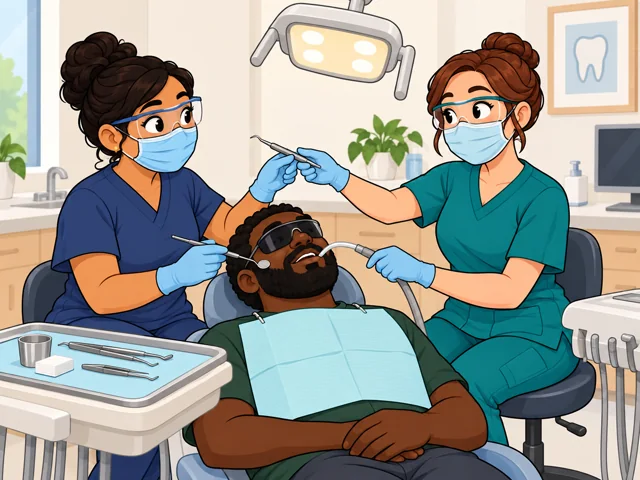
2A dental assistant holds suction and passes an instrument to a dentist while a relaxed adult man receives treatment.

Pass instruments and hold suction

During treatment, have the next tool ready to pass and keep the mouth clear with suction.

3A dental assistant sits at eye level with a concerned adult man, listening and calmly explaining the next part of his visit.

Calm a nervous patient

Ask an anxious patient what's bothering them, listen, acknowledge the worry and explain each step in everyday words.
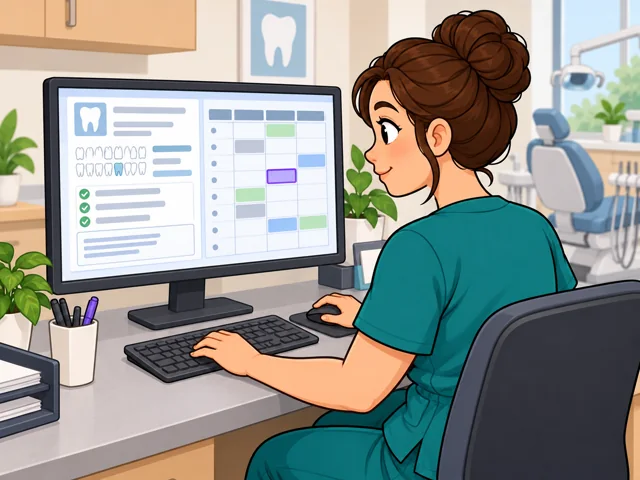
4A dental assistant updates a treatment chart and selects a follow-up appointment at a computer workstation.

Chart treatment and book return

You chart the patient's treatment and book their next visit in dental software that keeps records together.

Quick facts

Preparation

School or workplace training

United States

Pay

$48,070/year

United States · May 2025

Outlook

7% growth

United States · 2025–2035

Quick orientation

Preparation, pay & outlook

Preparation

School or workplace training

Your state and the duties you want to perform determine which preparation you need.

Geography
United States
Period
Not applicable

Pay

$48,070/year

National median, equivalent to $23.11 an hour.

Geography
United States
Period
May 2025

Outlook

7% growth

Projected national employment growth over the decade.

Geography
United States
Period
2025–2035

Fit, tradeoffs & changing tools

Things to weigh

  • Close patient contact brings infection exposure; masks, gloves, eye protection, and safety routines are part of the work.
  • A nervous patient may need patience even when you have already explained the visit.
  • Some offices need assistants in the evenings or on weekends.

Where AI may help

Patient-management software can send appointment reminders automatically and help you organize records.

What people still lead

You still handle instruments, prepare the room, and respond when a patient’s expression shows that something needs explaining.

What we can’t predict yet

How much scheduling and follow-up software will take over remains uncertain; the balance between computer work and chairside work may change.

Pay in context

Earnings

Use the national figures as a comparison point when you look at an offer, not as a promised starting wage.

The middle and the spread

The median was $48,070 a year, or $23.11 an hour. The middle half earned $44,340–$58,090 annually. The 10th and 90th percentiles were $37,130 and $62,250, or $17.85 and $29.93 hourly. These are wage percentiles, not beginner and experienced pay bands.

Geography
United States
Period
May 2025
Pay basis
Gross employee wages; national annual and hourly percentiles

Compare workplace types

Annual medians were $48,000 in dentists’ offices, $47,310 in physicians’ offices, and $55,270 in government, excluding state and local education and hospitals.

Geography
United States
Period
May 2025
Pay basis
Median annual employee wages for dental assistants within each industry

Openings include replacement hiring

About 53,000 openings are projected annually. Many replace people who leave the occupation or workforce; they are not all newly created jobs.

Geography
United States
Period
2025–2035
Pay basis
Employment projection, not compensation

Getting started

Learn in a dental office

What the route involves
Join an office that trains beginners and learn instrument names, room preparation, and patient routines from experienced staff.
What it can lead to
You gain working experience while building the skills for an assistant role.
What to check
This route depends on your state’s entry rules and the employer’s willingness to train.

Complete a dental assisting program

What the route involves
Study dental anatomy and instruments, practice in a lab, and complete supervised practical experience. Many programs take about a year.
What it can lead to
You earn a school certificate or diploma and preparation for dental assisting employment.
What to check
Check that the program meets your state’s requirements, including any required exams or registration.

You work under a dentist’s supervision. Check your state’s requirements before choosing training: taking x-rays and expanded duties may need separate qualifications.

After entry

Career paths

This starts where the entry routes leave off: early work, growing capability, and advancement or specialization. This path also has a credential or licensing boundary; see the requirements and limits.

  1. Get established

    Learn the office’s tray setups and record system until you can prepare for the next patient without overlooking supplies or chart details.

  2. Build chairside confidence

    Become familiar with more procedures and the materials each needs. Practice explaining the dentist’s aftercare instructions clearly.

  3. Guide other assistants

    A lead assistant may train new coworkers, coordinate staff schedules, and bring assistants’ concerns to the dentist or office manager.

    • Develop toward infection-control coordination, helping maintain safety records and train staff.

Where you can work

General dental practices

You switch among setups for exams, fillings, and crowns and meet patients of different ages. This setting offers a broad mix of procedures to learn.

  • Indoors
  • Office
  • Safety-sensitive

Orthodontic practices

The work centers on braces and aligners. You help prepare materials and track progress in patient records, often seeing the same people throughout a long treatment plan.

  • Indoors
  • Office
  • Safety-sensitive

Pediatric dental practices

You adapt explanations to a child’s age and help nervous children and parents settle in. Patience with questions and fear is a large part of the day.

  • Indoors
  • Office
  • Safety-sensitive

Try it

See whether the job clicks before you commit to the path.

Make paper cards labeled “instrument tray,” “suction,” “patient chart,” and “follow-up appointment.” Walk through an imaginary filling visit, explaining when the assistant would need each. Notice whether coordinating materials while keeping the patient in mind appeals to you.

Stay safe: Keep this a paper exercise; do not use dental instruments or practice on anyone’s mouth.

Explore more careers

Sources

  1. U.S. Bureau of Labor Statistics. Dental Assistants — Occupational Outlook Handbook. Accessed 2026-10-03.
  2. O*NET OnLine / U.S. Bureau of Labor Statistics. National Wages: Dental Assistants, 31-9091.00. Accessed 2026-10-03.
  3. O*NET OnLine. Dental Assistants, 31-9091.00. Accessed 2026-10-03.
  4. Dental Assisting National Board. Become a Dental Assistant. Accessed 2026-10-03.
  5. American Dental Association. Dental Assistant. Accessed 2026-10-03.
  6. Dental Assisting National Board. State Publications, Reports and Services. Accessed 2026-10-03.
  7. Dental Assisting National Board / American Association of Dental Office Management. Recognizing the magic of dental assistants. Accessed 2026-10-03.
  8. Dental Assisting National Board. Which dental assisting specialty is right for you?. Accessed 2026-10-03.
  9. Dental Assisting National Board. What could your dental assisting career path look like?. Accessed 2026-10-03.
  10. Dental Assisting National Board. Certified Dental Assistant. Accessed 2026-10-03.
  11. Dental Assisting National Board. Your CDA Certification Roadmap. Accessed 2026-10-03.

Your message goes to the Great Jobs team. How we use your information