
Career profile

Dental Hygienist

Dental hygienists scale, polish and x-ray teeth, examine gums, record findings and teach home care.

Almost every visit mixes precise, hands-on health care with teaching one person at a time. The job suits people who enjoy both.
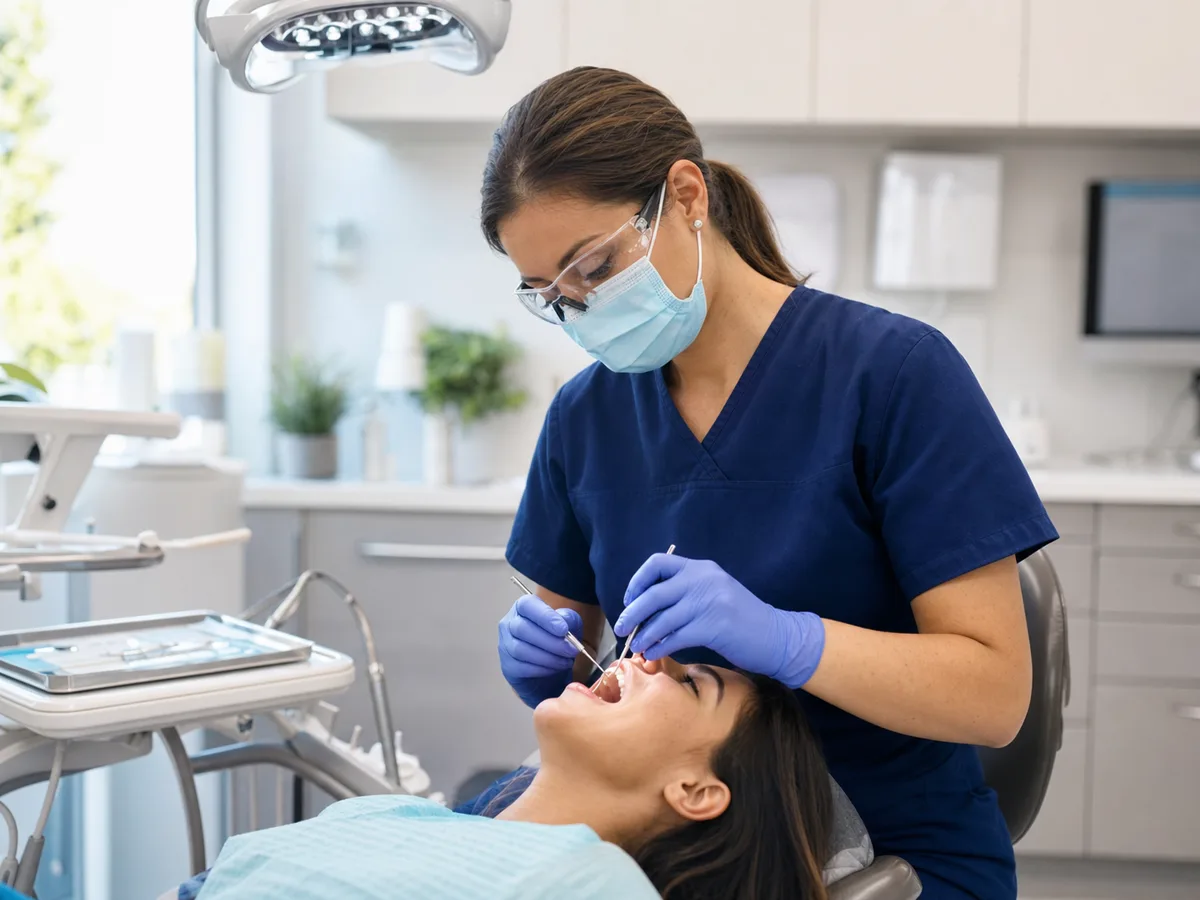
A dental hygienist uses hand instruments while caring for a patient in a dental clinic.

A day in the life

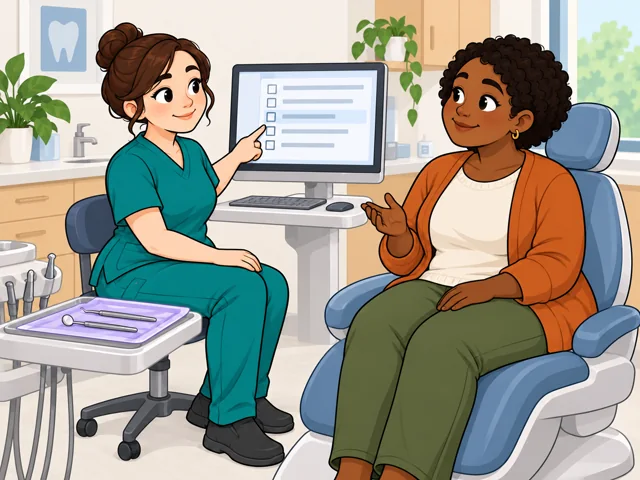
1A dental hygienist reviews a medical-history screen while listening to a patient seated upright beside her.

Review history and check gums

Review the health record for changes since last visit, then examine gums and soft tissue for warning signs.
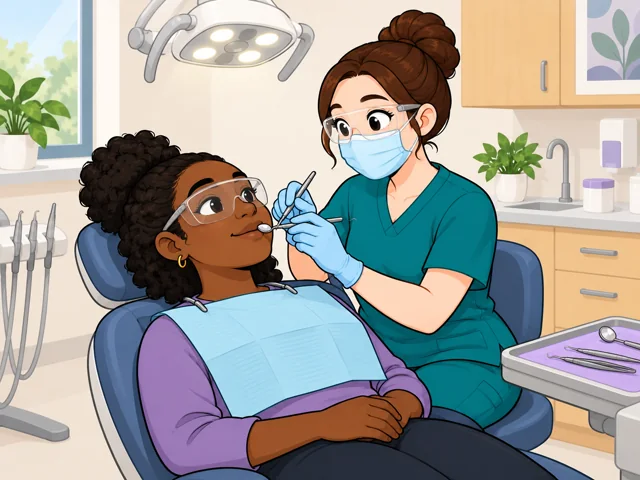
2A masked dental hygienist carefully cleans along a relaxed patient's gumline using a hand scaler and mirror.

Remove tartar, plaque and stains

Use hand, powered or ultrasonic instruments to remove tartar, plaque and stains from teeth and along the gumline.
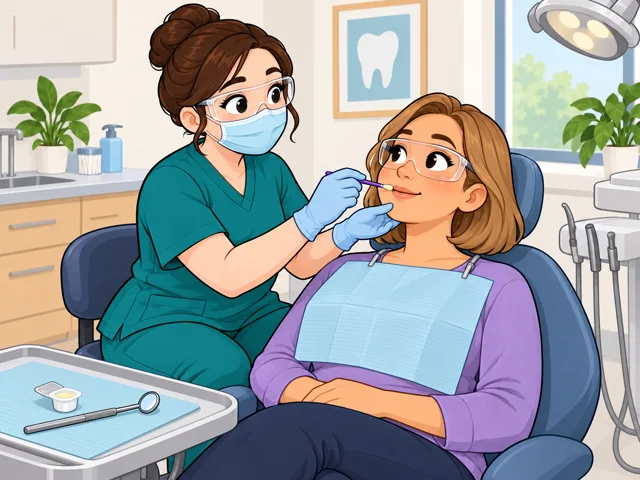
3A dental hygienist applies fluoride varnish with a small brush while a patient rests calmly in the chair.

Add fluoride or sealants

Apply fluoride, sealants or similar protection when the treatment plan calls for it and local rules allow.
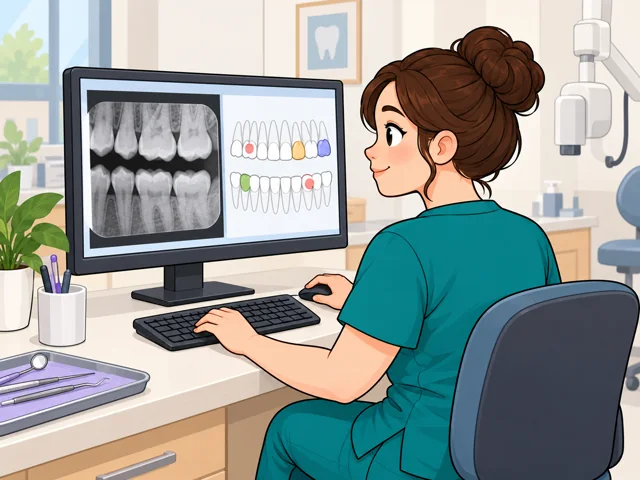
4A dental hygienist studies a dental x-ray on a monitor and records findings in an abstract tooth chart.

Take x-rays and update the chart

Take dental x-rays, chart what you see, write up the visit and flag anything the dentist should check.
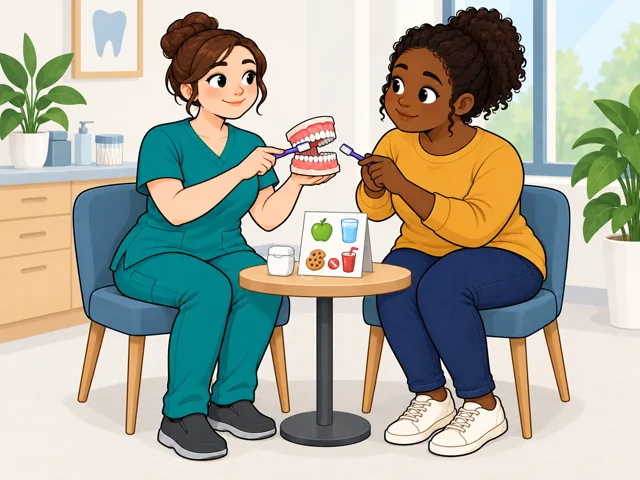
5A dental hygienist demonstrates brushing on a dental model while a patient practices the brush angle beside her.

Teach brushing and flossing

Demonstrate brushing or flossing, then explain how eating habits and home care affect this patient's mouth.

Quick facts

Preparation

Associate’s degree

United States

Pay

$47.16/hour median

United States · May 2025

Outlook

8% projected growth

United States · 2025–2035

Quick orientation

Preparation, pay & outlook

Preparation

Associate’s degree

Typical entry education; programs usually take about three years, followed by state-specific licensure.

Geography
United States
Period
Not applicable

Pay

$47.16/hour median

May 2025 national median for wage-and-salary dental hygienists; it is not a starting-pay figure.

Geography
United States
Period
May 2025

Outlook

8% projected growth

National employment projection for dental hygienists; it does not guarantee openings in a particular area.

Geography
United States
Period
2025–2035

Fit, tradeoffs & changing tools

Things to weigh

  • Expect repeated hand motions, close visual work, and time spent bending or twisting near patients.
  • Clinical work brings exposure to infections, contaminants, and x-ray radiation, so protective equipment and safety procedures are routine.
  • Part-time schedules are common. Some hygienists work in more than one office, and benefits may depend on full-time status.

Where AI may help

Dental record and scheduling software can organize histories, charts, reminders, billing, and office workflow; x-ray systems capture clinical images.

What people still lead

The hygienist still examines tissues, controls instruments in a patient’s mouth, judges what to report, and adapts explanations to the person.

What we can’t predict yet

Employers may adopt imaging, laser, and record tools at different rates, while state law controls which clinical tasks and supervision arrangements are allowed.

Pay in context

Earnings

Hourly pay is the clearest national reference because part-time work is common.

National median

The May 2025 median was $47.16 an hour. BLS also reports $98,100 annualized, but OEWS generally converts between hourly and annual figures using 2,080 hours; a part-time schedule can produce lower yearly earnings.

Geography
United States
Period
May 2025
Pay basis
OEWS median wage for wage-and-salary employees; hourly rate with annualized equivalent

The national spread

In May 2025, the 10th-percentile annual wage was $74,880 and the 90th-percentile wage was $126,050. These are wage percentiles, not starting and senior salaries.

Geography
United States
Period
May 2025
Pay basis
National annual wage percentiles

Getting started

Associate-level dental hygiene program

Programs usually take about three years; prerequisites vary by school.
What the route involves
Complete required prerequisites, then classroom, laboratory, and supervised clinical instruction in dental hygiene.
What it can lead to
Provides the usual entry education and, in most states when the program is accredited, the degree needed to seek required examinations and licensure.
What to check
Verify current CODA accreditation and the licensing rules of the state where you plan to practice.

Entry-level bachelor’s dental hygiene program

What the route involves
If you have no prior dental hygiene education, complete an entry-level bachelor’s program with prerequisite, classroom, laboratory, and clinical work.
What it can lead to
Graduation from a CODA-accredited entry-level program qualifies you to seek licensing examinations; the bachelor’s degree can also support broader options in research, teaching, and public or school health.
What to check
Do not confuse this with a bachelor’s degree-completion program, which is for already licensed hygienists who finished entry-level education. Verify CODA accreditation and state licensing rules; the degree does not replace a license.

There is no ordinary work-first route into independent hygiene duties: qualifying education and a state license come before practice.

After entry

Career paths

This starts where the entry routes leave off: early work, growing capability, and advancement or specialization.

  1. Get established

    After licensure, learn the employer’s record system, infection-control and x-ray procedures, and process for reporting findings to the dentist.

  2. Develop clinical range

    Build precision and an efficient workflow across periodontal assessment, instrumentation, imaging, care planning, and patient coaching while staying inside local scope.

  3. Advance or specialize

    Further education can support moves into research, teaching, or clinical work in public and school health programs.

    • Where state law allows, pursue approved additional training for expanded clinical functions.

Where you can work

Dentists’ offices

This is the dominant setting: 94% of hygienists worked in dentists’ offices in 2025. Work follows patient appointments, and part-time or multi-office schedules are common.

  • Indoors
  • Office
  • Physical demands
  • Safety-sensitive

Government and community programs

A much smaller share work in government settings. Roles may include clinics, preventive services, and oral-health education for groups rather than one private-office patient list.

  • Indoors
  • Office
  • Safety-sensitive

Try it

See whether the job clicks before you commit to the path.

Print a tooth-and-gum diagram. For 10 minutes, use tweezers to place grains of rice on marked spots while explaining a brushing tip aloud. Notice your hand steadiness, close-focus comfort, patience, and ability to speak calmly while concentrating.

Stay safe: Keep the exercise on paper. Do not put tools in anyone’s mouth or attempt a dental procedure.

Explore more careers

Sources

  1. U.S. Bureau of Labor Statistics. Occupational Outlook Handbook: Dental Hygienists. Accessed 2026-09-14.
  2. O*NET OnLine. 29-1292.00 Dental Hygienists. Accessed 2026-09-14.
  3. Commission on Dental Accreditation. Find a Program. Accessed 2026-09-14.
  4. American Dental Education Association. Dental Hygiene Programs. Accessed 2026-09-14.
  5. U.S. Bureau of Labor Statistics. OEWS May 2025 Survey Methods. Accessed 2026-09-14.

Your message goes to the Great Jobs team. How we use your information