

Career profile

Direct-Entry Midwife

Midwives see clients through pregnancy, a home or birth-center delivery, and the baby's first weeks.

Over many visits, you get to know one household well. Later, once labor begins, you put that knowledge to work at the birth.
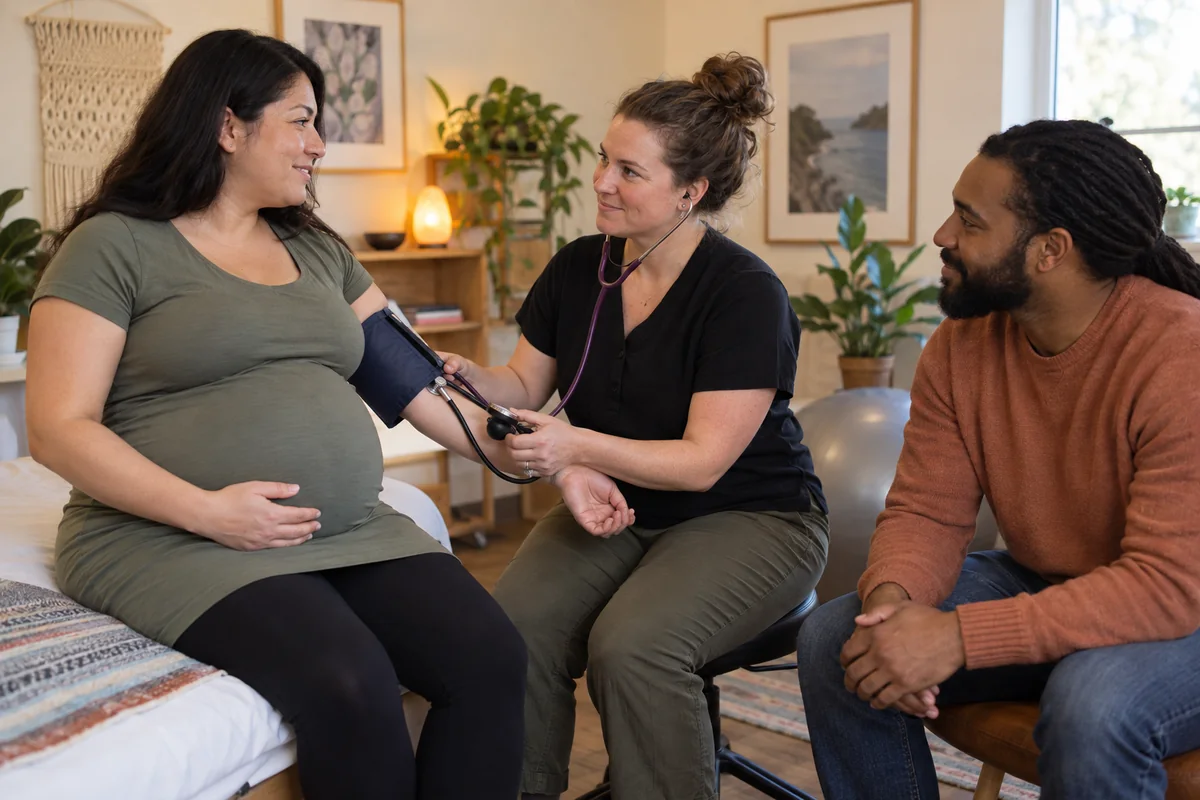
Direct-entry midwife checks a pregnant client’s blood pressure.

A day in the life

1A midwife checks a seated pregnant man's blood pressure while listening, with an open pregnancy record and measuring tape nearby.

Check in at a prenatal visit

Open the chart, take blood pressure, check the baby's growth, and ask what's changed since you last met.

2A midwife monitors a laboring man's baby's heartbeat with a handheld Doppler while a coworker adjusts pillows for his side-lying position.

Support a birth in progress

Track the baby's heart rate and the parent's condition while you help them shift positions and deliver.

3A midwife coordinates hospital care by phone while showing a seated pregnant man his emergency plan, as a coworker gathers the record and care bag.

Shift care to a hospital

Once a problem needs a hospital, tell the client, follow their existing emergency plan, and coordinate the handoff.

4During a home visit, a midwife listens to a newborn boy's chest while the recovering father holds him securely, with a follow-up record nearby.

Visit parent and baby after birth

Examine the parent's healing and the baby, talk about feeding, and log worries for follow-up.

Quick facts

Preparation

Midwifery study + clinical training

United States

Pay

Not displayed

Pay depends on the position and its call commitment; see the local salary range below.

Outlook

Not displayed

Explore licensed-midwife positions in the area where you hope to practice.

Quick orientation

Preparation, pay & outlook

Preparation

Midwifery study + clinical training

Build knowledge and hands-on experience with an experienced midwife before seeking certification.

Geography
United States
Period
Not applicable

Pay

Not displayed

Pay depends on the position and its call commitment; see the local salary range below.

Geography
United States
Period
Not applicable

Outlook

Not displayed

Explore licensed-midwife positions in the area where you hope to practice.

Geography
United States
Period
Not applicable

Fit, tradeoffs & changing tools

Things to weigh

  • Being on call can interrupt sleep and make personal plans harder to keep.
  • The work involves intimate physical care and decisions with serious consequences.

Where AI may help

Electronic charts let some community practices record visits on a tablet and keep client information together.

What people still lead

You still examine the person and interpret changes that may require different care.

What we can’t predict yet

How much future software can take over charting without missing important context remains uncertain.

Pay in context

Earnings

Read a salary alongside its call schedule: time available for births can be a substantial part of the commitment.

A Washington salary range

A full-time licensed Certified Professional Midwife (CPM) position in Kirkland listed $70,000–$90,000 annually in July 2026, with 15 call days per month plus clinic work and postpartum home visits. This is a local advertised range, not a national average.

Geography
Kirkland, Washington, United States
Period
2026-07-08
Pay basis
Advertised annual salary for a full-time employee

Getting started

Study in an accepted midwifery program

What the route involves
Complete a midwifery program with classroom learning and supervised clinical experience.
What it can lead to
An accepted program can establish eligibility for the North American Registry of Midwives (NARM) examination; certification also requires the remaining clinical and application requirements.
What to check
NARM provisionally recognizes the Midwifery Education Accreditation Council (MEAC) pathway from October 1, 2026 through March 31, 2028. Confirm how your expected graduation date and state licensing rules affect your choice.

Build a supervised training portfolio

What the route involves
Use NARM’s Portfolio Evaluation Process (PEP): study, attend clinical care with registered preceptors, and document verified experience and skills. Complete required adult cardiopulmonary resuscitation and newborn resuscitation training.
What it can lead to
Approved training documentation allows you to proceed to the written examination. Passing it and completing the final application requirements leads to CPM certification.
What to check
Agree in writing on clinical opportunities, call expectations, teaching time, and financial obligations with your preceptor.

These routes lead toward the CPM credential through midwifery education and supervised practice. Before enrolling, check the licensing requirements where you intend to work.

After entry

Career paths

This starts where the entry routes leave off: early work, growing capability, and advancement or specialization. This path also has a credential or licensing boundary; see the requirements and limits.

  1. Get established

    Build dependable routines for client updates, handoffs, and emergency contacts so information is ready when care changes.

  2. Strengthen your judgment

    Discuss cases in peer review, refresh emergency skills, and use continuing education to improve your care.

  3. Teach future midwives

    With additional experience and the required registration, become a preceptor who teaches students and verifies their clinical skills.

Where you can work

Home-birth group practice

You may combine office appointments with travel to births and early postpartum visits. Birth assistants and regular meetings help a small practice keep track of each family.

  • Indoors
  • Travel
  • On call
  • Safety-sensitive

Freestanding birth center

A center can provide a shared base with other midwives and administrative staff. The schedule may still include call and visits to clients’ homes.

  • Indoors
  • On call
  • Travel
  • Safety-sensitive

Try it

See whether the job clicks before you commit to the path.

Sketch an emergency-contact sheet for a fictional home-birth client: include a receiving hospital, care contacts, and a family contact. Explain why each belongs there. Notice whether preparing for a change of plan interests you as much as attending the birth.

Stay safe: Use invented personal details. This is a coordination exercise, not a clinical emergency plan.

Explore more careers

Sources

  1. O*NET OnLine. 29-9099.01 — Midwives. Accessed 2026-10-06.
  2. O*NET OnLine / U.S. Bureau of Labor Statistics. National Wages: Midwives — broader occupation data. Accessed 2026-10-06.
  3. North American Registry of Midwives. Certification/Recertification. Accessed 2026-10-06.
  4. North American Registry of Midwives. MEAC accredited pathway provisional recognition status update. Accessed 2026-10-06.
  5. North American Registry of Midwives. Entry-Level PEP Application Instructions. Accessed 2026-10-06.
  6. North American Registry of Midwives. Preceptor/Student Relationships & Policies. Accessed 2026-10-06.
  7. North American Registry of Midwives. State Information. Accessed 2026-10-06.
  8. North American Registry of Midwives. Emergency Care Form. Accessed 2026-10-06.
  9. North American Registry of Midwives. Recertification. Accessed 2026-10-06.
  10. Home4Birth. Now Hiring. Accessed 2026-10-06.
  11. Puget Sound Birth Center via American Association of Birth Centers. Washington — Full-Time Midwife. Accessed 2026-10-06.

Your message goes to the Great Jobs team. How we use your information