
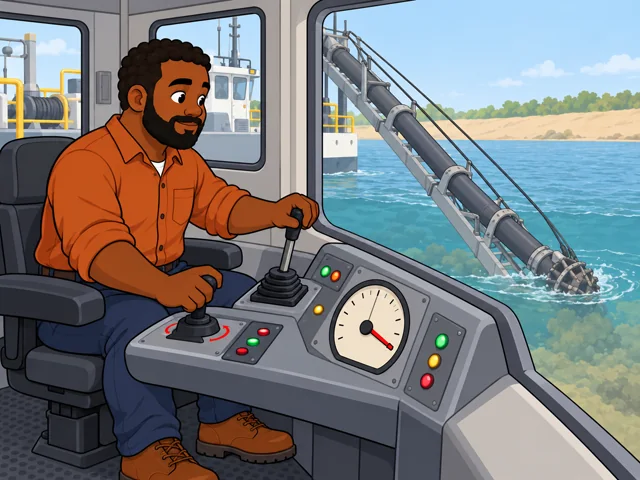
Dig at the right depth
On a hydraulic dredge, lower the suction boom, start the cutterhead spinning, and read the depth gauge.
Career profile
Dredge operators run equipment that digs material out from below the waterline.
You steer a dredge that removes sediment, gravel, or sand. On hydraulic dredges you cannot see the digging, so pump and depth readings guide you.
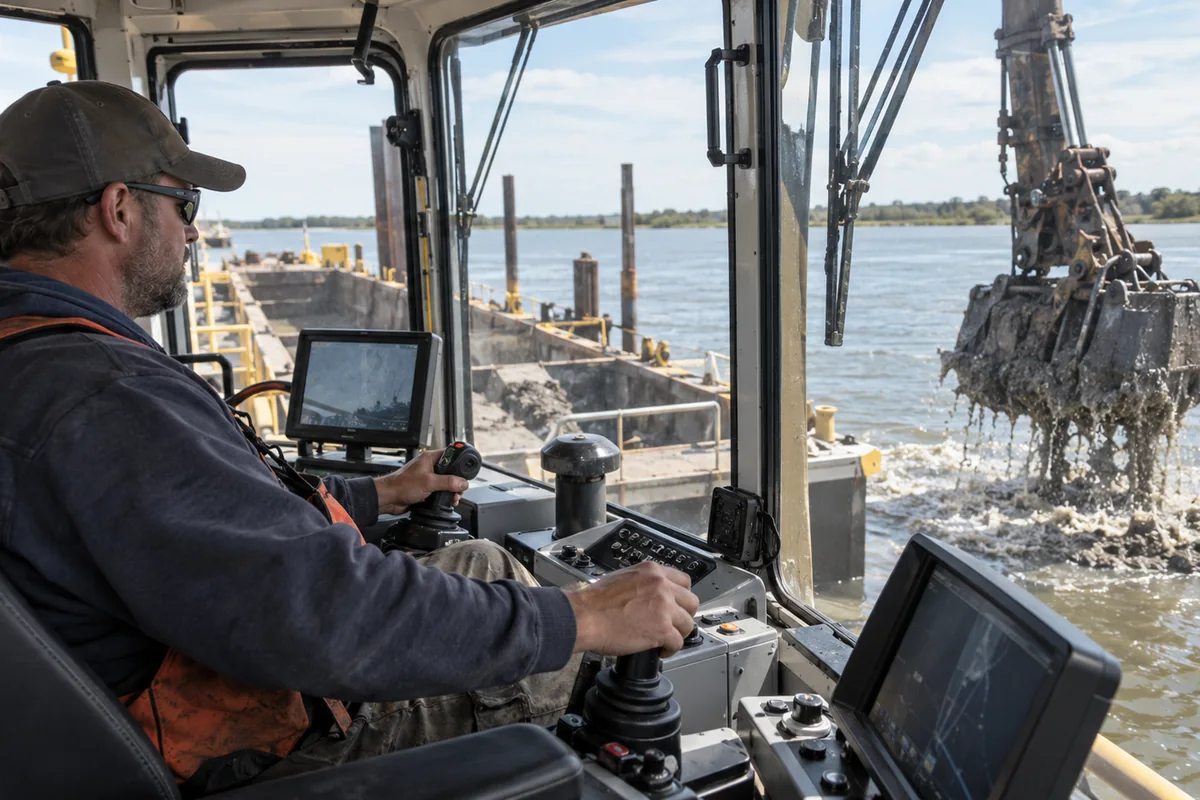
On a hydraulic dredge, lower the suction boom, start the cutterhead spinning, and read the depth gauge.
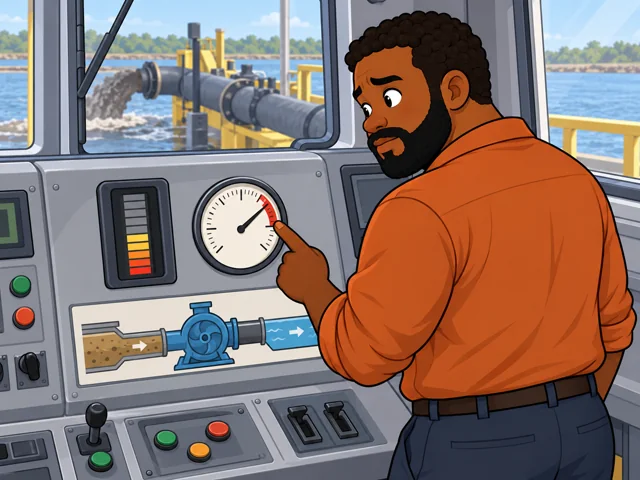
Watch pump flow and pressure, and when they shift, check whether a suction or discharge pipe is clogging.
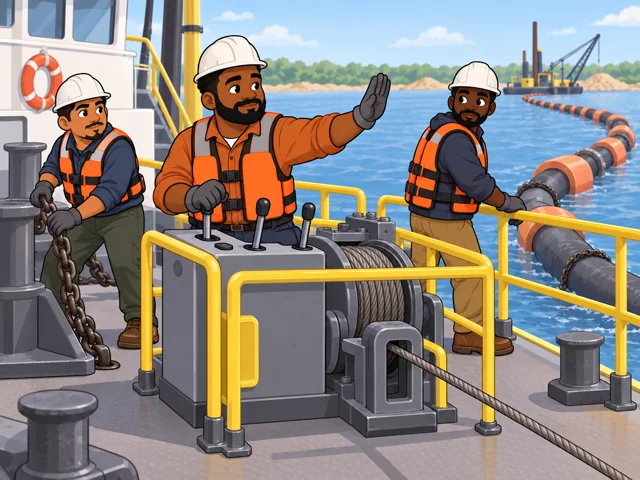
Run the winches, pulling cable in or letting it out, alongside crew members who tend pipe and anchors.
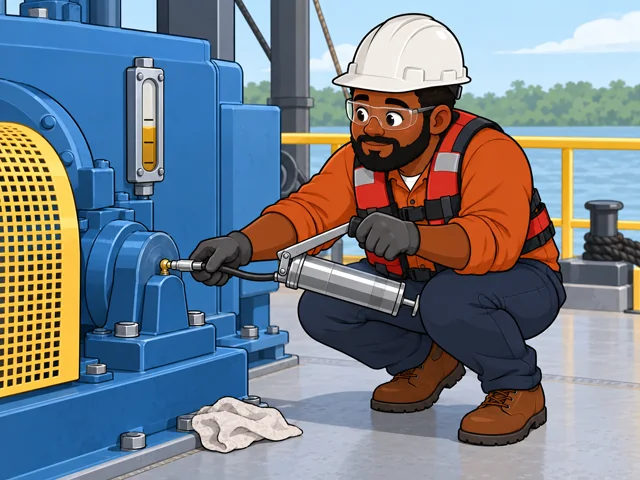
Inspect the equipment before startup, and keep the grease and oil points lubricated.

Fill out a daily production report at a sand quarry and keep talking with the processing plant crew.
United States
United States · May 2025
United States · 2025–2035
Quick orientation
A high school diploma or equivalent is typical; you learn the equipment at work.
National median for dredge operators, equivalent to $23.86 an hour.
Projected growth of 0.7%, with about 100 openings a year nationally.
Some hydraulic dredges have automatic controls that steady the flow of water and sediment and coordinate pumps with the processing plant.
You still need to interpret unusual readings and understand the machinery. Simulator practice and troubleshooting courses help build that judgment.
How much routine adjustment moves to automatic control will vary with the dredge and its upgrades; future systems may change how often you intervene.
Pay in context
The national median is $49,640 a year, or $23.86 an hour. Use it as a comparison point when looking at an offer.
In May 2025, the 10th-percentile wage was $41,080 a year ($19.75 an hour), and the 90th-percentile wage was $74,140 ($35.65 an hour). These mark the lower and upper ends of the middle 80% of wages—not starting and senior pay levels.
Employment is projected to grow 0.7% from 2025 to 2035. About 100 openings a year are projected nationally, including replacement needs. That is a small national market, so openings near you may be limited.
A high school diploma or equivalent is the usual starting point. Look for a job that explains how you will learn its particular dredge.
After entry
This starts where the entry routes leave off: early work, growing capability, and advancement or specialization.
Get consistent with startup, shutdown, and equipment checks before trying to improve production.
Develop your ability to connect pressure and flow changes with what is happening inside the pump and pipeline.
Advanced training can build skill with software that tracks dredging work or with diagnosing hydraulic and electrical problems.
You may operate both the dredge and processing plant, keeping material moving between them. The job can mix control work, maintenance, and production reporting.
Marine contractors deepen waterways, replenish beaches, and build marshes. Your workplace follows project locations, so travel can be part of the job.
Try it
Draw a channel as a grid and give each square an imaginary water depth. Choose a target depth, mark the shallow squares, and sketch a sequence of dredge passes. Notice whether you enjoy turning measurements into a digging plan.
Stay safe: Keep this a paper exercise; it is not an operating plan for real equipment.