

Check a dataset before trusting it
You assemble the data in spreadsheet software or a statistical program and hunt for gaps and mismatched definitions.
Career profile
Economists study how people and businesses respond when the economy changes.
Would changing a tax make shoppers buy differently? Economists turn questions like that into analysis that can help shape decisions.

You assemble the data in spreadsheet software or a statistical program and hunt for gaps and mismatched definitions.

Fit a statistical model linking economic factors, then change one assumption to see whether the finding survives.
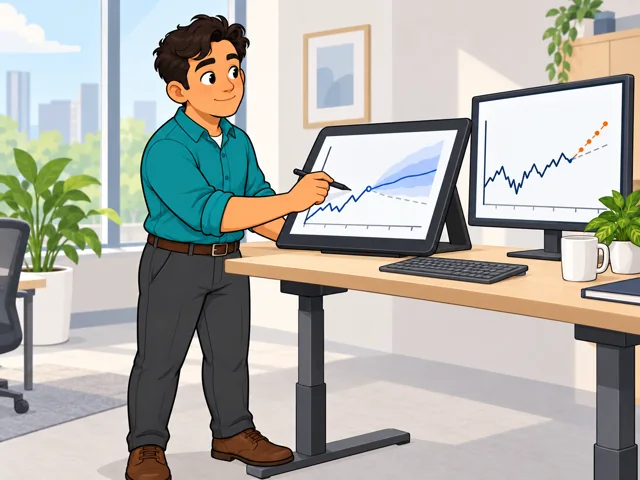
First you set fresh numbers against past patterns, then adjust projections for demand, jobs, or similar economic activity.
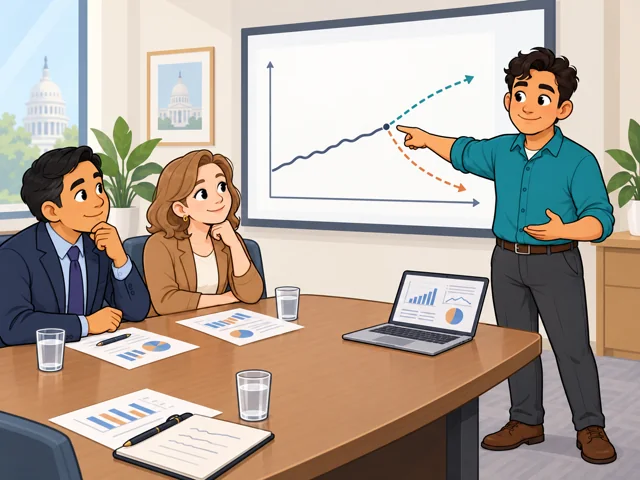
In policy jobs, you brief policymakers, explaining the chart and which findings depend on assumptions.
United States
United States · May 2025
United States · 2025–2035
Quick orientation
Some government positions accept a bachelor's degree; some research roles require a doctorate.
Median, equivalent to $59.96/hour, across economists, including environmental economists.
About 1,100 openings annually across economists, including environmental economists.
Artificial intelligence (AI) tools can help write analysis code, gather data, and search research papers. These uses have been demonstrated in economic research.
You still need to check the data and code, decide whether the method fits the question, and explain what the result means.
How much of a research project these tools can complete reliably without close checking remains uncertain, especially when the data or question is unfamiliar.
Pay in context
These national figures cover economists as a whole, including environmental economists.
The median was $124,720 a year, equivalent to $59.96 an hour. Half earned more and half earned less; this is not a starting-salary estimate.
The 10th-percentile wage was $67,360 a year and the 90th-percentile wage was $238,060. These mark positions in the wage distribution, not beginner and senior salaries.
Employment is projected to grow 4.7%, with about 1,100 openings a year on average. Many replace people leaving the occupation. Government budgets can affect hiring.
Choose coursework with the jobs you want in mind: degree requirements differ.
After entry
This starts where the entry routes leave off: early work, growing capability, and advancement or specialization.
Learn your employer's datasets and checks so colleagues can follow your calculations.
Take a question through analysis and presentation. Use colleagues' feedback on work in progress to strengthen the argument.
Work toward coordinating research projects or supervising economists. Another direction is deeper expertise in a subject such as labor or banking.
You analyze economic conditions or proposed policies for public decisions. The audience needs to understand potential effects of laws and regulations.
Your audience is managers making commercial decisions. Consumer demand and sales can shape the questions you investigate.
Research and policy analysis share your time. Research assistants, internal workshops, and academic conferences support work that may become a published paper.
Try it
Imagine your city lowers bus fares. Write a prediction about ridership, then name another change that could also affect it. Sketch what data you would compare before and after. Notice whether you enjoy separating a plausible explanation from evidence that could test it.