
Career profile

Extruding, Forming, and Compacting Machine Operator

Forming machine operators run equipment that shapes glass, food, rubber, or clay into identical products.

A small change in temperature or pressure can alter the finished piece. Your job is to watch what comes out and adjust the settings.
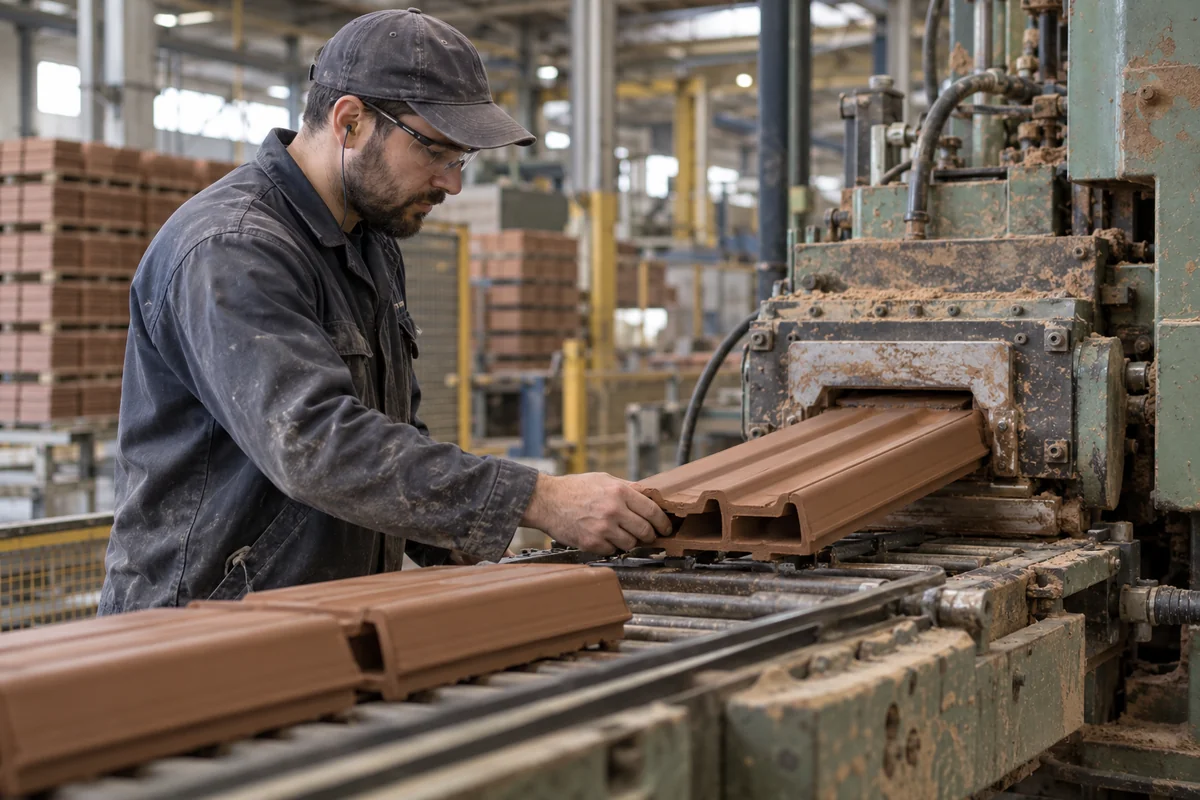
Machine operator checks clay shapes emerging from an extruder.

A day in the life

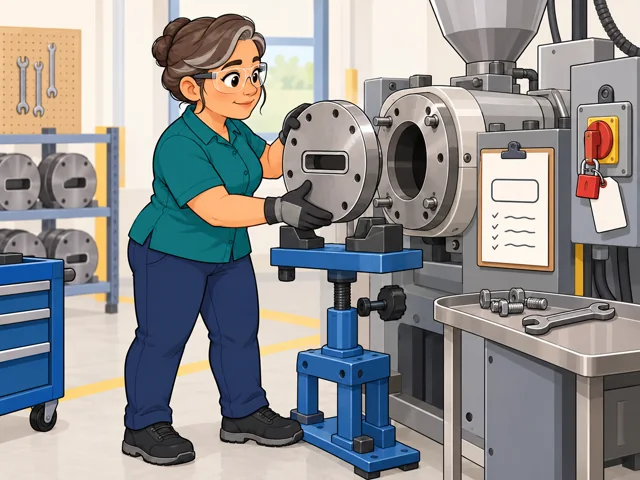
1An operator aligns a shaping die with a stopped extrusion machine, comparing its opening with a diagram on a work order.

Fit the mold the job needs

Install the mold or die the work order calls for, since it sets the product's final shape.
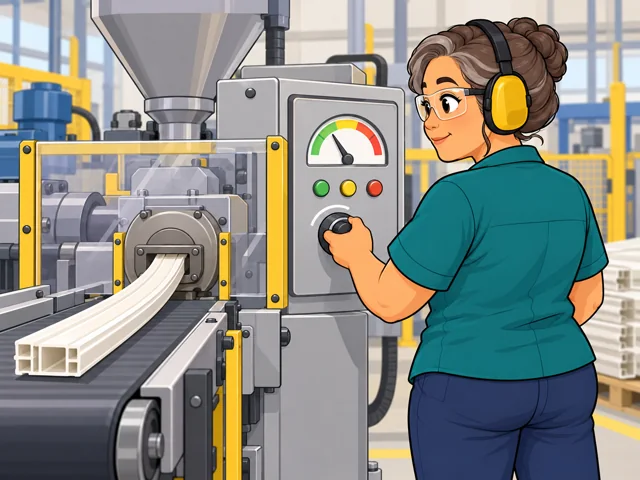
2An operator adjusts a machine control while monitoring a gauge and the shape of material moving along a guarded conveyor.

Tune the machine back to spec

Watch the gauges and the output, and change temperature, speed, or pressure when results drift from spec.

3An operator gauges a cooled glass bottle at an inspection bench and points out a misshapen sample to the crew leader, beside a scale and inspection record.

Glass plants: check sample bottles

Weigh and measure bottles, log the numbers, and tell the crew leader about flaws you cannot fix.
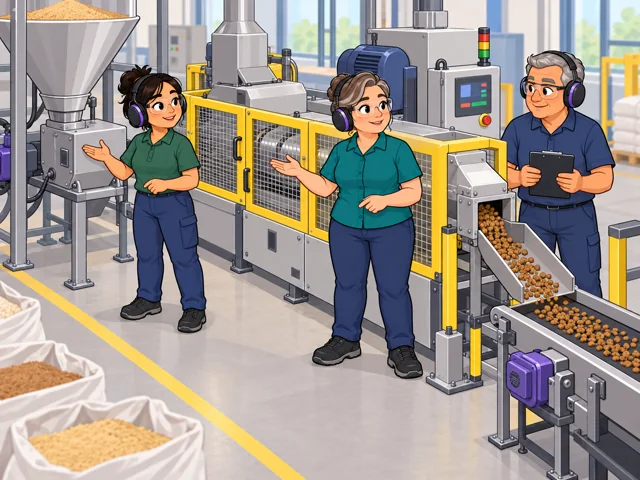
4An operator coordinates with a medium-skinned Asian woman at the ingredient feeder and a light-skinned man at the downstream conveyor as formed feed moves through the extrusion line.

Keep feed moving down the line

On feed extrusion lines, you coordinate with ingredient and downstream operators so material flows through every stage.

Quick facts

Preparation

High school + workplace training

United States · 2025

Pay

$22/hour median

United States · 2025

Outlook

1.5% projected growth

United States · 2025–2035

Quick orientation

Preparation, pay & outlook

Preparation

High school + workplace training

A high school diploma or equivalent is typical, followed by on-the-job training.

Geography
United States
Period
2025

Pay

$22/hour median

Equivalent to $45,760 annually in 2025.

Geography
United States
Period
2025

Outlook

1.5% projected growth

About 5,200 openings per year are projected across the occupation for 2025–2035.

Geography
United States
Period
2025–2035

Fit, tradeoffs & changing tools

Things to weigh

  • Expect substantial standing and a pace partly set by the machinery.
  • Glass plants can be hot and loud, with rotating shifts that include weekends and holidays.

Where AI may help

Some glass-forming systems use sensor readings to adjust the process automatically. Robots can also lubricate molds.

What people still lead

Operators still investigate defects, change molds and recognize problems that need repair.

What we can’t predict yet

How much hands-on adjustment remains will depend on the equipment a plant installs and how far automatic controls can handle changing production conditions.

Pay in context

Earnings

Use the national figures as a reference when comparing actual offers.

The middle and the spread

The 2025 median was $45,760 a year, or $22 an hour. The 10th and 90th percentiles were $34,630 and $63,450 annually. Those mark positions in the pay distribution, not beginner and experienced rates.

Geography
United States
Period
2025
Pay basis
Annual and hourly employee wages; median and annual 10th/90th percentiles

Specialized glass work

An experienced glass-forming position in Lapel, Indiana lists $36.23 an hour and requires a Forming Operator Journeyman Card. This is a particular job rate, not typical starting pay or a glass-industry average.

Geography
Lapel, Indiana
Period
Posting accessed 2026-10-04
Pay basis
Advertised hourly wage for an experienced full-time position

Openings despite slow growth

Employment is projected to grow 1.5% from 2025 to 2035, with about 5,200 openings annually. Openings include replacing workers who leave; they are not all newly created jobs.

Geography
United States
Period
2025–2035
Pay basis
Employment projection; not compensation

Getting started

Enter through an operator trainee job

What the route involves
Learn machine controls, measurements and production routines from experienced workers. A high school diploma or equivalent is typical.
What it can lead to
Build the skills to operate the plant's equipment; related work experience is not typically required for entry.

Seek a forming-machine apprenticeship

Paid
What the route involves
Combine mentored work with related classroom learning through a registered apprenticeship. Forming-machine operator is a recognized apprenticeship occupation.
What it can lead to
Completing a registered program earns a nationally recognized, portable credential documenting your training.
What to check
Apply through an employer or sponsor and check its eligibility rules. Recognition of the occupation does not mean a program is recruiting near you.

Employer training is the typical starting point. Look carefully at whether a vacancy is for a trainee or an experienced operator.

After entry

Career paths

This starts where the entry routes leave off: early work, growing capability, and advancement or specialization.

  1. Get reliable on one line

    Learn what normal output looks like, complete quality checks consistently and recognize when a problem needs help.

  2. Handle changes and faults

    Build skill in changing shaping parts and tracing routine defects to machine settings.

  3. Specialize in glass forming

    Pursue experienced work involving mold changes and defect analysis. Some positions require a Forming Operator Journeyman Card.

Where you can work

Glass-container plants

Work around molten glass and molds that form bottles. Heat and noise are part of the setting; some plants rotate crews across weekends and holidays.

  • Indoors
  • Shift work
  • Safety-sensitive

Animal-feed plants

An extruder sits between ingredient preparation and later processing. You coordinate material flow with nearby operators while meeting food-safety and housekeeping requirements.

  • Indoors
  • Physical demands
  • Safety-sensitive

Try it

See whether the job clicks before you commit to the path.

Press modeling dough through a hand-operated dough extruder to make several matching lengths. Measure their thickness with a ruler, change how steadily you press, and compare again. Notice whether you enjoy repeating a process and investigating differences.

Stay safe: Use a toy or craft tool designed for modeling dough, not powered equipment.

Explore more careers

Sources

  1. O*NET OnLine. 51-9041.00 — Extruding, Forming, Pressing, and Compacting Machine Setters, Operators, and Tenders. Accessed 2026-10-04.
  2. U.S. Bureau of Labor Statistics. Occupational Employment and Wages, May 2023 — 51-9041. Accessed 2026-10-04.
  3. O*NET OnLine / U.S. Bureau of Labor Statistics. National Wages: 51-9041.00 — 2025 wage data. Accessed 2026-10-04.
  4. U.S. Bureau of Labor Statistics. Occupational projections, 2025–35, and worker characteristics, 2025. Accessed 2026-10-04.
  5. O-I. Forming Operator — Journeyman, Lapel. Accessed 2026-10-04.
  6. Cargill. Extrusion Machine Operator II — Kansas City, Kansas. Accessed 2026-10-04.
  7. U.S. Department of Labor, Apprenticeship.gov. Career Seekers. Accessed 2026-10-04.
  8. Bucher Emhart Glass. Automation & data. Accessed 2026-10-04.

Your message goes to the Great Jobs team. How we use your information