
Career profile

Food Cooking Machine Operator

Cooking machine operators run large fryers, cookers and kettles that turn raw ingredients into food.

Why watch the dials and the food itself? You want to catch a small shift early, before a whole batch turns out bad.
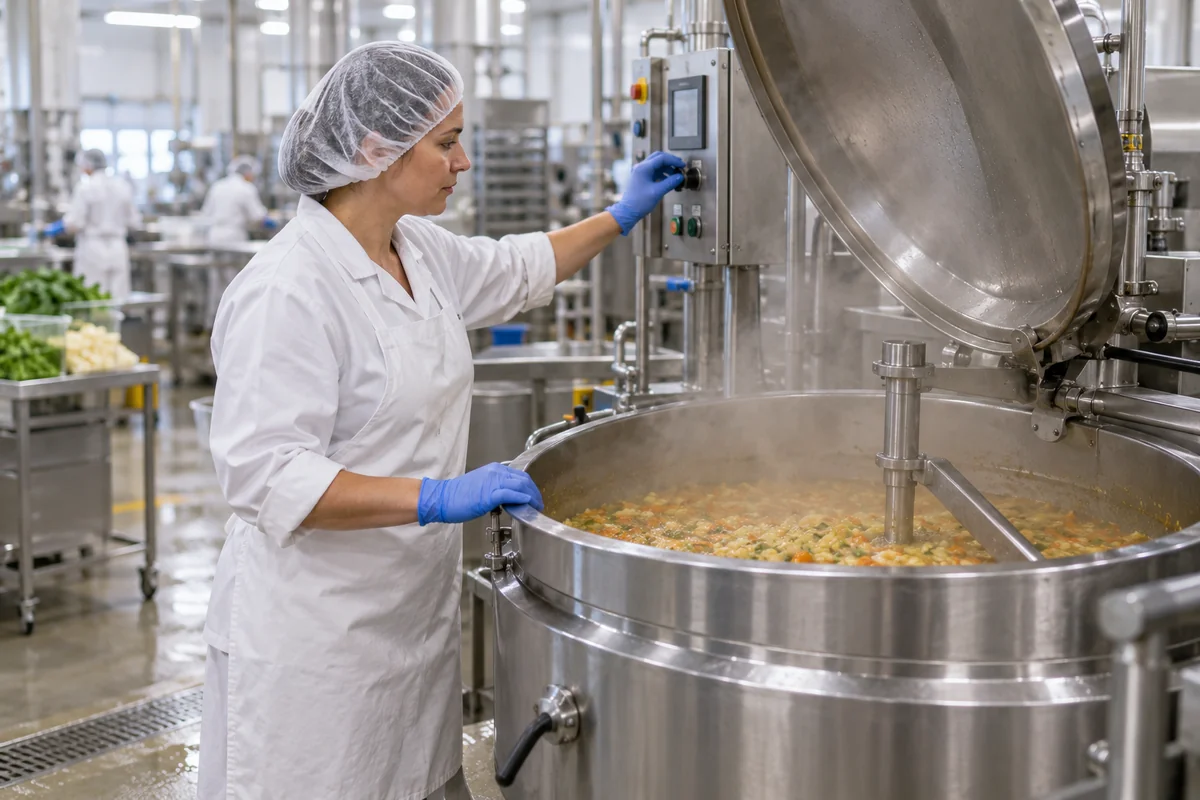
Food cooking machine operator checks a large industrial kettle.

A day in the life

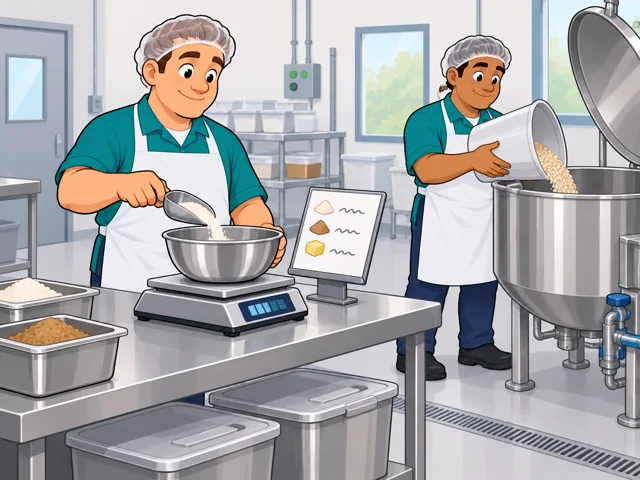
1A food cooking machine operator weighs ingredients beside a recipe sheet while a coworker loads a measured portion into an idle kettle.

Weigh ingredients for the batch

Work from the recipe, weigh each ingredient on a scale, then load them into the cooker.
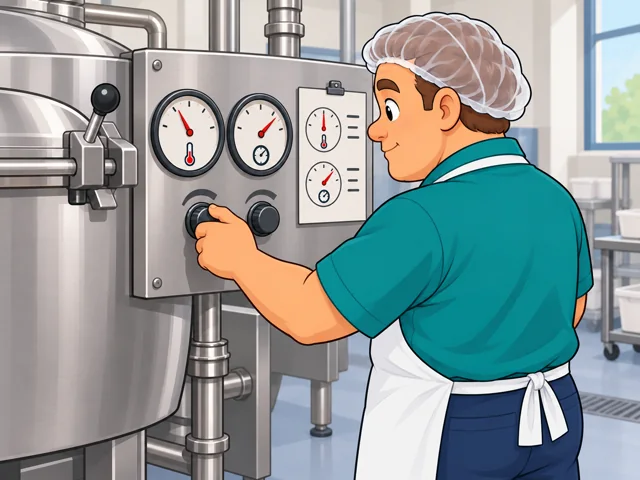
2The operator compares cooker temperature and pressure gauges with a recipe reference and adjusts a control knob.

Keep pressure and temperature on target

Watch the pressure and temperature against the recipe's numbers, and adjust the controls if they drift.
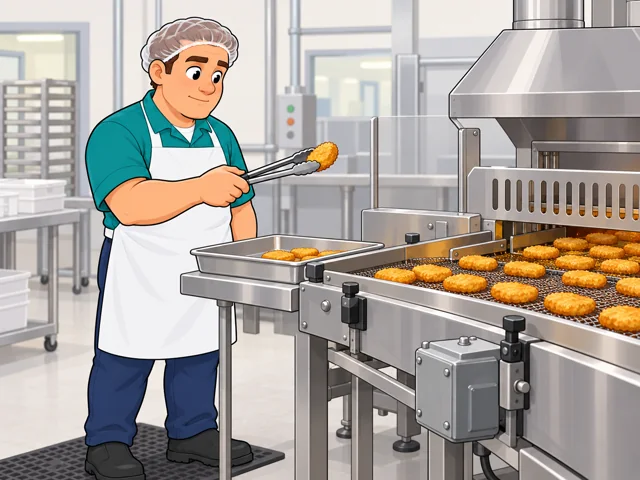
3At a frying-line discharge, the operator lifts a cooked piece with tongs and checks its color against the food coming off the conveyor.

Judge the fried product's color

Where the line fries product, you check the color coming off to see if it's cooking right.
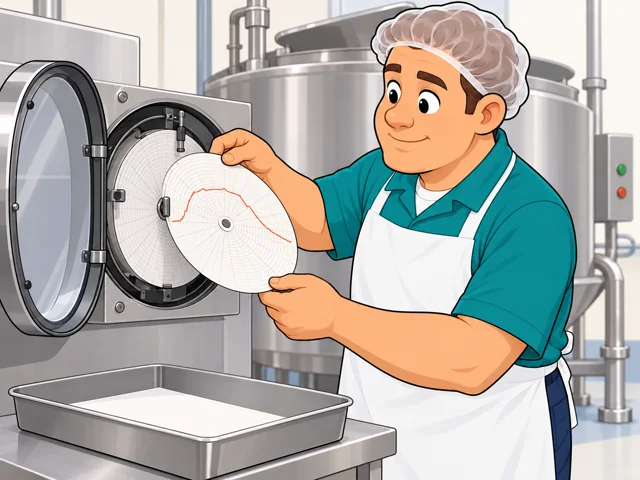
4The operator checks a kettle's circular temperature chart and removes the completed record for quality staff to review.

Collect the kettle's chart record

Confirm the kettle's chart recorder and collect its record so quality staff can review how the batch cooked.
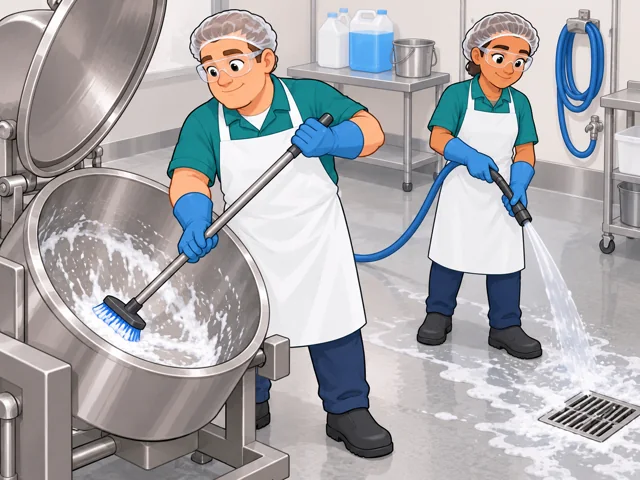
5Wearing washdown protection, the operator scrubs an emptied kettle while a coworker washes the surrounding production floor toward a drain.

Wash and sanitize the equipment

You wash and sanitize the cooking equipment and the production area around it as part of your shift.

Quick facts

Preparation

High school + job training

United States · 2025

Pay

$41,590/year

United States · 2025

Outlook

Little overall change

United States · 2025–2035

Quick orientation

Preparation, pay & outlook

Preparation

High school + job training

Typical preparation is a high school diploma or equivalent, followed by training at work.

Geography
United States
Period
2025

Pay

$41,590/year

National median for food cooking machine operators and tenders, equivalent to about $20.00 an hour.

Geography
United States
Period
2025

Outlook

Little overall change

Employment is projected to fall 0.3% from 2025 to 2035, with about 3,700 openings annually.

Geography
United States
Period
2025–2035

Fit, tradeoffs & changing tools

Things to weigh

  • Fryer areas can be hot, humid, and wet underfoot; monitoring equipment keeps you standing and walking.
  • Some kettle shifts start before dawn, and overtime can change your finishing time.

Where AI may help

Some industrial fryers store recipe settings and control temperature, conveyor speed, and oil level. Screens bring those controls together.

What people still lead

You still inspect the product and respond when the line stops behaving normally.

What we can’t predict yet

The uncertain part is how much checking and cleanup future equipment will take over, and how much of your shift will move toward monitoring several machines.

Pay in context

Earnings

The national median is a useful reference point when comparing hourly offers.

The middle and the spread

In 2025, the median was $41,590 a year, or $20.00 an hour. The lowest-paid 10% earned $31,680 or less; the highest-paid 10% earned $54,410 or more. These are wage percentiles, not starting and experienced pay grades.

Geography
United States
Period
2025
Pay basis
National annual and hourly wages for food cooking machine operators and tenders

Compare the plant and the role

Advertised hourly pay includes $18–$19 for kettle production in Union City, California, and $27.30 for potato frying in Boardman, Oregon. These are individual plant rates, not workplace averages. Location, experience, and responsibilities affect the comparison.

Geography
Union City, California; Boardman, Oregon
Period
Postings accessed 2026-10-04
Pay basis
Advertised hourly base range or rate for specific positions

Openings despite flat employment

For 2025–2035, about 3,700 openings are projected each year even though total employment is expected to edge down 0.3%. Openings include replacing people who leave the occupation.

Geography
United States
Period
2025–2035
Pay basis
Employment projection; annual average openings, not current vacancies

Getting started

Enter through employer training

What the route involves
With a high school diploma or equivalent, seek beginner operator roles and learn the equipment with an experienced worker.
What it can lead to
Training builds competence on the plant's cooking process; prior related work experience is not the national entry norm.

Bring manufacturing experience

What the route involves
Build factory experience before applying to roles that require it.
What it can lead to
Some fryer roles accept a high school diploma or equivalent plus 3–6 months of manufacturing experience.

A college degree is not the typical entry requirement. Employers differ in whether they hire beginners or expect factory experience.

After entry

Career paths

This starts where the entry routes leave off: early work, growing capability, and advancement or specialization.

  1. Get consistent

    Learn one cooker's setup and keep accurate batch records.

  2. Cover more equipment

    Learn additional fryers so you can cover another operator's station.

  3. Move toward cook lead

    Build the troubleshooting and teaching skills needed to train operators, coordinate the production schedule, and help resolve line problems. Lead roles add responsibility for other people's work.

Where you can work

Soup and sauce plants

Kettle work revolves around batches. You check recording equipment and strainers, with quality staff and maintenance workers handling issues alongside you.

  • Indoors
  • Shift work
  • Safety-sensitive

Potato-processing plants

A connected line moves potatoes through blanching, drying, and frying. You watch product flow across machines and check the frying oil.

  • Indoors
  • Physical demands
  • Safety-sensitive

Try it

See whether the job clicks before you commit to the path.

Make a pretend cooking log with a target temperature and six readings, including one outside the target. Mark the odd reading and write a clear message to the shift lead. Notice whether careful checking and explaining a problem appeal to you.

Stay safe: Keep this on paper; invented temperatures are not food-safety instructions.

Explore more careers

Sources

  1. O*NET OnLine. Food Cooking Machine Operators and Tenders. Accessed 2026-10-04.
  2. O*NET OnLine / U.S. Bureau of Labor Statistics. Food Cooking Machine Operators and Tenders: national 2025 wage rows. Accessed 2026-10-04.
  3. U.S. Bureau of Labor Statistics. Occupational projections and worker characteristics, 2025–2035. Accessed 2026-10-04.
  4. Kettle Cuisine. Kettle Operator — Union City, California. Accessed 2026-10-04.
  5. Lamb Weston. Operator Fryer — Boardman, Oregon, Req-271780. Accessed 2026-10-04.
  6. JBT. ALCO Fryer PRO & ECO Series. Accessed 2026-10-04.
  7. Kettle Cuisine. Cook Lead — Everett, Washington. Accessed 2026-10-04.

Your message goes to the Great Jobs team. How we use your information