
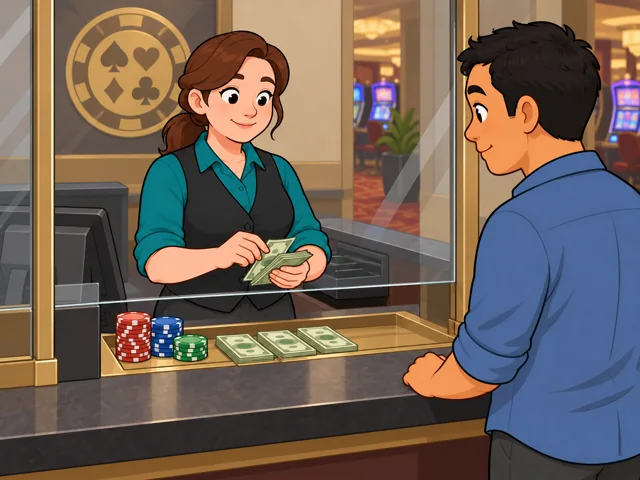
Pay out chips and tickets
Confirm what a customer's chips or gaming ticket are worth, then count out and pay exactly that much.
Career profile
Gambling cashiers trade chips and tickets for cash, tracking each exchange so nothing goes missing.
Picture serving customers at a service window while keeping your cash drawer even. The work may suit people who enjoy set steps and accurate figures.

Confirm what a customer's chips or gaming ticket are worth, then count out and pay exactly that much.

In jobs that cover check cashing, confirm the customer's identification first, then record the deal on a computer.

Check your cash against the transaction log, and if they differ, recount and bring in a lead cashier.

At certain booths, you count a change person's starting money so their shift begins with the right amount.
United States · 2025
United States · 2025
United States · 2025–2035
Quick orientation
Short-term workplace training is typical. Some employers require a high school diploma or equivalent, although the national entry classification specifies no formal credential.
National median for gambling change persons and booth cashiers in 2025—about $17.41 an hour.
Employment is projected to shrink during 2025–2035, with about 3,900 openings a year on average.
Self-service machines can redeem gaming tickets and break large bills, moving some routine exchanges away from the cashier window.
Cashiers still balance funds, maintain transaction records, and help customers with questions.
How much window work shifts to machines depends on what a casino installs and which transactions customers complete themselves.
Pay in context
The national median is $36,220 a year, equivalent to about $17.41 an hour over 2,080 hours. Your actual annual earnings depend on your wage and hours worked.
In 2025, the lowest-paid 10% earned $24,460 or less annually; the highest-paid 10% earned $60,330 or more. These are wage percentiles, not starting and senior pay levels.
About 3,900 openings are projected each year during 2025–2035, even as total employment declines 1.9%. Openings include replacing people who leave the occupation; they are not all new jobs.
A college degree is not the typical entry route. You can seek workplace training directly or build cash-handling experience first.
After entry
This starts where the entry routes leave off: early work, growing capability, and advancement or specialization.
Learn the transaction screens and counting equipment, and keep an accurate balance through your shift.
Build skill in reviewing transaction records and finding why a cash total differs from the recorded balance.
A lead cashier helps coordinate coworkers, teaches procedures, and investigates cash differences. Experience can prepare you to apply for this added responsibility.
Your station is near the machines. Along with customer exchanges, some booths supply starting cash to change staff working the floor.
Some casinos combine cash service with player accounts. You switch between payments, printing rewards cards, and answering promotion questions; overnight shifts are possible.
Try it
Make paper chips with different values and a pretend cash drawer. Ask someone to bring five sets of chips for redemption. Record each exchange, then check whether your remaining cash matches your records. Notice whether you enjoy keeping the count accurate while talking.
Stay safe: Use pretend money at home; no wagering or casino visit is needed.