

Map the family's health history
Ask which relatives had a condition and their age when it began, then chart them to spot patterns.
Career profile
Genetic counselors connect family histories and test results to the health choices people make.
The science is only part of the conversation. Counselors also help people choose what they want to learn and handle their feelings about the result.

Ask which relatives had a condition and their age when it began, then chart them to spot patterns.
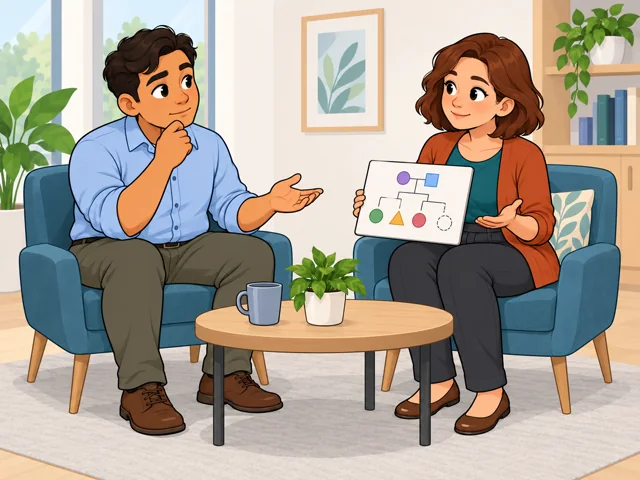
You explain what the test can and can't show, and ask about hopes and fears before they decide.

Tie the lab finding to the person's own history, and explain what it might mean for their relatives.

If someone gets upset, slow down for questions and feelings, and help them find extra support.

Record your assessment and the discussion so the patient and referring clinician can reread it after the visit.
United States
United States · May 2025
United States · 2025–2035
Quick orientation
Genetic counseling graduate study typically takes about two years after a bachelor's degree.
National median for genetic counselors, equivalent to $48.09 an hour.
About 300 openings a year are projected nationally, including replacements for workers who leave.
Software helps draw family diagrams. In cancer genetics, researchers have also tested chatbots that deliver education before testing.
You connect information to a family's situation and respond to the concerns that emerge during the conversation.
How much routine education will move into automated chats remains unsettled; the balance between screen-based preparation and counselor appointments may change.
Pay in context
Use national wages as a reference when comparing an offer's location, responsibilities and benefits.
Genetic counselors had a median wage of $100,040 a year, or $48.09 an hour. Half earned more and half earned less; this is not a starting salary.
The 10th-percentile wage was $78,270 and the 90th-percentile wage was $138,760 a year. These mark the middle 80% of wages, not entry-level and senior salaries.
Employment is projected to grow 10.4% from 2025 to 2035, with about 300 openings annually from growth and worker replacement. National growth does not guarantee a nearby opening.
The usual route is specialized graduate education after college. A separate, restricted pathway applies to counselors already trained internationally.
After entry
This starts where the entry routes leave off: early work, growing capability, and advancement or specialization. This path also has a credential or licensing boundary; see the requirements and limits.
Learn your clinic's visit and follow-up routines, and build a reliable way to organize histories, results and patient summaries.
Build experience in an area such as prenatal or cancer genetics, becoming more fluent in its testing choices and patient questions.
Take on teaching students or clinicians, or help improve how a genetic counseling service handles care.
You work with children and parents alongside doctors and nurses. A child's result can bring questions about siblings and other relatives into the same conversation.
In consultative roles, you help clinicians choose tests and understand results, working with laboratory genetics specialists. Your audience includes the professionals caring for the patient.
Try it
Invent a three-generation family and draw a health-history diagram with a few fictional diagnoses and ages. Explain to a friend what you would want to ask next and what the diagram cannot tell you. Notice whether you enjoy both organizing the details and explaining uncertainty.
Stay safe: Use fictional information; do not estimate a real person's genetic risk.