
Career profile

High School Teacher

High school teachers teach one subject, watching students and adjusting until more can apply it.

Behind each class you lead sit lesson plans, feedback on assignments, records, talks with parents and guardians, and choices about what each student needs next.

A high school teacher leads a classroom discussion with students.

A day in the life

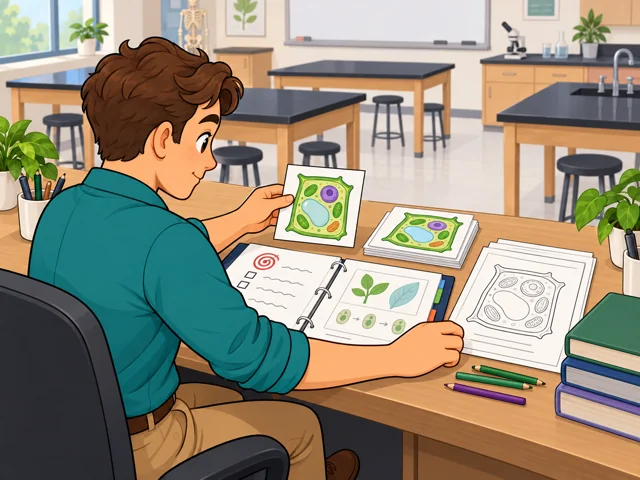
1A teacher plans a science lesson by arranging cell illustrations and activity sheets beside an open course binder.

Set a goal for the lesson

Choose one clear goal, then gather examples, tasks and handouts that fit the unit and the curriculum.
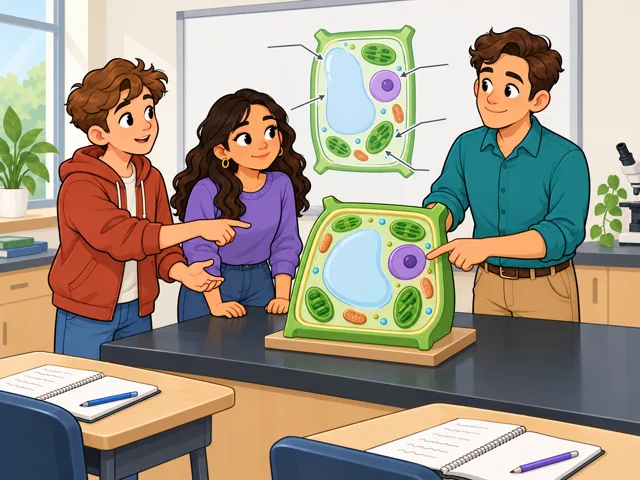
2A science teacher points to a cell model as one teenage student responds and another studies the diagram.

Explain, question and demonstrate

Explain an idea, ask questions, lead a discussion or demonstrate, and coach students through tough parts.
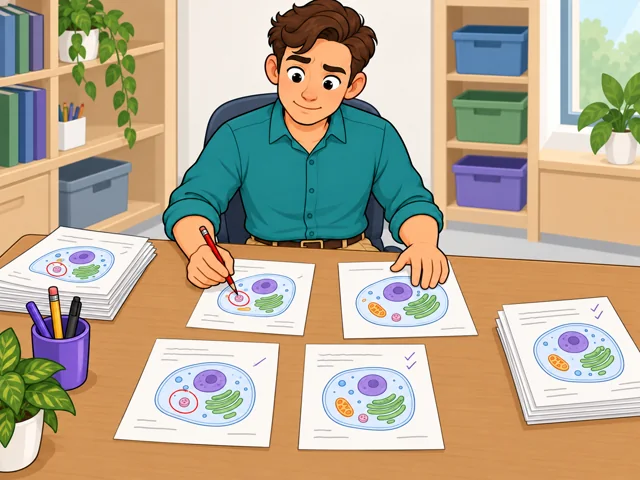
3A teacher compares student cell diagrams and circles a repeated error to identify material that needs another explanation.

Grade work and spot gaps

Sort through homework, tests, questions and behavior to see where students are strong, lost or need another method.

4A teacher adapts a science explanation using movable cell pieces as two teenage students work through the concept.

Change course mid-lesson

When students differ in skill, interest or learning needs, change the explanation, task, pace or support right away.
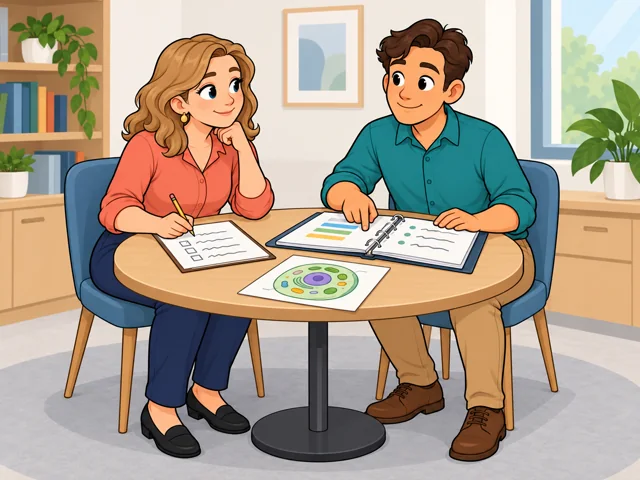
5A teacher and a female colleague review student work and progress records, agreeing on follow-up classroom support.

Keep records and confer with colleagues

You keep records, set and enforce class rules, supervise students and discuss progress with colleagues and parents.

Quick facts

Preparation

Bachelor’s degree

United States · 2026

Pay

$72,040

United States · May 2025

Outlook

0% growth

United States · 2025–2035

Quick orientation

Preparation, pay & outlook

Preparation

Bachelor’s degree

This is the typical entry-level education. Public-school teachers also need a state-issued certification or license, with requirements that vary by state and teaching subject.

Geography
United States
Period
2026

Pay

$72,040

National median annual wage for secondary school teachers, except special and career/technical education—not a starting-salary estimate.

Geography
United States
Period
May 2025

Outlook

0% growth

Employment is projected to show little or no change. About 63,500 openings a year are projected on average, mostly because workers leave the occupation or labor force.

Geography
United States
Period
2025–2035

Fit, tradeoffs & changing tools

Things to weigh

  • The school day does not contain the whole workload; grading, lesson preparation, meetings, clubs, and family communication can extend into evenings or weekends.
  • You may work with large classes, limited materials, distracting noise, conflict, or students who are discouraged or disengaged.

Where AI may help

AI and other software may help create draft materials, support assessment, organize records, share assignments, and handle routine communication.

What people still lead

Teachers still choose learning goals, interpret student responses, adapt instruction, manage the room, build trust, and make consequential decisions.

What we can’t predict yet

Tool capabilities and school rules on safety, privacy, equity, and acceptable use are changing. What is permitted will depend on local policy.

Pay in context

Earnings

National medians provide broad context. Actual pay depends on the employer and its placement rules, so compare the salary schedule attached to a specific job.

National median

The median was $72,040: half of workers in the measured occupation earned more and half earned less. Hourly pay is not reported for this title.

Geography
United States
Period
May 2025
Pay basis
Median annual wage for employees classified as secondary school teachers, except special and career/technical education

The national spread

In May 2025, the 10th-percentile annual wage was $48,780 and the 90th-percentile wage was $107,600. These are wage percentiles, not starting and senior salaries.

Geography
United States
Period
May 2025
Pay basis
National annual wage percentiles

School sector

The median was $74,190 in local public elementary and secondary schools and $61,810 in private elementary and secondary schools.

Geography
United States
Period
May 2025
Pay basis
Median annual wage by employing industry for the measured occupation

How one district sets pay

Fairfax County Public Schools’ FY27 standard 195-day scale uses years of experience for initial step placement and separate pay columns for BA, additional-credit, master’s, and PhD levels. Its FY27 budget includes a step increase for eligible employees.

Geography
Fairfax County, Virginia
Period
July 2026–June 2027
Pay basis
Employer salary schedule for standard 195-day teachers; one district example, not a national rule or guaranteed future progression

Getting started

Traditional public-school preparation

What the route involves
Complete a bachelor’s degree and the teacher-preparation, student-teaching, assessment, and background-check steps required by your state.
What it can lead to
Eligibility to apply for the state credential covering the relevant secondary grade level and subject.
What to check
Subject preparation, tests, grade authorization, and later education requirements vary by state.

Alternative certification

What the route involves
After earning a bachelor’s degree, enter a state alternative-certification program; some programs let candidates teach under an experienced teacher’s supervision while completing preparation.
What it can lead to
Completion can lead to full state certification through that alternative route.
What to check
Admission rules, available subjects, coursework, and when teaching may begin differ by state and program.

Private-school route

What the route involves
Build strong subject preparation; private schools typically seek a bachelor’s degree and a major in the subject taught.
What it can lead to
You can pursue private-school teaching roles that typically do not require a state teaching license.
What to check
Private schools set their own hiring standards, so the lack of a typical state-license requirement does not guarantee eligibility.

Public-school teaching is state-regulated, so there is no single national checklist. These are the main routes, with the local rules left visible.

After entry

Career paths

This starts where the entry routes leave off: early work, growing capability, and advancement or specialization.

  1. Get established

    Learn the school’s curriculum, routines, student-support systems, and any license-renewal or post-certification requirements.

  2. Develop your teaching

    Use student work, observation, and conversations with families and colleagues to refine explanations, activities, pacing, and support.

  3. Lead or specialize

    Experienced teachers may mentor new teachers or become lead teachers, taking more responsibility for colleagues and programs.

    • With additional education or certification, explore school counseling, librarianship, instructional coordination, or administration.

Where you can work

Local public schools

This setting employed 81% of high school teachers in 2025. In a 2020–21 national survey, departmentalized public secondary or high school classes averaged 21 students.

  • Indoors

Private schools

This setting employed 17% of high school teachers in 2025. In the same survey, departmentalized private secondary or high school classes averaged 16 students; individual schools may differ sharply.

  • Indoors

Try it

See whether the job clicks before you commit to the path.

Choose one concept you know well and make a 10-minute mini-lesson with one objective, two examples, two questions, and one likely wrong answer. Teach it to a friend, ask them to explain it back, then revise the part that did not land. Notice whether explaining, observing, and adapting gives you energy.

Explore more careers

Sources

  1. U.S. Bureau of Labor Statistics. High School Teachers. Accessed 2026-09-16.
  2. O*NET OnLine. Secondary School Teachers, Except Special and Career/Technical Education. Accessed 2026-09-16.
  3. Institute of Education Sciences. How Has Artificial Intelligence Been Used in Education?. Accessed 2026-09-16.
  4. U.S. Department of Education, Office of Educational Technology. Empowering Education Leaders: A Toolkit for Safe, Ethical, and Equitable AI Integration. Accessed 2026-09-16.
  5. Fairfax County Public Schools. Salary Scales FY27. Accessed 2026-09-16.
  6. National Center for Education Statistics. Characteristics of 2020–21 Public and Private K–12 School Teachers in the United States: Results From the National Teacher and Principal Survey. Accessed 2026-09-16.

Your message goes to the Great Jobs team. How we use your information