
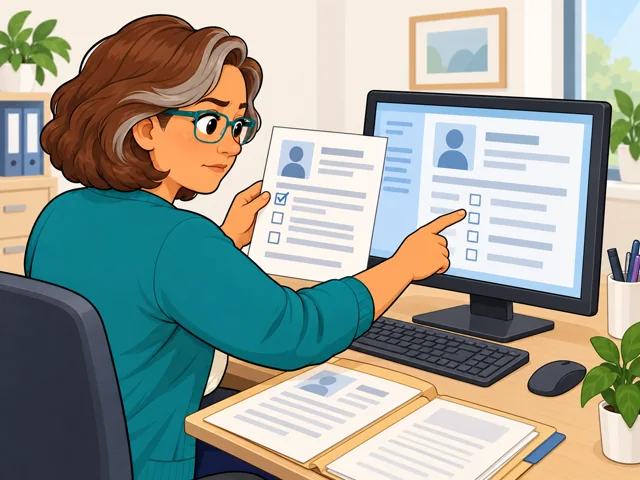
Keep a personnel file correct
Check a staff member's change form against their personnel file, and if they differ, find which is wrong.
Career profile
Human resources assistants keep staff files accurate and help people with hiring and job forms.
Spotting a missing form, updating a worker's file or telling a job applicant what happens next could all land on your desk.

Check a staff member's change form against their personnel file, and if they differ, find which is wrong.

Explain to a worker how to enroll in benefits, then handle the forms so their choices get recorded.

Assemble a new hire's packet, upload documents and set up a meeting room before they arrive.

In some roles, you screen job applications and send the ones meeting the listed requirements to hiring staff.
United States
United States · May 2025
United States · 2025–2035
Quick orientation
Some employers accept high-school-level education and administrative experience.
National median wages for human resources assistants, excluding payroll and timekeeping; $24.33 an hour.
About 7,900 openings a year are projected nationally despite shrinking employment.
Employee self-service systems can move routine submissions online, reducing clerical handling.
You still help people complete paperwork and sort out questions that do not fit the usual process.
How much routine processing remains will depend on how far employers automate it and how many exceptions still need attention.
Pay in context
The national figures describe the full human resources assistant occupation, excluding payroll and timekeeping. They are not starting-pay offers.
Median wages were $50,610 a year, equivalent to $24.33 an hour: half earned more and half earned less.
The lowest-paid 10% earned $37,340 or less; the highest-paid 10% earned $68,280 or more. These are wage percentiles, not beginner and experienced-worker rates.
Employment is projected to fall 6.2% over 2025–2035, with about 7,900 openings annually. Openings can exist even when the occupation is getting smaller.
You support the human resources department and bring complex problems to the appropriate specialist or manager. Entry requirements vary by employer.
After entry
This starts where the entry routes leave off: early work, growing capability, and advancement or specialization.
Get reliable at entering changes, checking files, and protecting employee information.
Build confidence processing personnel changes and answering routine policy questions.
With a bachelor’s degree, some assistants become human resources specialists, taking on broader recruiting, benefits, or employee-relations responsibilities.
Transactions can involve civil-service rules and union agreements. You may need to check which provisions apply before processing a change.
Some roles combine an employee-facing desk with filing staff licenses and certifications. Expect questions from hospital staff while keeping records organized.
Try it
Make a spreadsheet for five fictional new hires with columns for start date, returned forms, and missing information. Leave a few gaps, then write a short follow-up message for each. Notice whether you enjoy both checking records and helping someone finish a process.
Stay safe: Use invented names and details, not real employee records.