
Career profile

Industrial Ecologist

Industrial ecologists track materials and energy through plants, seeking cuts in waste and environmental damage.

Reusing a plant's leftovers looks like an obvious win, but you check whether the extra treatment it needs still leaves it the better choice.
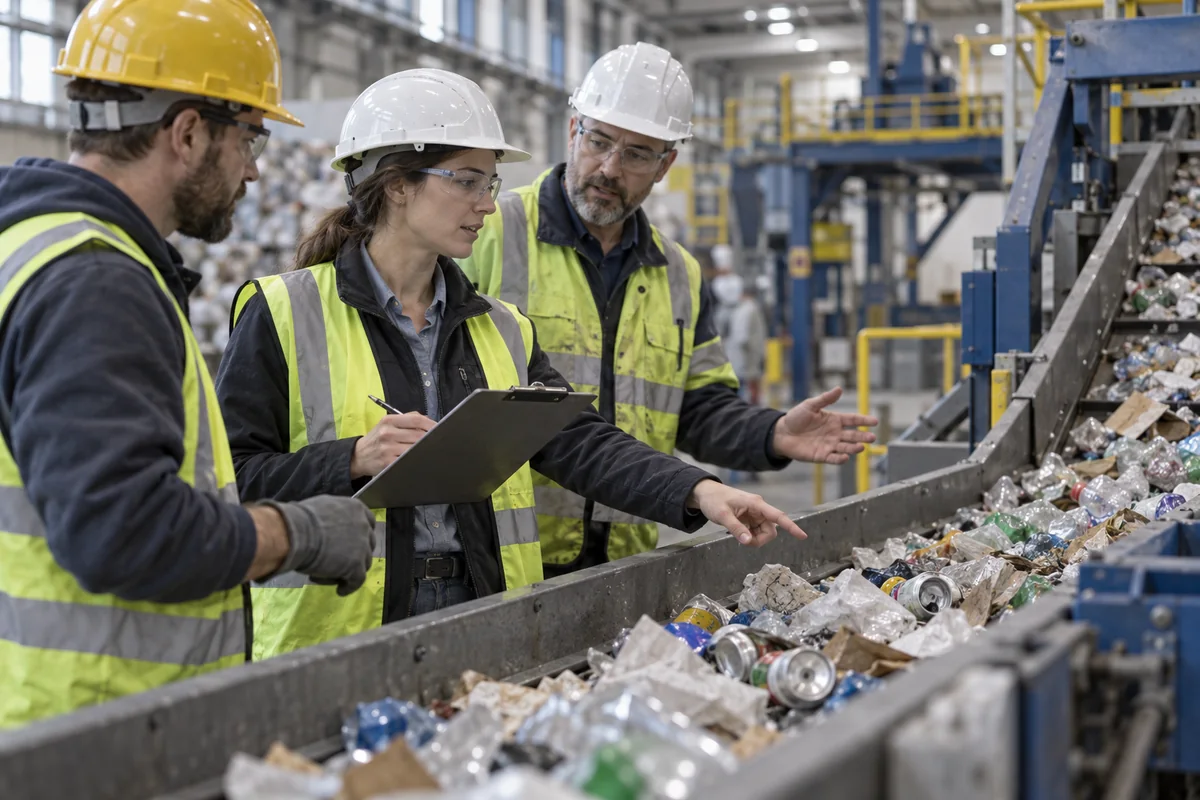
Industrial ecologist reviews material flows at a recovery facility.

A day in the life

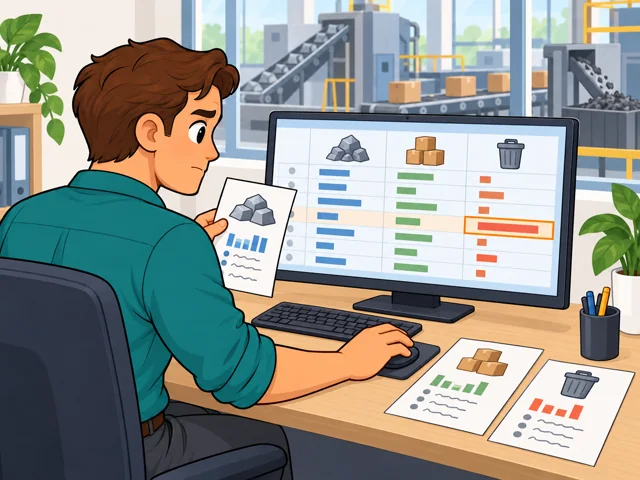
1An industrial ecologist compares material records with a spreadsheet to investigate an imbalance between inputs, products, and waste.

Tally one process's inputs and outputs

Build a spreadsheet of one process's inputs, products and discards, then dig in when it does not balance.
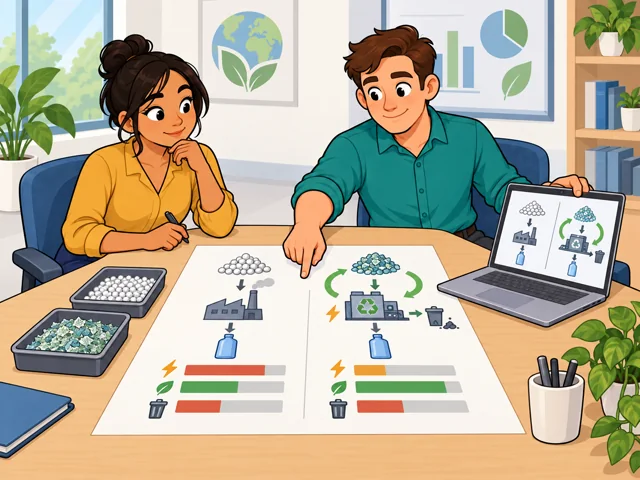
2The ecologist and a colleague compare new and recycled material scenarios, examining material savings alongside reprocessing energy and waste.

Model swapping virgin for recycled feedstock

You weigh the material saved against the energy and scrap created when the recycled stock gets treated again.
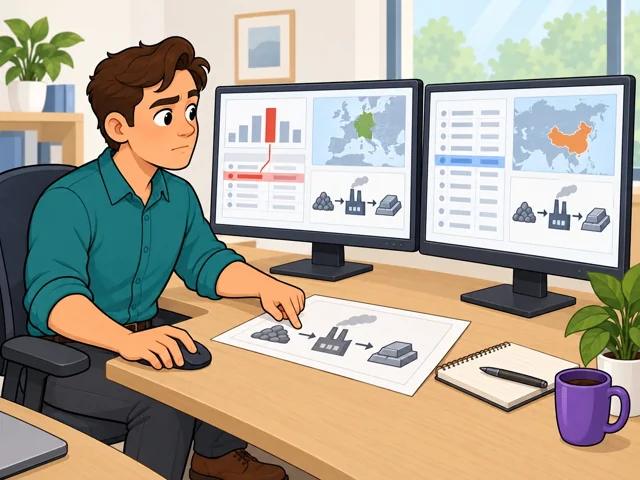
3The ecologist checks an emissions estimate against its source dataset, comparing the region and production method with the process being modeled.

Trace an emissions figure's source

If the data covers a different country or production route, find a closer match or note the weakness.
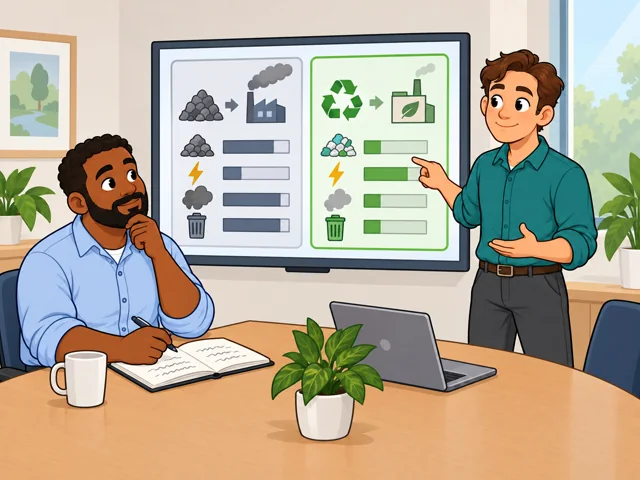
4The ecologist explains a recommended production change to a manager, highlighting its environmental benefit and a remaining tradeoff.

Walk a production manager through results

Point out which option does less environmental harm and explain any tradeoffs that come with it.

Quick facts

Preparation

Often a master's degree

United States

Pay

Not displayed

A separate national median for industrial ecologists is unavailable.

Outlook

Not displayed

A separate national growth forecast for this specialty is unavailable.

Quick orientation

Preparation, pay & outlook

Preparation

Often a master's degree

Some roles accept bachelor's preparation; advanced study is common.

Geography
United States
Period
Not applicable

Pay

Not displayed

A separate national median for industrial ecologists is unavailable.

Geography
United States
Period
2025

Outlook

Not displayed

A separate national growth forecast for this specialty is unavailable.

Geography
United States
Period
2025–2035

Fit, tradeoffs & changing tools

Things to weigh

  • Expect substantial computer work and sitting, even when your subject is a physical factory or material.
  • Missing data can leave you with a qualified recommendation when people want a definite answer.

Where AI may help

Shared datasets can reduce model-building work. For electricity studies, ElectricityLCI assembles regional models linking power generation with fuel supply and distribution.

What people still lead

You decide whether the data fit the product, location, and question, then explain how those choices affect the result.

What we can’t predict yet

How far data preparation can be automated depends partly on whether supplier records become consistent and detailed enough for the comparison.

Pay in context

Earnings

Use these U.S. figures as a broad benchmark: they cover environmental scientists and specialists, including health, rather than industrial ecologists alone.

Median and spread

In this broader group, median pay was $82,220 a year, equivalent to $39.53 an hour. The annual 10th–90th percentile range was $52,520–$140,010. These are points in the wage distribution, not starting and experienced salaries.

Geography
United States
Period
May 2025
Pay basis
Employee wages; annual median, hourly equivalent, and annual wage percentiles.

Pay differs by workplace

For the same broader group, annual medians were $116,110 in federal government excluding the postal service, $83,500 in engineering services, and $79,320 in management, scientific, and technical consulting.

Geography
United States
Period
May 2025
Pay basis
Industry median annual employee wages, not industrial-ecologist-specific salaries.

Prospects across the broader field

Environmental scientists and specialists are projected to grow 6%, with about 7,300 openings a year. Openings include replacements for people leaving the occupation, not just new jobs. These are broader-field projections, not a forecast for this specialty.

Geography
United States
Period
2025–2035
Pay basis
Employment growth and average annual openings; not a pay measure.

Getting started

Build from a bachelor's degree

What the route involves
Study environmental science or engineering, and seek coursework or projects that quantify material use and environmental effects.
What it can lead to
You can pursue roles that accept bachelor's-level preparation.
What to check
A bachelor's degree does not meet every role's requirements; many positions call for graduate preparation.

Add focused graduate study

Yale's Master of Environmental Management is a two-year program.
What the route involves
Study industrial ecology within a relevant master's program. Yale's Master of Environmental Management specialization includes systems analysis and life cycle assessment: comparing environmental effects across a product's life.
What it can lead to
Develop methods for technical environmental work in companies, consultancies, research organizations, or government.

Build quantitative science skills and learn to assess whole production systems. The degree and experience required depend on the role.

After entry

Career paths

This starts where the entry routes leave off: early work, growing capability, and advancement or specialization.

  1. Get established

    Take responsibility for a small dataset. Make its sources and assumptions clear enough for a colleague to check.

  2. Build a complete comparison

    Connect process inputs, energy use, and outputs in a model that compares manufacturing alternatives.

  3. Specialize or review others' work

    With experience, move into technical review of product assessments.

    • Develop research expertise in areas such as fiber recycling or emerging materials.

Where you can work

Product verification organizations

You examine clients' assessments and supporting records, resolve findings, and deliver review reports to deadlines. Clear written explanations are central.

  • Office
  • Indoors

University research centers

Work alongside researchers, students, and industry partners on questions such as recovering battery materials or evaluating new electronics. Projects can involve developing methods as well as applying them.

  • Office
  • Indoors

Manufacturing research teams

Work with engineers comparing process changes. Your models connect equipment and feedstock choices with energy use, waste, and economic performance.

  • Office
  • Indoors

Try it

See whether the job clicks before you commit to the path.

Choose a drink container and draw its journey from raw material to disposal or reuse. Mark where material and energy enter. Then propose one change and list the missing facts you would need to judge it. Notice whether tracing those connections makes you curious.

Explore more careers

Sources

  1. O*NET OnLine. Industrial Ecologists — 19-2041.03. Accessed 2026-10-06.
  2. O*NET OnLine / U.S. Bureau of Labor Statistics. National Wages: Industrial Ecologists. Accessed 2026-10-06.
  3. U.S. Bureau of Labor Statistics. Occupational projections and worker characteristics. Accessed 2026-10-06.
  4. U.S. Bureau of Labor Statistics. Environmental Scientists and Specialists. Accessed 2026-10-06.
  5. SCS Global Services. Technical Specialist II, Product Climate Verification. Accessed 2026-10-06.
  6. Yale School of the Environment. Industrial Ecology and Green Chemistry Specialization. Accessed 2026-10-06.
  7. Yale University. Admissions: Master's Degree Programs. Accessed 2026-10-06.
  8. Yale Center for Industrial Ecology. Center for Industrial Ecology: Research and Projects. Accessed 2026-10-06.
  9. U.S. Environmental Protection Agency. Guidance on Data Quality Assessment for Life Cycle Inventory Data. Accessed 2026-10-06.
  10. U.S. Environmental Protection Agency. Researchers Develop Regional Lifecycle Assessment Tool for Electricity Use. Accessed 2026-10-06.
  11. U.S. Environmental Protection Agency. Assessing Chemical Process Sustainability with GREENSCOPE. Accessed 2026-10-06.

Your message goes to the Great Jobs team. How we use your information