
Career profile

IT Support Specialist

Computer support specialists diagnose and repair the computers, programs, and devices people need for work.

Precise questions, one fix per try, and an answer explained without tech slang: if that sounds satisfying, this role puts it to use.
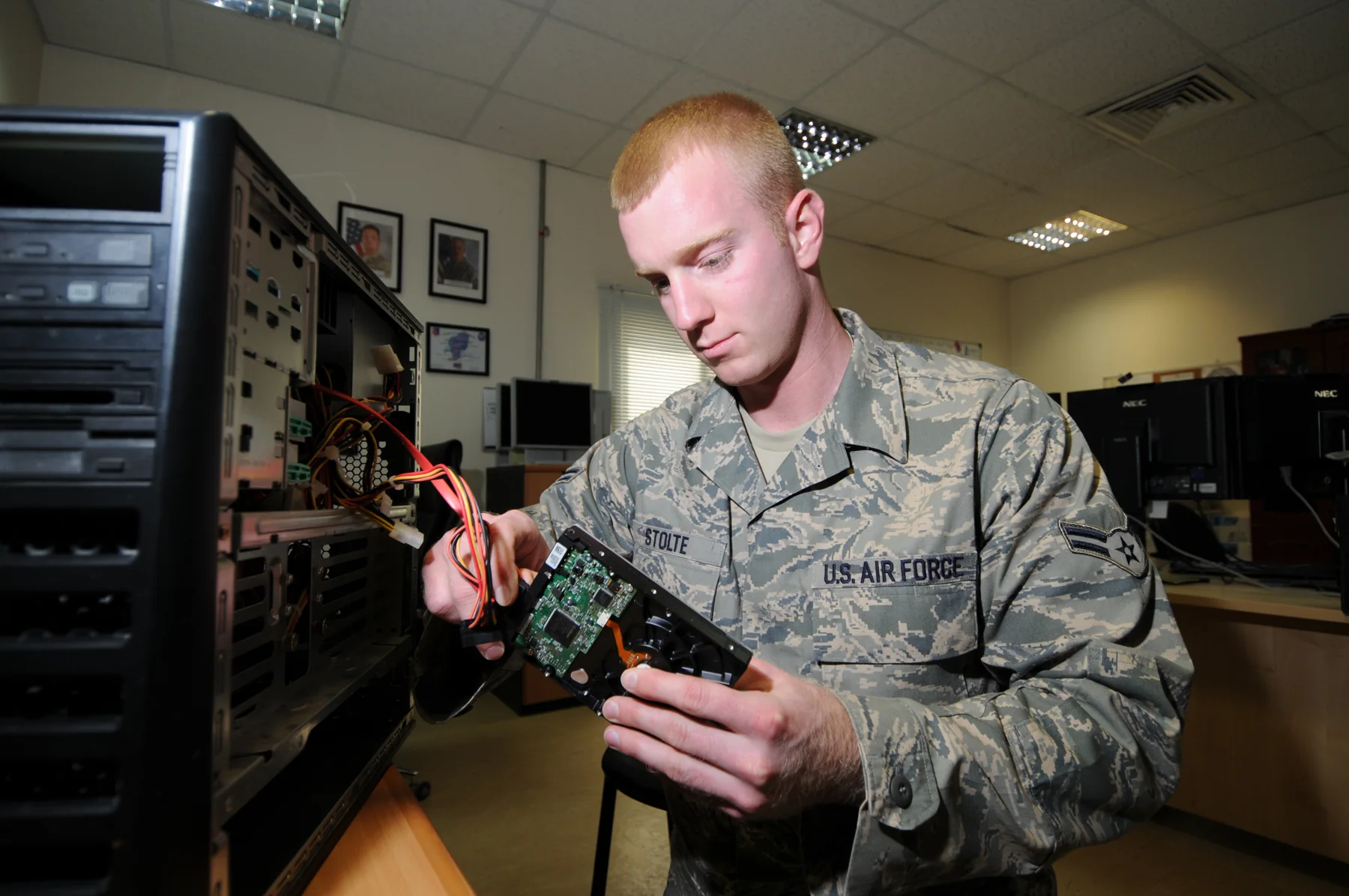
A help desk technician examines computer hardware at a workbench.
Tech. Sgt. Jason Edwards / Wikimedia Commons, Public domain

A day in the life

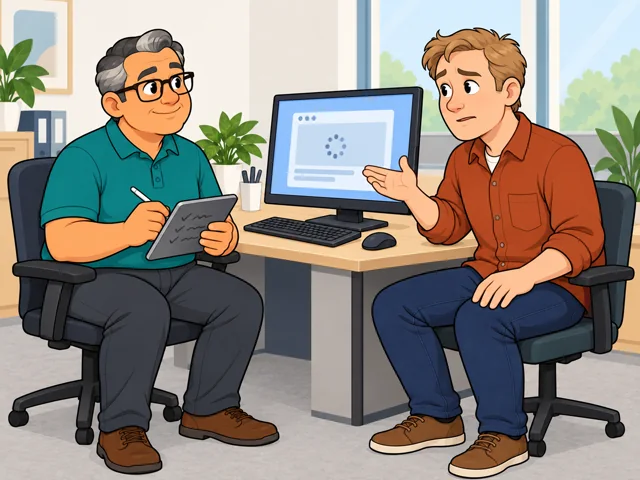
1An IT support specialist listens to an office user pointing at a computer problem and records the symptoms on a tablet.

Get the story behind the problem

Hear how the trouble began, ask about recent changes and what's on screen, then note symptoms plainly.
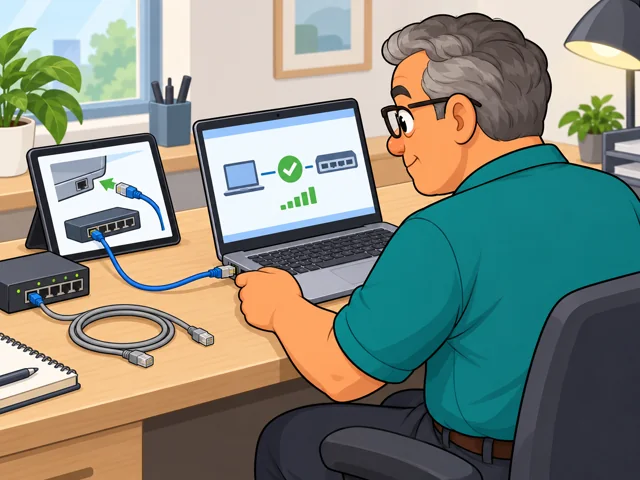
2The specialist tests a suspected network cable fault by changing the cable and checking a laptop diagnostic against technical instructions.

Test one likely cause

Check the manual, run a diagnostic, change one thing, and see if the result supports your suspicion.
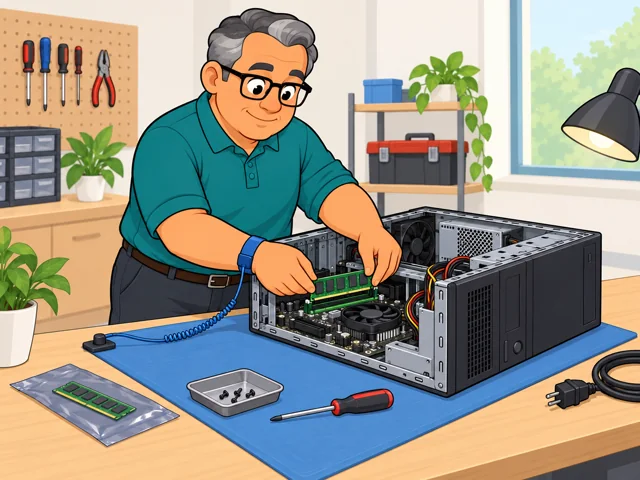
3The specialist carefully installs a replacement memory module in an unplugged desktop computer at a repair bench.

Install software and swap parts

Connect the equipment, load the operating system or an app, swap a small part, and confirm it runs.

4The specialist guides an office user through a display setting while the user controls the mouse and checks the result.

Coach the user step by step

Give single instructions, watch or listen to each result, and teach the user new hardware and programs.

5The specialist reviews a troubleshooting record with another technician and hands over an unresolved laptop for further investigation.

Close the case or hand off

Log the problem, checks, and fix, and hand serious failures to the vendor or a more senior tech.

Quick facts

Preparation

Some college, often no degree

United States

Pay

$61,860 median annual wage

United States · May 2025

Outlook

3% projected decline

United States · 2025-2035

Quick orientation

Preparation, pay & outlook

Preparation

Some college, often no degree

User-support jobs typically require some college courses, but some candidates qualify with a high school diploma and relevant IT certifications. Employers set their own requirements.

Geography
United States
Period
Not applicable

Pay

$61,860 median annual wage

This was the national median for computer user support specialists, not an entry wage or a promised offer.

Geography
United States
Period
May 2025

Outlook

3% projected decline

BLS projects employment of computer user support specialists to decline 3% as automated tools handle more routine troubleshooting.

Geography
United States
Period
2025-2035

Fit, tradeoffs & changing tools

Things to weigh

  • Users may arrive frustrated, so solving the technical problem is only part of the interaction.
  • Some support operations cover nights or weekends, even though many jobs follow regular full-time schedules.
  • Some roles allow telework; others require you on-site with the device or traveling to a client.

Where AI may help

Automated tools such as chatbots can answer or troubleshoot some routine requests and leave specialists with a smaller set of harder cases.

What people still lead

People still lead when symptoms are unclear, a user needs a careful explanation, or the fix requires judgment or hands-on work.

What we can’t predict yet

Routine requests may shrink while the remaining queue becomes more complex; how far automation takes over depends on the employer's systems and the problems users bring.

Pay in context

Earnings

Use the national median as a midpoint for this occupation, then compare local employers, duties, schedules, and experience expectations.

National midpoint

The median annual wage was $61,860, meaning half of computer user support specialists earned more and half earned less. The median hourly wage was $29.74.

Geography
United States
Period
May 2025
Pay basis
Median annual wage for computer user support specialists

The national spread

In May 2025, the 10th-percentile annual wage was $40,980 and the 90th-percentile wage was $100,540. These are wage percentiles, not starting and senior salaries.

Geography
United States
Period
May 2025
Pay basis
National annual wage percentiles

Industry can change the picture

Among major industries BLS listed, median annual wages were $77,180 in government excluding state and local education and hospitals, and $58,550 in educational services. These are group medians, not entry offers.

Geography
United States
Period
May 2025
Pay basis
Median annual wages by industry for computer user support specialists

Getting started

High school plus a relevant IT certification

What the route involves
Finish high school and build practical support knowledge. One option is CompTIA A+, which covers end-user equipment and software, troubleshooting, networking basics, and customer support.
What it can lead to
This combination may qualify you for some support openings that do not require college.
What to check
A+ is one credential option, not a universal entry requirement; each employer decides whether a certification is useful or required.

College coursework or a degree

What the route involves
Take courses in areas such as networking, server administration, and information security; an associate or bachelor's degree may add broader technical study.
What it can lead to
Relevant courses may qualify you for user-support jobs, while more technical roles and some large software companies may seek a degree.

Registered Apprenticeship

Paid
What the route involves
Work for pay under a mentor while completing structured on-the-job learning and related classroom instruction.
What it can lead to
You build supervised experience and earn a portable completion credential; approved titles include computer support specialist and help desk technician.
What to check
Program titles are approved nationally, but actual openings vary; search current listings and apply directly with the employer or sponsor.

There is no single required school path. Compare employer requirements with the skills and supervised experience each route gives you.

After entry

Career paths

This starts where the entry routes leave off: early work, growing capability, and advancement or specialization.

  1. Get established

    Learn the employer's devices, applications, support records, and escalation rules while handling common requests with experienced teammates.

  2. Build capability

    Take broader cases, test fixes, document outcomes, train users, and keep learning as the workplace changes its tools.

  3. Specialize or lead

    Build the skills for systems administration, information security, or support management.

    • Move toward technical sales if you prefer product conversations to managing a support queue.

Where you can work

An organization's help desk

Support employees or students using the organization's computers and software. Requests may arrive in person, by phone, chat, or email; some roles are remote and others require you on-site.

  • Indoors
  • Office
  • Remote may be possible

A software company's support team

Help business customers use one company's product, such as specialized records software. Product knowledge and clear step-by-step instruction matter.

  • Indoors
  • Office

A consumer help center

Take a queue of household technology questions and guide customers through problems such as restoring a connection or troubleshooting a router. Around-the-clock services may use night or weekend shifts.

  • Indoors
  • Office
  • Shift work

Try it

See whether the job clicks before you commit to the path.

With permission, ask someone to describe one harmless computer annoyance without taking over immediately. Write down their exact symptom, ask three clarifying questions, predict two possible causes, try one reversible change, record the result, and explain what happened in plain language. Notice whether you enjoyed both the conversation and the methodical testing.

Stay safe: Use a non-sensitive device or profile. Do not change passwords or security settings, delete files, install unknown software, or open hardware; stop if the test needs administrator access.

Explore more careers

Sources

  1. U.S. Bureau of Labor Statistics. Computer Support Specialists. Accessed 2026-09-28.
  2. O*NET OnLine. 15-1232.00 — Computer User Support Specialists. Accessed 2026-09-28.
  3. CompTIA. CompTIA A+ 220-1201 V15 Certification Exam Objectives. Accessed 2026-09-28.
  4. U.S. Department of Labor, Apprenticeship.gov. Career Seekers. Accessed 2026-09-28.

Your message goes to the Great Jobs team. How we use your information