
Career profile

Logging Equipment Operator

Logging equipment operators run machines that fell trees and haul logs from the woods.

Small hand moves on the controls shift heavy wood, so this fits anyone who enjoys precise machine work among the trees.
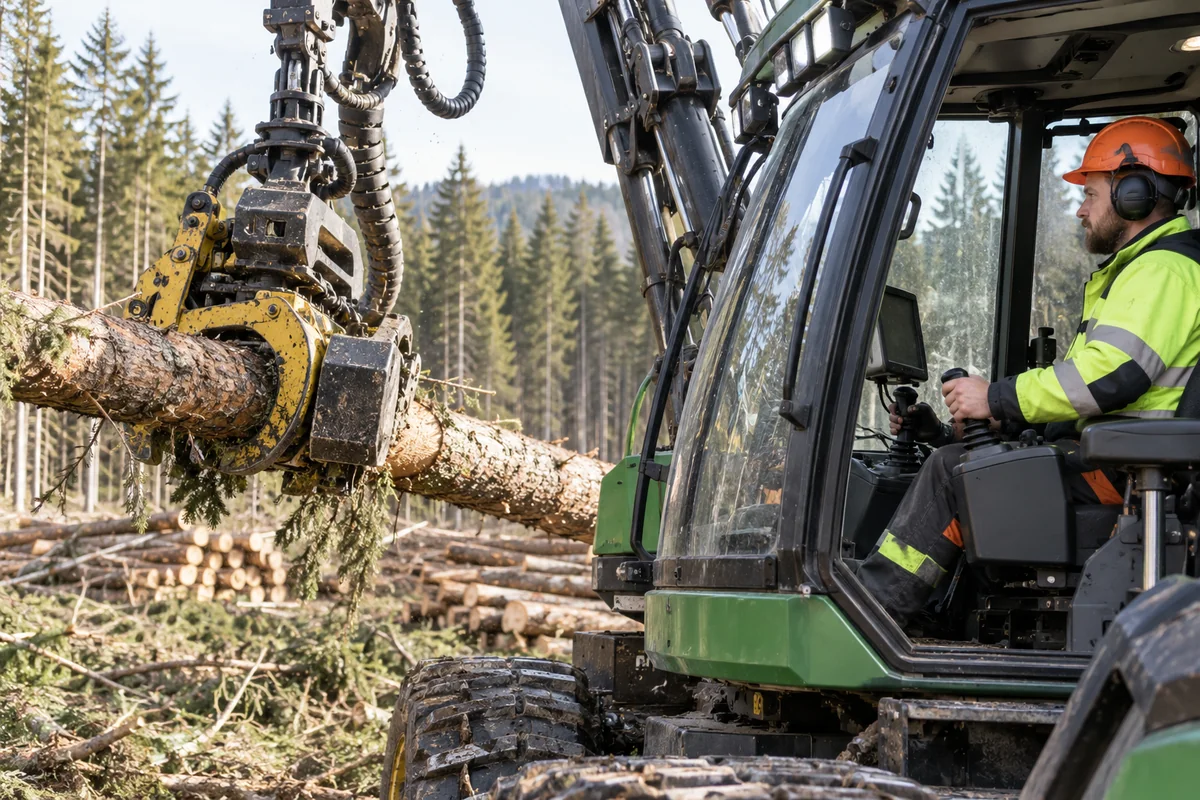
Logging equipment operator controls a forestry harvester handling a log.

A day in the life

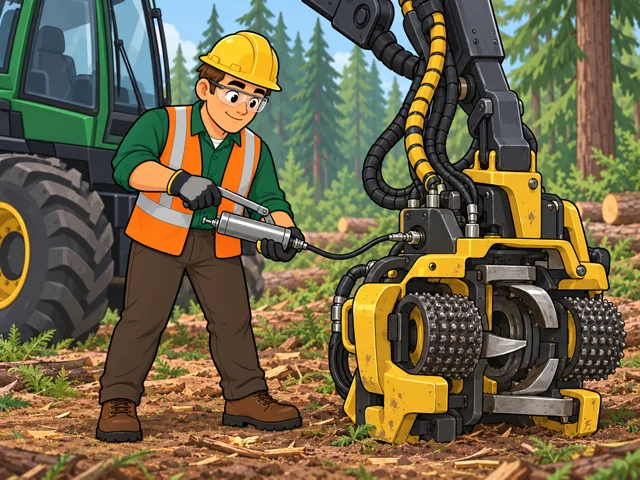
1A logging equipment operator inspects hydraulic hoses and greases a fitting on a parked harvester with its cutting head resting on the ground.

Check the machine before starting

Check the machine for safety hazards and do basic upkeep, all before you start running it.
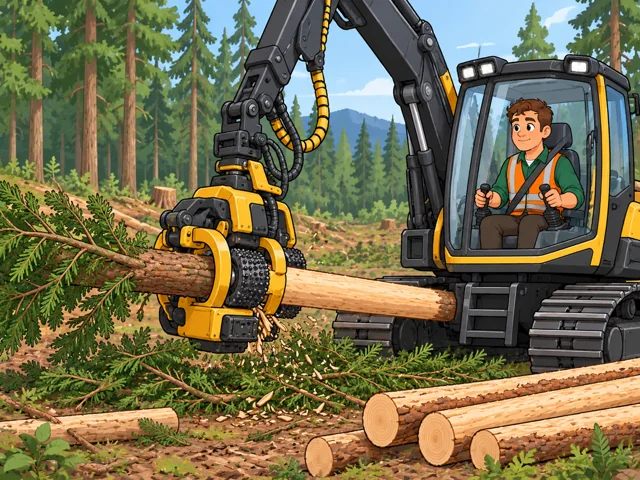
2An operator controls a harvester as its cutting head feeds a felled trunk through delimbing knives, with cut logs and stripped branches nearby.

Drop a tree with the harvester

Steer the harvester's cutting head to drop a tree, strip its limbs and saw the trunk to length.
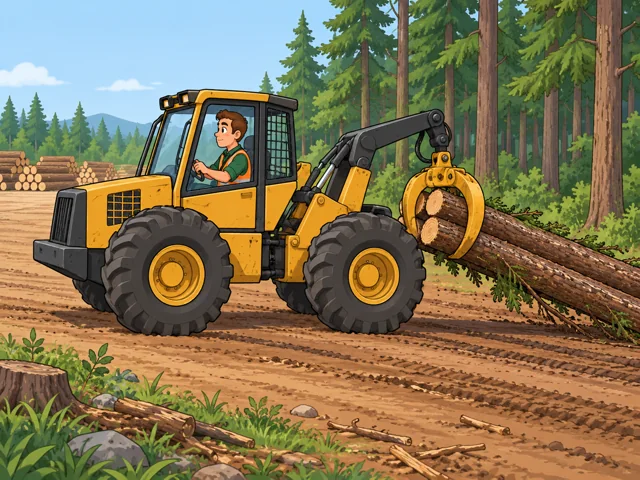
3A skidder operator pulls felled trees along a forest trail, with their butt ends held above the ground by the rear grapple.

Drag trees out with a skidder

Clamp the skidder's grapple on fallen trees and haul them through the woods to the landing.
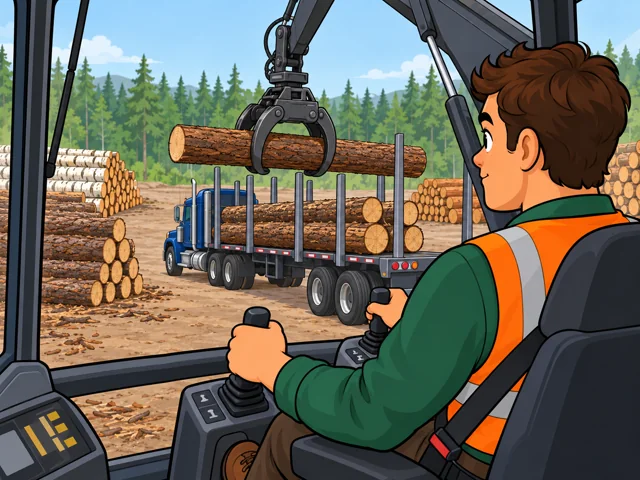
4Viewed over the operator's shoulder, a log loader lifts timber from a sorted stack and positions it between the stakes of a logging truck.

Sort logs and load the truck

Sort timber by species or wood type with a log loader, then lift the logs onto the truck.

Quick facts

Preparation

High school + job training

United States · 2025–2035

Pay

$49,740 median

United States · 2025

Outlook

3.8% projected decline

United States · 2025–2035

Quick orientation

Preparation, pay & outlook

Preparation

High school + job training

A high school diploma or equivalent is typical; you learn machine operation on the job.

Geography
United States
Period
2025–2035

Pay

$49,740 median

National annual median for logging equipment operators; the hourly median is $23.91.

Geography
United States
Period
2025

Outlook

3.8% projected decline

About 3,700 openings per year are projected despite declining total employment.

Geography
United States
Period
2025–2035

Fit, tradeoffs & changing tools

Things to weigh

  • Repeated control movements can strain your shoulders, arms, and wrists, even inside a cab.
  • Early starts, long shifts, and distant sites can shape your day. Some regions have seasonal work.
  • Moving logs and machinery can cause serious injuries; staying alert is part of every shift.

Where AI may help

Some forwarders help coordinate boom movements so you steer the grapple more directly. Digital maps can also share machine locations and harvesting progress.

What people still lead

You still choose where to move the load and respond when terrain, trees, or nearby workers create a hazard.

What we can’t predict yet

How much of a complete loading or travel cycle machines will handle automatically remains uncertain, especially across changing forest conditions.

Pay in context

Earnings

The national median is a useful starting point for comparing offers, not a promised starting wage.

The middle and the spread

In 2025, the median was $49,740 a year, or $23.91 an hour. The 10th and 90th percentile annual wages were $35,170 and $74,300. Those mark the wage distribution, not beginner and experienced rates.

Geography
United States
Period
2025
Pay basis
Annual and hourly employee wages; national median and annual percentiles

Pay in forestry and logging

Operators employed in forestry and logging had a median of $50,840 a year, or $24.44 an hour. This describes that industry’s workers; changing workplaces does not automatically produce that pay.

Geography
United States
Period
2025
Pay basis
Median employee wages for logging equipment operators in NAICS 113

Openings despite a smaller workforce

Employment is projected to fall 3.8% from 2025 to 2035, with about 3,700 openings annually on average. Openings are opportunities to replace departing workers as well as fill any new positions; they are not a count of jobs available today.

Geography
United States
Period
2025–2035
Pay basis
Employment projection, not compensation

Getting started

Learn with a logging employer

What the route involves
Join an employer that trains beginners. Learn machine controls, site hazards, and maintenance with an experienced trainer.
What it can lead to
Once you demonstrate safe performance, you can move beyond close trainee supervision for those duties.
What to check
Federal child labor rules generally prohibit logging employment before age 18.

Take a hands-on logging program

What the route involves
Programs such as Northern Maine Community College’s Mechanized Logging Operations combine classroom learning with operating equipment in a forest.
What it can lead to
You build machine experience and knowledge of harvesting systems to bring to operator applications.
What to check
A hiring employer still needs to verify that your training fits the work and provide any additional training needed.

Employer training is the usual starting point. A practical logging program offers another way to build machine experience before applying.

After entry

Career paths

This starts where the entry routes leave off: early work, growing capability, and advancement or specialization.

  1. Get established

    Make equipment checks and clear crew communication dependable habits.

  2. Build machine knowledge

    Learn to trace operating problems and improve your maintenance skills.

  3. Specialize or add a machine

    Train for another assignment, such as moving from a skidder to a harvester or log loader.

Where you can work

Inside the harvest area

A skidder works between the feller buncher’s piles and the landing. Your workspace moves through the woods with each load.

  • Outdoors
  • Field work
  • Vehicle
  • Safety-sensitive

At a landing or processing yard

Logs arrive where processing machines and loaders work near truck loading. Coordinating movements around other machines and workers becomes a central concern.

  • Outdoors
  • Vehicle
  • Safety-sensitive

Try it

See whether the job clicks before you commit to the path.

Watch a forestry-machine demonstration video. Pause as a grapple picks up a log and sketch where the machine, load, and nearby equipment sit. Notice whether tracking several moving parts holds your interest.

Stay safe: Keep this exercise on screen; it is not practice for operating machinery.

Explore more careers

Sources

  1. O*NET OnLine. Logging Equipment Operators, 45-4022.00. Accessed 2026-10-04.
  2. O*NET OnLine / U.S. Bureau of Labor Statistics. Logging Equipment Operators wages: United States rows. Accessed 2026-10-04.
  3. U.S. Bureau of Labor Statistics. Occupational projections and worker characteristics. Accessed 2026-10-04.
  4. U.S. Bureau of Labor Statistics. Logging Workers. Accessed 2026-10-04.
  5. U.S. Bureau of Labor Statistics. Forestry and Logging: NAICS 113. Accessed 2026-10-04.
  6. John Deere. 1910G Forwarder. Accessed 2026-10-04.
  7. Northern Maine Community College. Mechanized Logging Operations. Accessed 2026-10-04.
  8. Occupational Safety and Health Administration. Required Training and Qualifications for Loggers. Accessed 2026-10-04.
  9. U.S. Department of Labor. Child Labor Rules: Hazardous Occupations. Accessed 2026-10-04.
  10. Occupational Safety and Health Administration. Logging: Machine Operators. Accessed 2026-10-04.
  11. Occupational Safety and Health Administration. Logging: Grapple Skidder. Accessed 2026-10-04.
  12. Occupational Safety and Health Administration. Logging: Processing at the Yard. Accessed 2026-10-04.

Your message goes to the Great Jobs team. How we use your information