
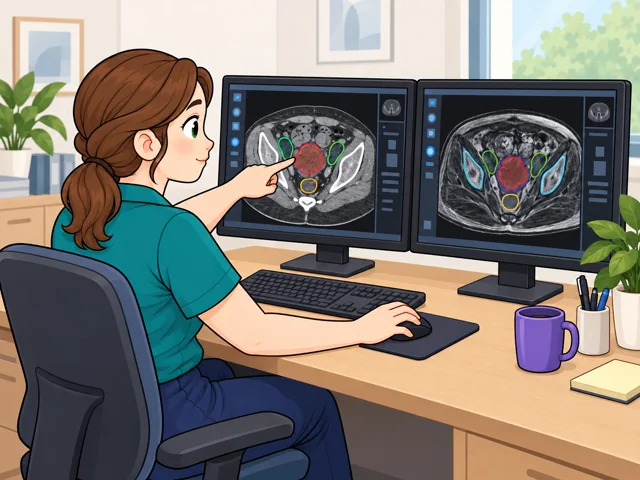
Find the tumor on scans
On CT, MRI or other scans, pick out the tumor and nearby structures your plan must allow for.
Career profile
Dosimetrists use CT, MRI and a prescription to aim radiation at disease, sparing healthy tissue.
Want to use math, physics and anatomy on a team treating cancer patients? This job does it through careful work at a computer.

On CT, MRI or other scans, pick out the tumor and nearby structures your plan must allow for.
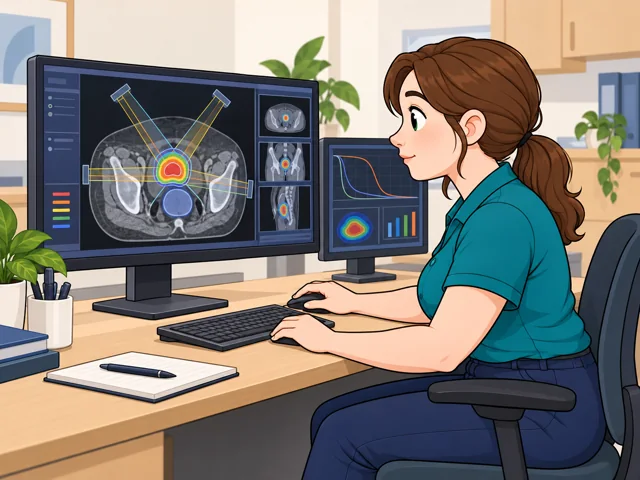
Calculate the dose the doctor prescribed and arrange the beams to treat the target while sparing critical organs.
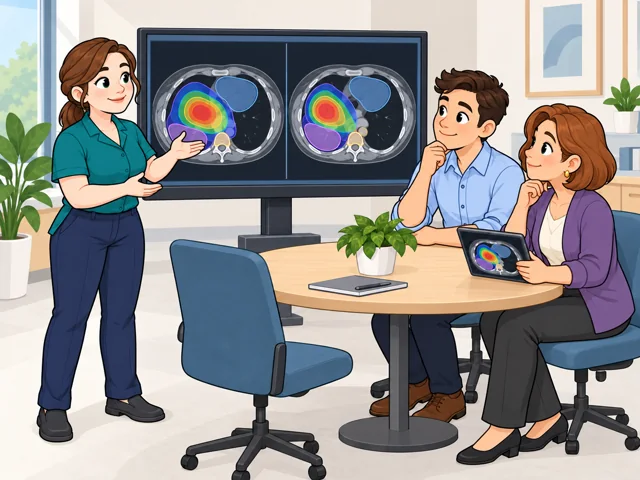
You talk the plan through with the radiation oncologist, medical physicist, radiation therapist and other oncology staff.

Recheck calculations and run quality checks on treatment-planning systems to catch errors before anyone uses a plan.

Record dose information and pass positioning details or reference images to the staff who deliver the approved plan.
United States · 2026
United States · May 2025
United States · 2025–2035
Quick orientation
Typical entry requires a bachelor's degree and an accredited medical dosimetry program with supervised clinical experience.
Median annual wage for U.S. medical dosimetrists.
Projected U.S. employment growth for medical dosimetrists.
AI tools are beginning to draft outlines of tumors, organs, and other anatomy on patient images and help create treatment plans. Systems that update plans when a patient's anatomy changes can also add time-sensitive replanning.
Dosimetrists review computer-generated outlines and dose patterns, correct problems, and work with physicians and physicists to adjust or optimize the plan.
Use differs by clinic and system. Automated outlining needs local testing and upkeep plus checks for each patient, so its effect on workload is not yet uniform.
Pay in context
Individual pay can vary by employer industry; BLS reports different median wages across major employing industries.
The median annual wage was $147,470. That figure describes the middle of the May 2025 wage distribution across the occupation, not what a new graduate should expect. The median hourly wage was $70.90.
In May 2025, the 10th-percentile annual wage was $111,670 and the 90th-percentile wage was $185,450. These are wage percentiles, not starting and senior salaries.
BLS projects employment to rise from about 3,500 jobs in 2025 to about 3,700 in 2035, with roughly 200 openings per year on average. Because these figures cover the entire country, they do not show how many openings will be available near you.
Certified Medical Dosimetrist (CMD) is the credential earned by meeting MDCB's education rules and passing its certification exam; BLS says most employers require certification. For current U.S. exam eligibility, MDCB requires at least a bachelor's degree plus graduation from a JRCERT-accredited medical dosimetry program lasting at least 12 months.
After entry
This starts where the entry routes leave off: early work, growing capability, and advancement or specialization.
After hiring, learn the team's procedures, plan-review checkpoints, and escalation rules. Use peer review on early cases and ask when prescription intent or anatomy is unclear.
Build skill across image review, dose calculation, beam design, quality checks, and a wider range of treatment techniques.
With experience, you may teach trainees, support research, improve planning systems, or coordinate technical work.
Hospitals employed 58% of dosimetrists in 2025. One current academic-hospital role combines complex techniques, trainee instruction, and clinical-trial documentation with three onsite and two remote days; that hybrid schedule is employer-specific.
Physicians' offices employed 27% and outpatient centers 3% in 2025. Planned care often supports regular schedules, but outpatient does not guarantee fixed daytime hours: one current ambulatory role lists variable 8 a.m.–8 p.m. weekdays and rotating weekends.
Try it
Use JRCERT's program finder to choose two accredited medical dosimetry programs. Compare their prerequisite courses and clinical-placement details; note three shared requirements and one difference that could affect where or when you enroll.
Stay safe: Program listings and prerequisites can change, so verify them before paying an application fee.