

Career profile

Medical Records Specialist

Medical records specialists fill gaps in patient records, and some turn recorded care into codes.

One missing detail may leave a patient record unusable. Your work is spotting the gap and reaching the person who can fill it.
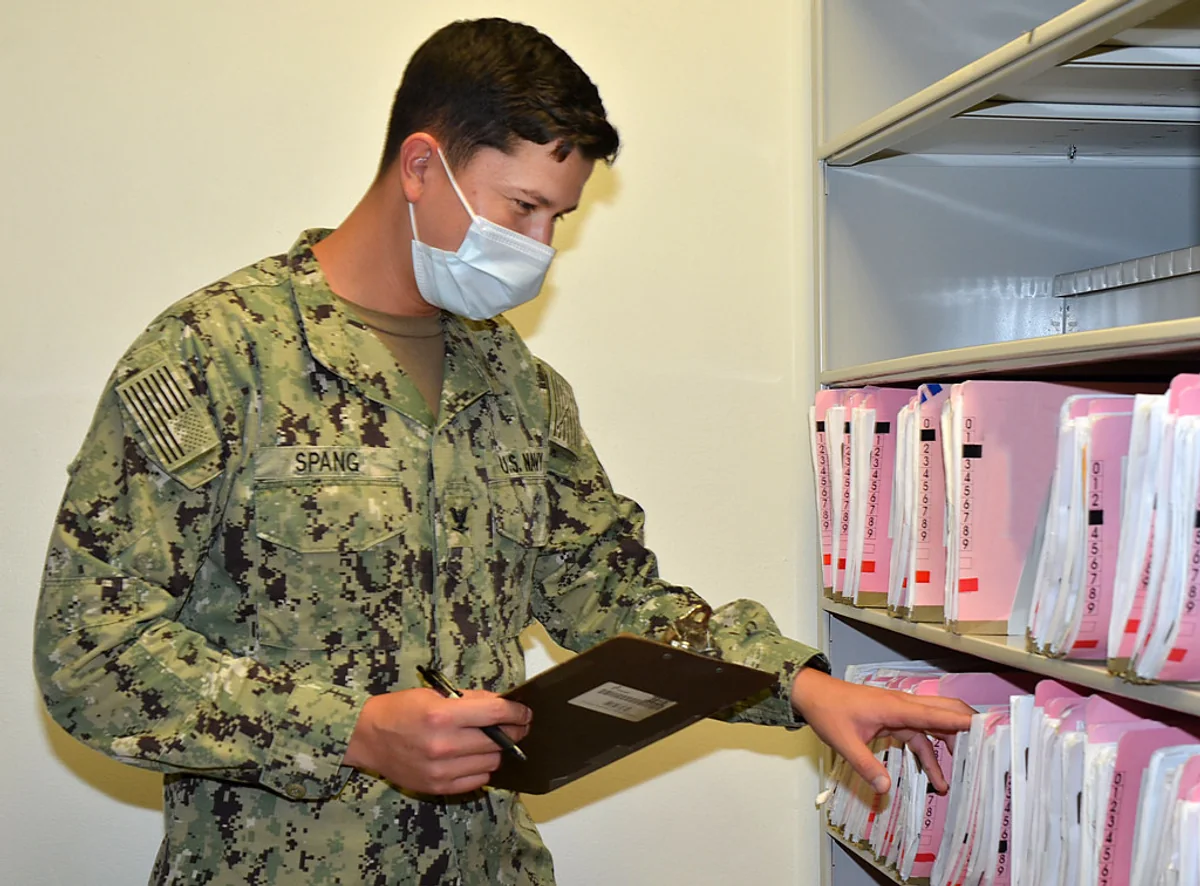
A medical records specialist reviews patient files in a clinic.
Navy Medicine / Public Domain Mark

A day in the life

1A medical records specialist checks a patient record and flags an empty field for follow-up.

Flag gaps in a chart

Go through one patient's record and mark any blank date or partial entry so someone returns to it.

2The specialist consults a coding reference while comparing a care note with an entry in coding software.

Enter codes in coding software

In coding jobs, you look up the note's diagnoses and procedures in references and type matching codes.

3The specialist sends a clarification question about conflicting record entries to a nurse reviewing it at a nearby terminal.

Send a clinician a pointed question

Ask a doctor or nurse when the record contradicts itself or lacks a detail you need for coding.

4The specialist checks a records request and authorization before preparing the retrieved documents for release.

Fill a records request

Confirm a records request has the required authorization, then pull and prepare the files for the right recipient.

Quick facts

Preparation

Usually a certificate

United States

Pay

$51,140/year

United States · May 2025

Outlook

8% projected growth

United States · 2025–2035

Quick orientation

Preparation, pay & outlook

Preparation

Usually a certificate

Some jobs accept a high school diploma plus healthcare experience.

Geography
United States
Period
Not applicable

Pay

$51,140/year

National median, equivalent to $24.59/hour.

Geography
United States
Period
May 2025

Outlook

8% projected growth

About 14,000 openings annually, including replacements for workers who leave.

Geography
United States
Period
2025–2035

Fit, tradeoffs & changing tools

Things to weigh

  • Repeated checking can feel monotonous, especially with deadlines approaching.
  • A request for someone's records requires careful handling even when the caller is impatient.

Where AI may help

Coding software helps organize and assign codes; artificial intelligence may make that work faster.

What people still lead

You still investigate unclear documentation and ask clinicians for missing details.

What we can’t predict yet

How much coding becomes automated—and how that changes staffing—remains uncertain.

Pay in context

Earnings

The national median was $51,140 a year, or $24.59 an hour, in May 2025.

The national spread

The 10th-percentile wage was $37,000; the 90th was $81,150. These describe workers across the occupation, not starting and senior salaries.

Geography
United States
Period
May 2025
Pay basis
Annual employee wages, 10th and 90th percentiles

Workplace makes a difference

Annual medians were $59,120 in hospitals and $47,120 in physicians' offices.

Geography
United States
Period
May 2025
Pay basis
Industry median annual employee wages for medical records specialists

Getting started

Complete a coding or records certificate

What the route involves
Study medical terminology, anatomy and coding, then practice interpreting records.
What it can lead to
Meet the typical education level for entry.
What to check
A school certificate is separate from certification. For the Certified Coding Associate examination, the American Health Information Management Association requires a high school diploma and recommends training or experience. Passing the exam earns the credential.

Bring healthcare experience

What the route involves
Combine a high school diploma or equivalent with experience in a healthcare setting.
What it can lead to
Qualify for some records positions without a postsecondary certificate.

Check employers' requirements: certification may be preferred or required.

After entry

Career paths

This starts where the entry routes leave off: early work, growing capability, and advancement or specialization.

  1. Get established

    Learn the employer's record system and check your entries against the original documents.

  2. Handle harder records

    On the coding track, build enough knowledge to research complicated cases and explain why a code fits. Continuing education helps you keep up with coding changes.

  3. Review and teach

    Experienced coding roles can add auditing, reviewing coworkers' coding and training newer staff.

Where you can work

A health system's coding team

In a centralized billing operation, you work with records from across the health system. Questions take you back to physicians and nurses; the finished codes support hospital or professional charges.

  • Indoors
  • Office

A release-of-information office

Your queue centers on requests for records. You communicate with patients or representatives and handle requests arriving through portals, mail or other channels, with authorization checks shaping what you send.

  • Indoors
  • Office

Try it

See whether the job clicks before you commit to the path.

Make two fictional visit records with names, dates and a short care note. Put a missing date in one and a conflicting detail in the other. Compare them, flag each problem, and write the clarification question you would send. Notice whether this careful checking holds your interest.

Stay safe: Use invented information only; do not use anyone's actual medical records.

Explore more careers

Sources

  1. U.S. Bureau of Labor Statistics. Medical Records Specialists. Accessed 2026-10-03.
  2. O*NET OnLine / U.S. Bureau of Labor Statistics. National Wages: Medical Records Specialists, 29-2072.00. Accessed 2026-10-03.
  3. O*NET OnLine. Medical Records Specialists, 29-2072.00. Accessed 2026-10-03.
  4. American Health Information Management Association. Certified Coding Associate. Accessed 2026-10-03.
  5. Duke Human Resources. Medical Records Coder I. Accessed 2026-10-03.
  6. Duke Human Resources. Medical Records Coder II. Accessed 2026-10-03.
  7. Duke Health. Medical Records Coder II — Patient Revenue Management Organization. Accessed 2026-10-03.
  8. Mayo Clinic. Medical records and imaging request. Accessed 2026-10-03.

Your message goes to the Great Jobs team. How we use your information