
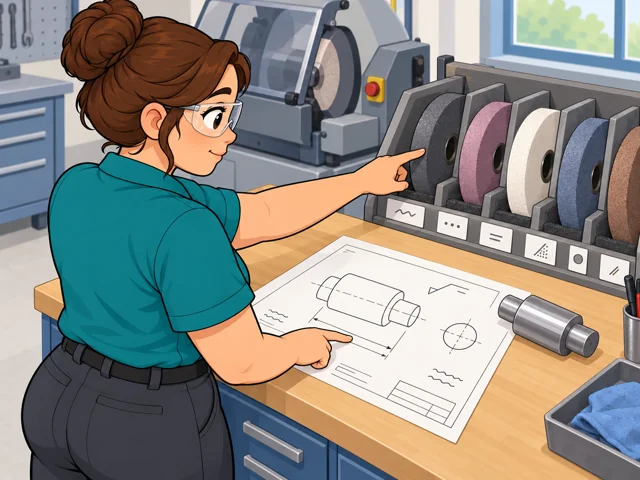
Read drawings before picking a wheel
For setup work, you read the drawing's required size and smoothness, then pick a grinding wheel to match.
Career profile
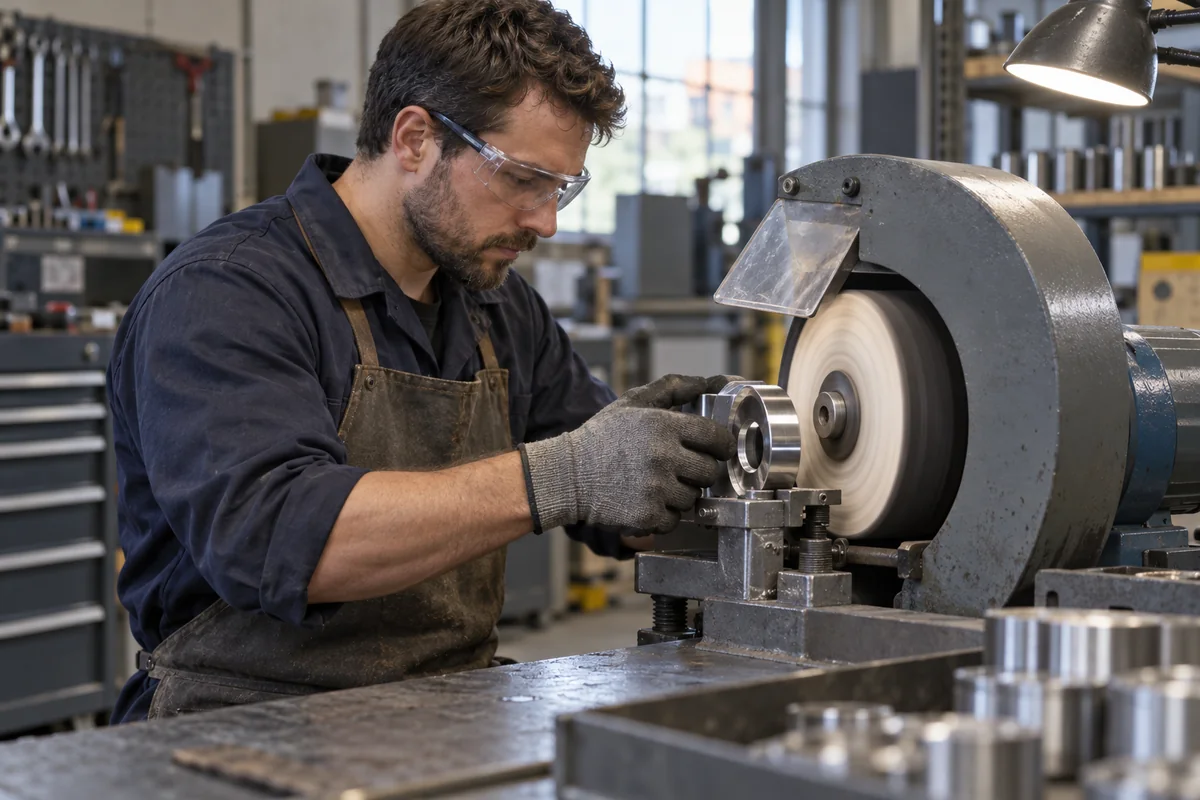
Grinding and polishing machine operators grind parts to exact size or polish their surfaces.
You bring a rough surface to a planned, controlled smoothness, then make sure the part still measures within its specified size.
For setup work, you read the drawing's required size and smoothness, then pick a grinding wheel to match.
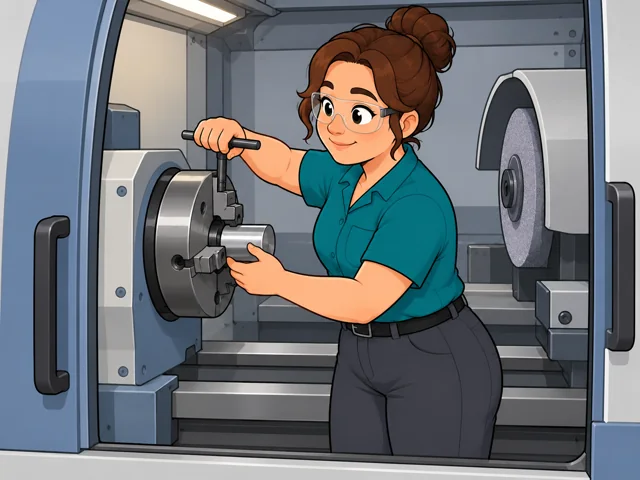
Set the next workpiece in position and lock it in place with clamps or the machine's chuck.
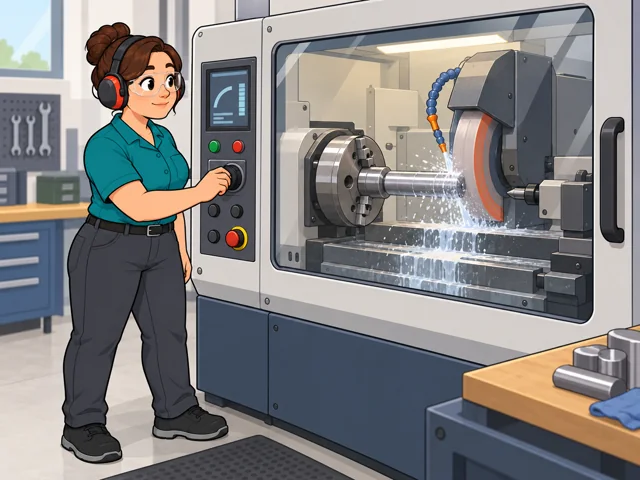
Stay by the running grinder, and if it acts up, pin down why and adjust its controls.
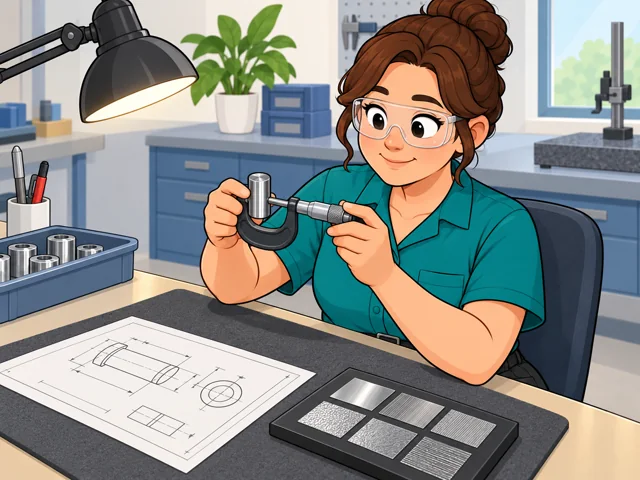
Measure the piece with a micrometer or gauge against the drawing's tolerance range, and check its smoothness.
United States · 2025
United States · May 2025
United States · 2025–2035
Quick orientation
A high school diploma or equivalent is the typical starting point; you learn the machines on the job.
The national median is $46,550 a year.
About 4,500 openings a year are projected despite falling employment.
Some cylindrical grinding systems use robots to load parts and automatic gauges to measure them, reducing repeated handling.
Operators still choose setups, investigate bad results and check whether the finished surface meets the drawing.
How much loading and checking will remain hands-on depends on the machines a shop installs and the parts it makes.
Pay in context
Use the national median as a reference when comparing actual offers.
The May 2025 median was $46,550 a year, or $22.38 an hour. Half earned more and half less; this is not a starting rate.
Employment is projected to fall 10.8% from 2025 to 2035, with about 4,500 openings annually on average. Openings are not the same as newly created jobs.
In 2025, the lowest-paid 10% earned $36,110 a year or less, and the highest-paid 10% earned $62,600 or more. These are wage thresholds, not beginner and experienced pay rates.
An older national comparison shows average hourly pay of $20.45 in foundries and $22.19 in metalworking machinery manufacturing for this occupation in May 2023. Treat these as historical industry averages, not current offers.
A high school diploma or equivalent is typical. You can seek trainee employment or build machining skills in a school shop first.
After entry
This starts where the entry routes leave off: early work, growing capability, and advancement or specialization.
Build a reliable rhythm of running parts and checking the results.
Learn to select fixtures, set feeds and speeds, and troubleshoot a grinder’s loading system.
Work toward setup responsibility or specialize in demanding surface and cylindrical grinding, where wheel choice and dimensional control become central.
You may grind batches of parts, troubleshoot automatic loading and record piece counts and run times. Keeping production consistent matters throughout the lot.
Short runs of tooling and components can put more emphasis on choosing wheels and setting up each job. Some shops pair this work with a small team and a climate-controlled floor.
Try it
Watch a surface-grinding demonstration from a machine maker or technical college. Sketch how the part is held, where material comes off and how the result is checked. Notice whether the repeated measuring interests you as much as the machine.
Stay safe: Keep this exercise observational; operating a grinder requires hands-on instruction.