
Career profile

Molecular and Cellular Biologist

Molecular and cellular biologists study how cells work by testing what their molecules do.

Why would altering one protein change how a cell behaves? You design experiments that turn questions like that into evidence.
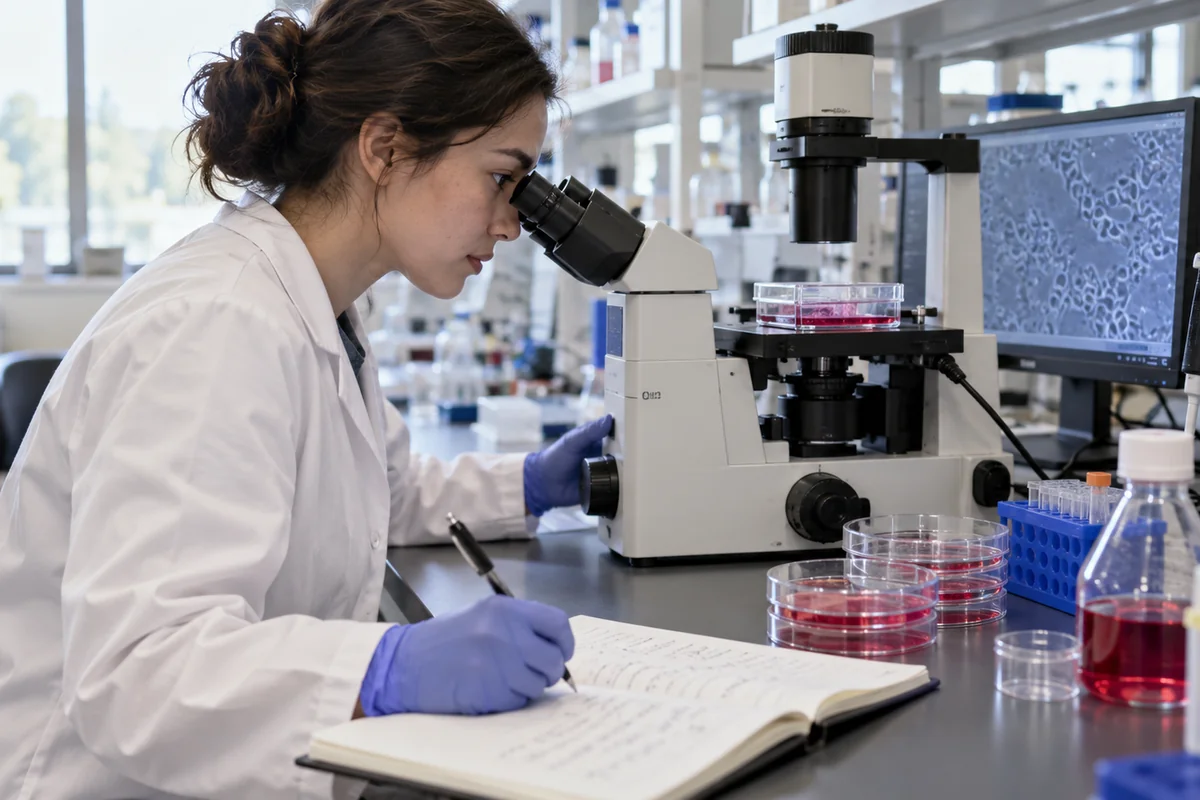
Cell biologist examines samples with a microscope and records observations.

A day in the life

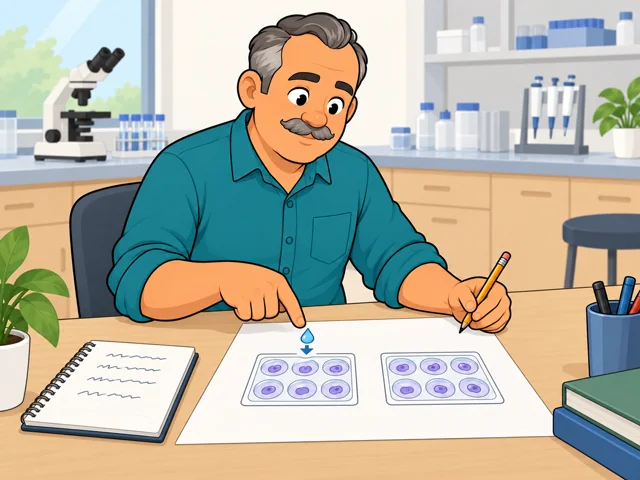
1A biologist plans matching groups of cells, marking one for treatment and leaving the other unchanged.

Plan treated and untreated cells

Decide beforehand which cells get a treatment and which stay untouched, so any difference traces to its cause.
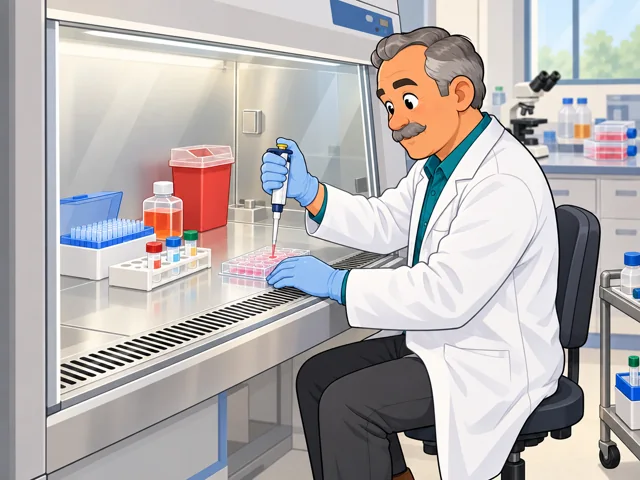
2Wearing a laboratory coat and gloves, the biologist carefully pipettes reagent into a cell-culture plate inside a biological safety cabinet.

Change a gene in cultured cells

In cell culture jobs, you plate cells, alter one gene's activity, then measure how the cells react.
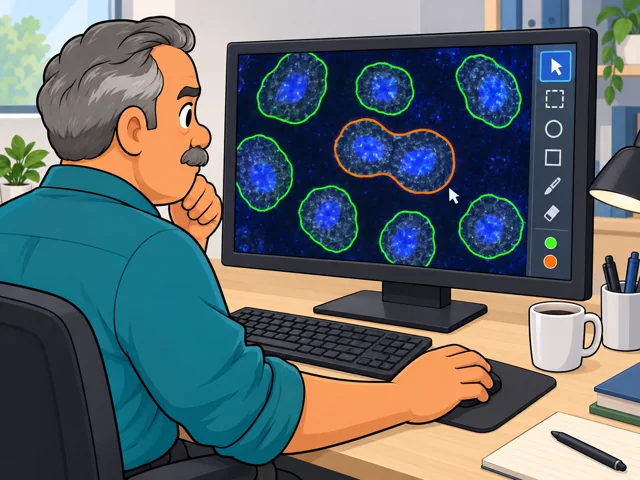
3The biologist checks image-analysis outlines and spots two touching cells incorrectly enclosed as one.

Check software-traced cell borders

Measure cells in image-analysis software, then check its traced borders, since merging two touching cells can skew results.

4The biologist and two women colleagues compare conflicting graphs as he sketches a follow-up experiment.

Present graphs at a research meeting

Compare your graphs with earlier findings, and when the data challenge your explanation, propose another experiment.

Quick facts

Preparation

Degree plus research experience

United States · 2026

Pay

Not displayed

A separate national median for this specialty is not available. See the role-specific salary ranges below.

Outlook

Not displayed

A separate national growth rate and annual openings estimate for this specialty are not available.

Quick orientation

Preparation, pay & outlook

Preparation

Degree plus research experience

Some roles accept a bachelor’s degree with relevant experience; others call for doctoral training.

Geography
United States
Period
2026

Pay

Not displayed

A separate national median for this specialty is not available. See the role-specific salary ranges below.

Geography
United States
Period
2025

Outlook

Not displayed

A separate national growth rate and annual openings estimate for this specialty are not available.

Geography
United States
Period
Not applicable

Fit, tradeoffs & changing tools

Things to weigh

  • A carefully prepared experiment can still give an unclear answer. Repeating it may be necessary before you can move on.
  • Some workweeks exceed 40 hours, and reports or funding applications can take you away from the lab bench.

Where AI may help

Image-analysis software can measure large collections of cell images and help group cells by their appearance.

What people still lead

You decide which biological question matters, what comparison can answer it, and whether the measurements support your explanation.

What we can’t predict yet

How much image checking can be automated depends on the cells and images. A method that works on one experiment may need adjustment for the next.

Pay in context

Earnings

Your job level, research experience and employer matter. These California salary ranges show two distinct roles; they are not national averages or a measure of the pay advantage of one workplace.

Industry cellular research

An associate scientist role developing cell-based tests in Thousand Oaks lists $94,340.65–$127,637.35 a year in base salary. It requires a master’s degree plus one year of relevant experience, or a bachelor’s plus three years. Skills and qualifications affect the offer.

Geography
Thousand Oaks, California, United States
Period
October 2026
Pay basis
Advertised annual base salary for Amgen role R-250690; additional compensation excluded

University research after a doctorate

A molecular and cell biology postdoctoral role in Davis lists $69,073–$74,281 a year. It requires a relevant doctorate and involves managing a research project, developing tests and mentoring junior lab members.

Geography
Davis, California, United States
Period
May 2026 posting, checked October 2026
Pay basis
Advertised annual salary for University of California, Davis role JPF07651

Getting started

Combine a science degree with research experience

What the route involves
Study biology or a related science, then build relevant experience designing experiments, analyzing results and working with cell models.
What it can lead to
Some scientist roles accept this experience in place of a doctorate. A rare-disease research role accepts a bachelor’s plus five years of scientific research, or a master’s plus three.
What to check
Those thresholds belong to that role; employers also assess whether your laboratory skills match their research.

Train through a research doctorate

What the route involves
After a bachelor’s degree, pursue a Doctor of Philosophy (PhD) through advanced courses, laboratory rotations and an original dissertation project.
What it can lead to
A relevant doctorate makes you eligible for postdoctoral research roles where you develop experiments and take responsibility for a defined research question.
What to check
Some doctoral programs admit students without a master’s degree. Admission and completion requirements depend on the program.

There are routes through degree study and through accumulated research experience. Match your preparation to the experiments a lab needs you to run.

After entry

Career paths

This starts where the entry routes leave off: early work, growing capability, and advancement or specialization.

  1. Make your results dependable

    Learn the lab’s methods and keep records another researcher can use to repeat your experiment.

  2. Take ownership of a question

    Connect your experiments with published findings and explain to collaborators which next test would resolve an uncertainty.

  3. Lead a research program

    A faculty route can lead to running a lab, seeking research funding and mentoring students. Competitive appointments may require postdoctoral experience and evidence of research achievement.

Where you can work

University research laboratories

Your project sits alongside student training and publication. You may mentor junior researchers, discuss findings at seminars and help turn experiments into papers or funding proposals.

  • Indoors
  • Lab

Drug-discovery laboratories

Cell experiments feed decisions about potential treatments. You work with disease specialists and automation colleagues, making tests repeatable enough to compare many experimental conditions.

  • Indoors
  • Lab

Try it

See whether the job clicks before you commit to the path.

Try a free CellProfiler example using its supplied cell images. Compare the software’s cell outlines with what you see, then change one setting and check the result. Notice whether investigating a measurement error interests you.

Stay safe: Use the supplied digital images; no cell culture or laboratory materials are needed.

Explore more careers

Sources

  1. O*NET OnLine. Molecular and Cellular Biologists — 19-1029.02. Accessed 2026-10-04.
  2. O*NET OnLine / U.S. Bureau of Labor Statistics. National Wages: Molecular and Cellular Biologists. Accessed 2026-10-04.
  3. U.S. Bureau of Labor Statistics. Occupational projections and worker characteristics. Accessed 2026-10-04.
  4. Amgen. Associate Scientist — Cellular Assay Development, Functional Genomics. Accessed 2026-10-04.
  5. Amgen. Scientist, Rare Disease Biology. Accessed 2026-10-04.
  6. Harvard University. Molecules, Cells and Organisms doctoral program. Accessed 2026-10-04.
  7. University of California, Davis. Postdoctoral Scholar — Barlow lab, JPF07651. Accessed 2026-10-04.
  8. University of California, Davis. Assistant/Associate Professor — Cell Biology & Human Anatomy, JPF07708. Accessed 2026-10-04.
  9. CellProfiler. CellProfiler: automated biological image analysis. Accessed 2026-10-04.
  10. CellProfiler. Getting Started. Accessed 2026-10-04.

Your message goes to the Great Jobs team. How we use your information