

Explain a pregnancy ultrasound
Look at the ultrasound images alongside the chart, then tell the patient what they mean for the pregnancy.
Career profile
Obstetrician-gynecologists are doctors who treat reproductive conditions and care for patients through pregnancy and birth.
Your days range from discussing menopause symptoms to performing surgery. It suits people who like explaining options to patients as much as making medical calls.
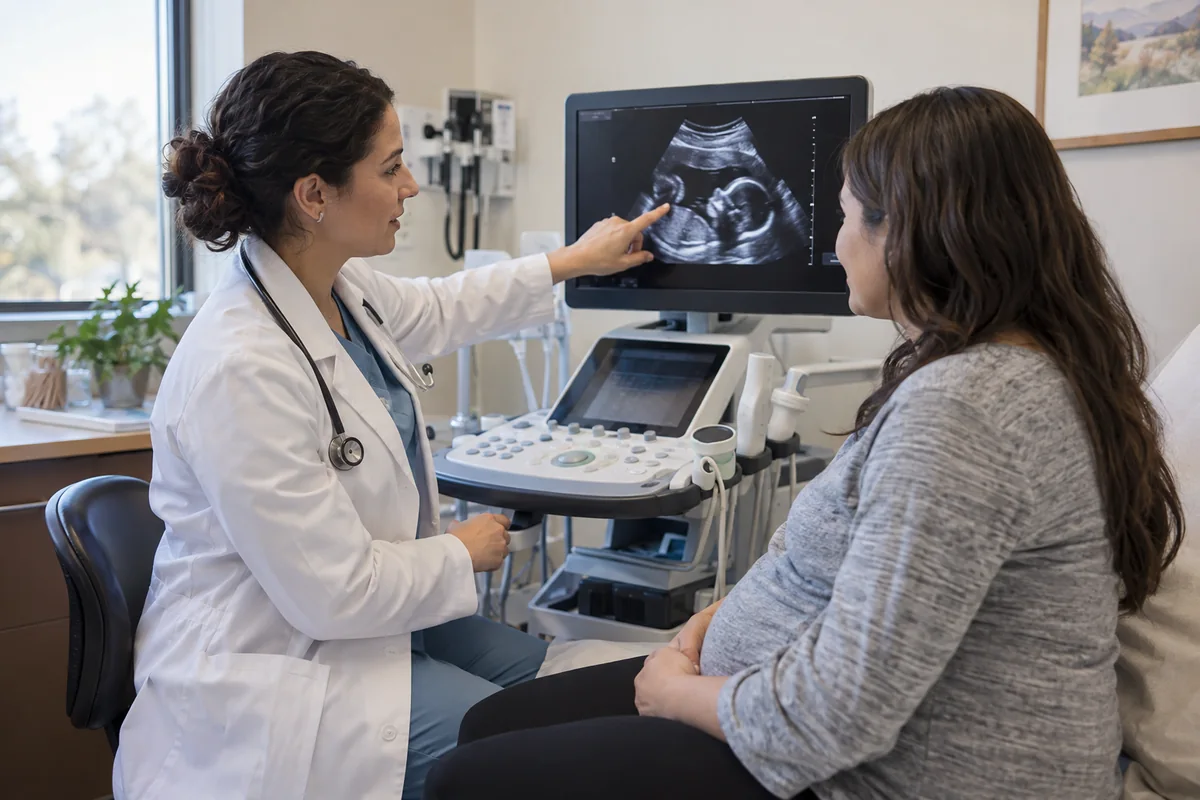
Look at the ultrasound images alongside the chart, then tell the patient what they mean for the pregnancy.

Ask about the pelvic pain, examine the patient and compare test results before you suggest any treatment.

If your practice handles births, you track labor and perform a cesarean when one is needed.

At a follow-up, ask what has changed, and if symptoms linger, revisit the chart and rethink treatment.
United States
United States · May 2025
United States · 2025–2035
Quick orientation
A professional medical degree is followed by specialty training in obstetrics and gynecology.
National median employee wage; the hourly equivalent is $140.82.
About 500 openings per year are projected nationally for obstetricians and gynecologists.
Electronic health records help you retrieve and share patient information. Artificial intelligence tools may also assist with ultrasound image analysis and paperwork.
You still need to connect a tool's output with the patient's symptoms, explain options, and make clinical decisions with the patient.
How much image review or documentation software will take over remains unsettled. Reliability and the amount of checking required will shape whether it actually saves you time.
Pay in context
These are employee wages, not the income of self-employed practice owners.
The median was $292,910 a year, equivalent to $140.82 an hour. Half of employed obstetricians and gynecologists earned more and half earned less.
The 10th-percentile wage was $94,680 and the 90th-percentile wage was $437,300 annually. These are positions in the national wage distribution, not starting and senior salaries. Location and job responsibilities can affect an offer.
Employment is projected to grow 1.7% from 2025 to 2035, with about 500 openings annually on average. Openings include replacement needs as well as employment growth.
The usual route has two consecutive training steps: medical school, then specialty residency. You also need a state medical license to practice independently.
After entry
This starts where the entry routes leave off: early work, growing capability, and advancement or specialization. This path also has a credential or licensing boundary; see the requirements and limits.
Build reliable habits for following up results and consulting colleagues about difficult cases.
Use case discussions and surgical simulation to work on difficult decisions and procedures.
Pursue fellowship training in maternal-fetal medicine for complicated pregnancies or gynecologic oncology for reproductive cancers. Subspecialty certification adds its own requirements and examinations.
Repeat visits let you follow symptoms and treatment over time. Office examinations and procedures shape the day, though your job may also include hospital coverage.
Complex pregnancies and surgical cases bring you together with other specialists. You may teach residents while working in the birth unit or operating room; birth coverage includes nights.
Try it
Imagine a patient at a first prenatal visit who is worried about an ultrasound. Write three questions that would help you understand their concerns, then practice explaining why a doctor considers both images and medical history. Notice whether careful listening interests you as much as the scan.
Stay safe: Use a fictional situation; do not interpret a real person's scan or offer medical advice.