
Career profile

Construction Equipment Operator

Construction equipment operators dig, move and shape earth with bulldozers, loaders and excavators.

A tiny lever move decides where the bucket bites into dirt or the blade lifts off, and each pass across the ground shows the result.

An adult construction equipment operator seated at the controls of a large excavator, moving earth on a construction site, visible clearly through the open cab doorway.

A day in the life

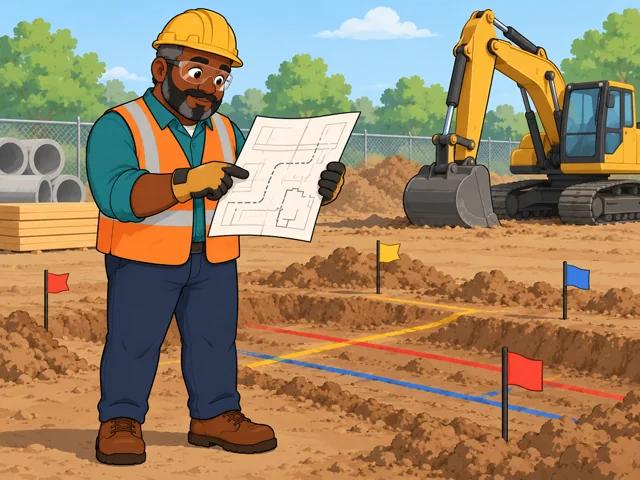
1A construction equipment operator compares a dig plan with reference stakes and utility markings before positioning a parked excavator.

Check stakes and utilities first

Look at the dig plan, the marker stakes and utility locations before you move the machine into place.

2Viewed from inside the excavator cab, the operator lowers a bucketful of soil while a crew member signals from beyond the swing radius.

Set each bucketload in place

Work the excavator levers to dig soil and carry it away, timing each move to a crewmate's signals.

3The operator makes a shallow bulldozer blade pass, turning uneven earth into a smooth, gently sloped surface.

Match the plan's slope or elevation

Make repeated blade passes, while some excavators use a screen and self-adjusting controls to keep dig depth steady.
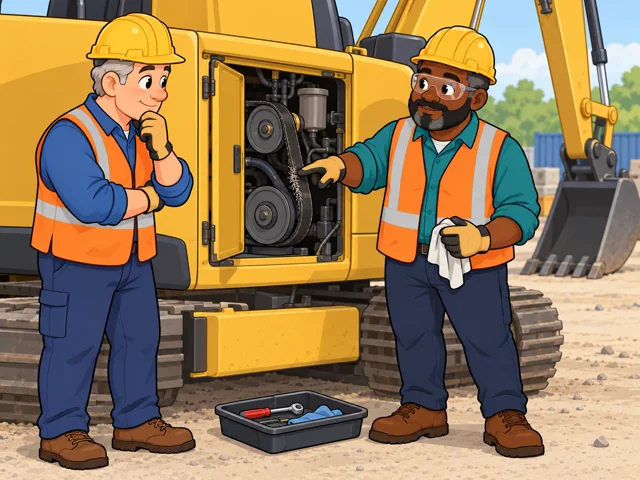
4During maintenance on a shut-down excavator, the operator points out a frayed belt to his supervisor.

Catch machine trouble early

Clean and service the machine, make simple fixes, and report anything broken or acting up to your supervisor.

Quick facts

Preparation

High school + job training

United States · 2025

Pay

$59,850/year

United States · May 2025

Outlook

4.6% projected growth

United States · 2025–2035

Quick orientation

Preparation, pay & outlook

Preparation

High school + job training

A diploma or equivalent is typical. You then learn equipment operation through workplace training or an apprenticeship.

Geography
United States
Period
2025

Pay

$59,850/year

National median, equivalent to $28.78 an hour.

Geography
United States
Period
May 2025

Outlook

4.6% projected growth

About 39,200 openings per year are projected, including replacement needs. These are national projections, not current vacancies.

Geography
United States
Period
2025–2035

Fit, tradeoffs & changing tools

Things to weigh

  • Noise, vibration, and weather can wear on you. A control mistake can have serious consequences.
  • Some jobs run at night; cold weather can interrupt seasonal work.

Where AI may help

On some excavators, sensors show the bucket’s position relative to the planned depth and slope. Grade assistance can automatically adjust boom and bucket movements.

What people still lead

You still set the target and control digging speed. Watching nearby workers and responding to their signals remain operator responsibilities.

What we can’t predict yet

How much of a future shift becomes automatic remains uncertain: maintaining a planned slope is only one part of working around changing ground and people.

Pay in context

Earnings

The national midpoint is $59,850 a year, or $28.78 an hour. Your starting offer may differ substantially.

The national spread

In May 2025, the lowest-paid 10% earned $42,190 or less; the highest-paid 10% earned $101,090 or more. These are wage percentiles, not beginner and experienced pay grades.

Geography
United States
Period
May 2025
Pay basis
Annual wage percentiles for operating engineers and other construction equipment operators, SOC 47-2073.

Workplace type can matter

A historical comparison shows annual averages of $70,430 in highway, street, and bridge construction and $53,460 in local government excluding schools and hospitals. These May 2022 averages are not current offers or the 2025 median.

Geography
United States
Period
May 2022
Pay basis
Industry annual mean wages for SOC 47-2073.

Look at hours as well as rates

Apprentices generally earn less, with increases as skills develop. Seasonal interruptions can reduce what you earn across a year.

Geography
United States
Period
Not stated
Pay basis
Qualitative apprentice pay progression and annual earnings context.

Getting started

Learn with an employer

What the route involves
Learn lighter equipment with an experienced operator.
What it can lead to
Build toward operating heavier machines, such as bulldozers.

Enter an operating engineer apprenticeship

Typically three or four years.Paid
What the route involves
Combine paid job experience with classroom and field instruction in equipment operation and maintenance.
What it can lead to
Completion leads to journey-worker status and work with less guidance.
What to check
Entry requirements vary by sponsor and region; check eligibility before applying.

High school completion is typical. Equipment hauling may require a commercial driver’s license; some states also license equipment operation.

After entry

Career paths

This starts where the entry routes leave off: early work, growing capability, and advancement or specialization.

  1. Get consistent

    Build reliable habits for machine checks, controlled movements, and crew signals.

  2. Handle more demanding work

    Use further field training to broaden your equipment skills. Learn to set depth and slope targets on machines with grade assistance.

  3. Specialize in a setting

    Experience on loaders or bulldozers can support a move into landfill operation, where you shape waste cells and cover layers to an engineered plan.

Where you can work

Highway and dam projects

Large projects can put you at remote sites, with weather affecting the workday.

  • Outdoors
  • Field work
  • Safety-sensitive

Municipal landfills

You compact waste and place cover material to match grade stakes. Some jobs include rotating shifts, weekends, or holidays.

  • Outdoors
  • Vehicle
  • Shift work
  • Safety-sensitive

Try it

See whether the job clicks before you commit to the path.

Put dry sand in a shallow tray. Use a spoon to move it, then a straight card to form a smooth slope between two marked heights. Notice whether you enjoy checking the result and making small corrections.

Stay safe: This explores patience and spatial judgment; it is not equipment training.

Explore more careers

Sources

  1. O*NET OnLine. Operating Engineers and Other Construction Equipment Operators. Accessed 2026-10-03.
  2. O*NET OnLine / U.S. Bureau of Labor Statistics. National Wages: Operating Engineers and Other Construction Equipment Operators. Accessed 2026-10-03.
  3. U.S. Bureau of Labor Statistics. Table 1.2 Occupational projections, 2025–35, and worker characteristics, 2025. Accessed 2026-10-03.
  4. U.S. Bureau of Labor Statistics. May 2022 Occupational Employment and Wage Estimates: Operating Engineers and Other Construction Equipment Operators. Accessed 2026-10-03.
  5. U.S. Bureau of Labor Statistics. Occupational Outlook Handbook: Construction Equipment Operators. Accessed 2026-10-03.
  6. Caterpillar. Use Cat Grade With Assist for Efficiency. Accessed 2026-10-03.
  7. International Union of Operating Engineers. Earn While You Learn. Accessed 2026-10-03.
  8. International Union of Operating Engineers Local 150. Apprenticeship and Skill Improvement Program. Accessed 2026-10-03.
  9. City of San Diego. Landfill Equipment Operator, recruitment AG-T11719-202603. Accessed 2026-10-03.

Your message goes to the Great Jobs team. How we use your information