

Enter the prescription details
Copy the prescription details from each order into the computer so the lens-cutting machine gets the right settings.
Career profile
Ophthalmic lab technicians make prescription lenses and fit them into frames to finish eyeglasses.
Shape a lens until it sits exactly right in its frame, then inspect the finished pair to make sure it matches the order.
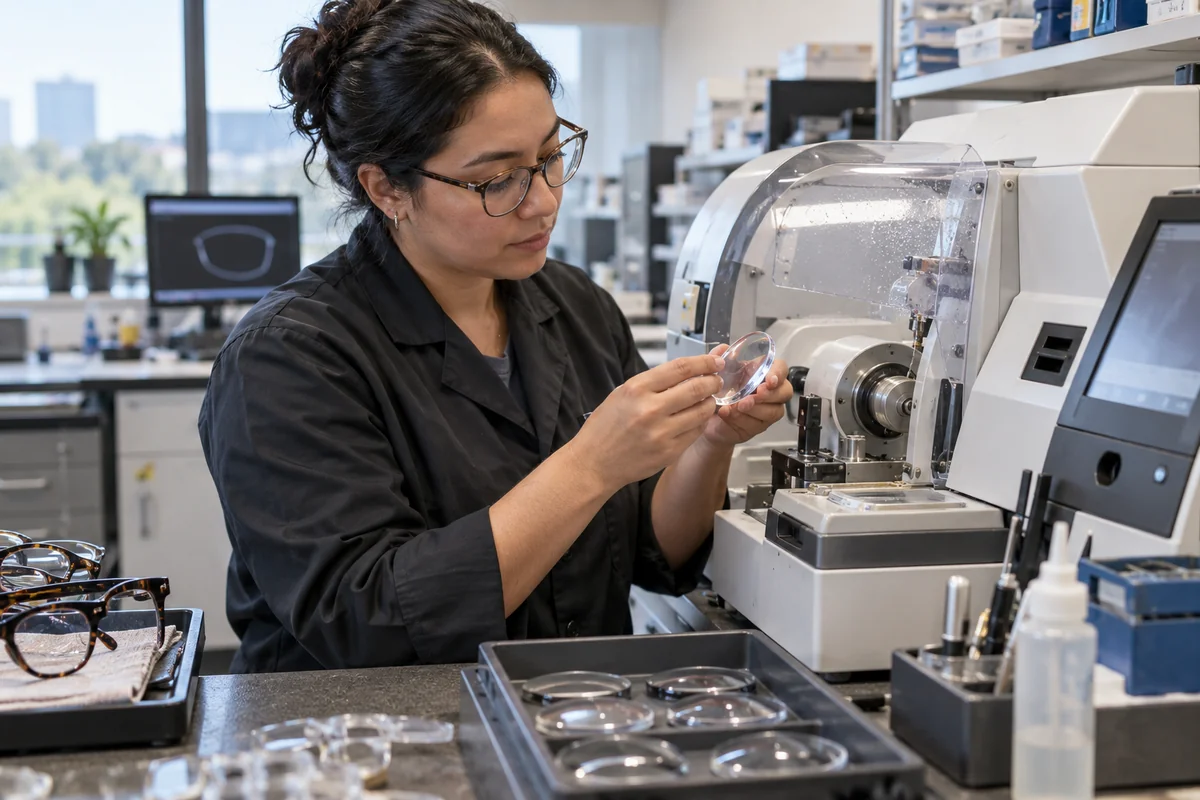
Copy the prescription details from each order into the computer so the lens-cutting machine gets the right settings.
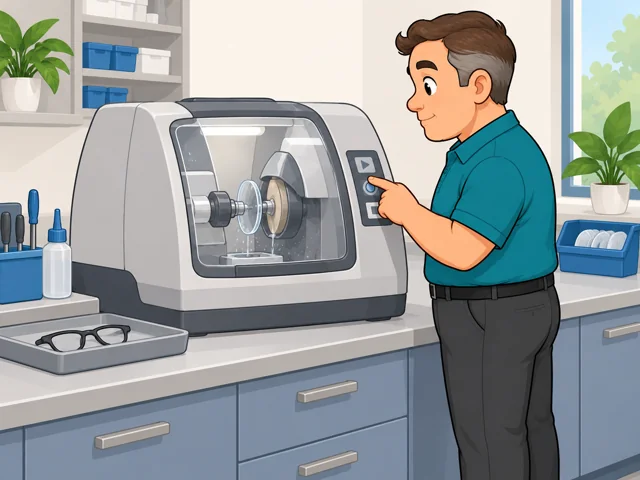
Run the edging machine to trim each lens to the outline and size its frame calls for.

Set the trimmed lenses into their frame, then make sure each one sits snugly and lines up correctly.
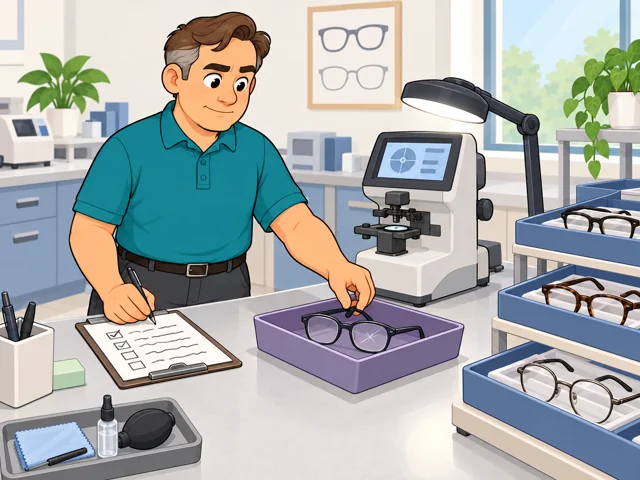
Measure lens power and inspect for flaws, setting failing pairs apart from finished orders and logging the problem.
United States · 2025
United States · 2025
United States · 2025–2035
Quick orientation
A high school diploma or equivalent is the typical starting point; you learn production skills on the job.
National median for ophthalmic laboratory technicians, equivalent to $18.97 an hour.
About 2,200 openings a year are projected, including openings to replace workers who leave the occupation.
Automated equipment already shapes lenses. You prepare the lenses and operate machines that carry out precise production steps.
Technicians inspect the results, handle failed checks, and troubleshoot equipment when production goes wrong.
Further automation may change how much time you spend handling lenses versus monitoring machines. The pace and extent of that shift will vary among labs.
Pay in context
The national median was $39,460 a year, or $18.97 an hour, in 2025. It is a midpoint across workers, not a starting-pay promise.
The lowest-paid 10% earned $33,530 or less; the highest-paid 10% earned $57,380 or more. These are wage percentiles, not beginner and senior pay grades.
In Plano, Texas, an entry-level optical manufacturing role starts at $17.05 an hour including a 10% shift premium, with separate bonus opportunities. That rate applies to its evening-to-overnight shifts.
Employment is projected to grow 2.2% from 2025 to 2035, with about 2,200 openings annually across the country. Openings include replacement hiring, so they exceed the number of newly added jobs.
Most people enter with a high school diploma or equivalent and build their skills at work.
After entry
This starts where the entry routes leave off: early work, growing capability, and advancement or specialization.
Learn your station's setup and quality checks until you can consistently produce acceptable lenses.
Cross-train in finishing, surfacing, or coating so you can handle more of the lens-making process.
Build toward troubleshooting equipment, investigating recurring defects, and teaching newer technicians.
Work moves through separate surfacing, coating, and finishing departments. You may focus on one stage, and some labs run shifts into the night.
You may move between several equipment stations to complete glasses for local customers. Stores offering same-day glasses can set hourly finishing deadlines.
Try it
Draw a lens-shaped outline on paper, then cut a matching shape from another sheet. Overlay them and mark every mismatch. Try again: do you enjoy the careful checking as much as making the shape?
Stay safe: Use paper and ordinary scissors; leave actual lenses and frames intact.