

Career profile

Optometrist

Optometrists examine eyes, prescribe lenses, and diagnose and treat eye diseases.

Someone has trouble seeing, and you pin down the cause. Then you lay out the options: a new lens prescription, treatment, or a specialist referral.
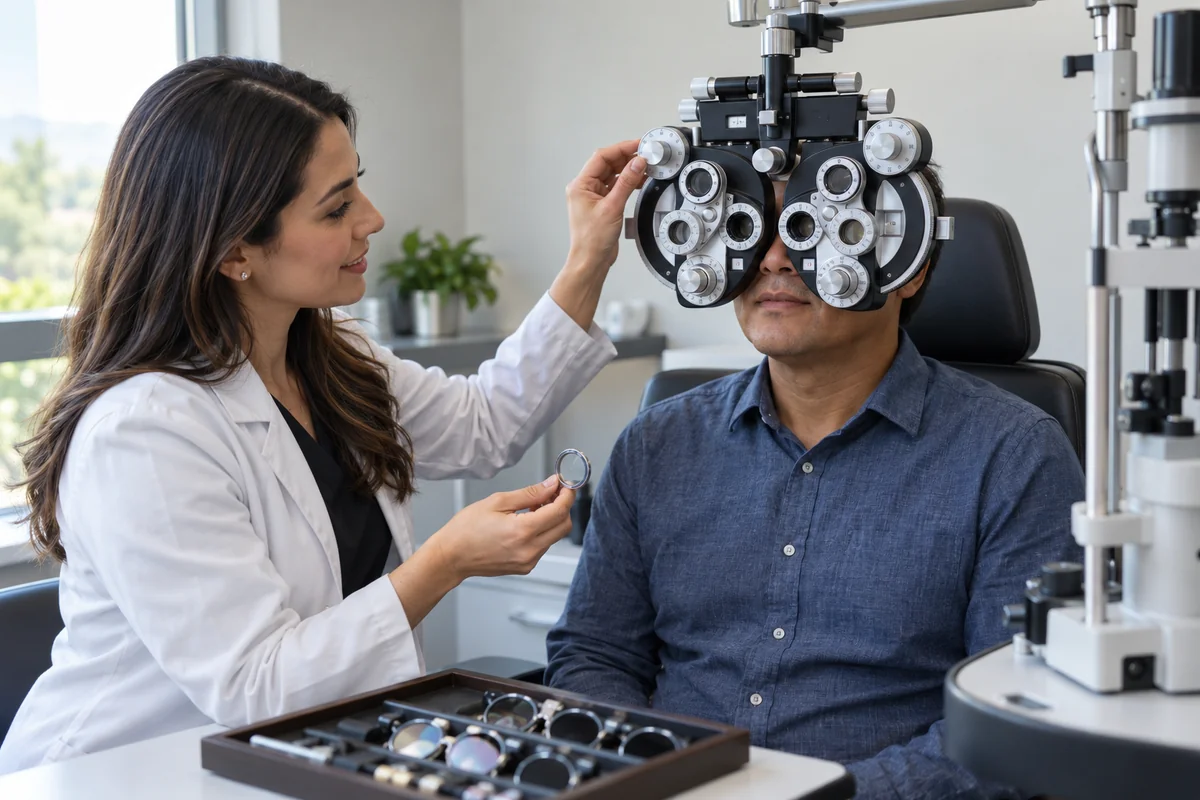
Optometrist examines a patient’s eyes in a clinic.

A day in the life

1An optometrist listens to a seated woman describe vision changes, taking notes beside a medicine container.

Talk through the patient's history

Ask a patient about sight changes, medicines, and past health so you know which tests to run.
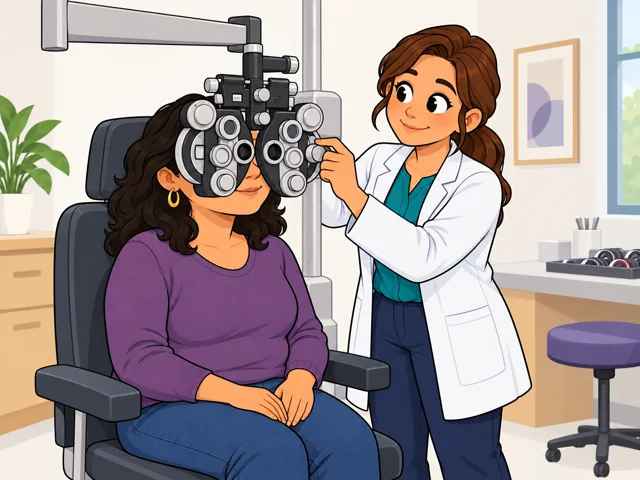
2An optometrist adjusts a phoropter as a woman looks through it to compare lenses.

Fine-tune the lens prescription

As the patient looks through a phoropter, you swap lenses until their answers point to the sharpest view.
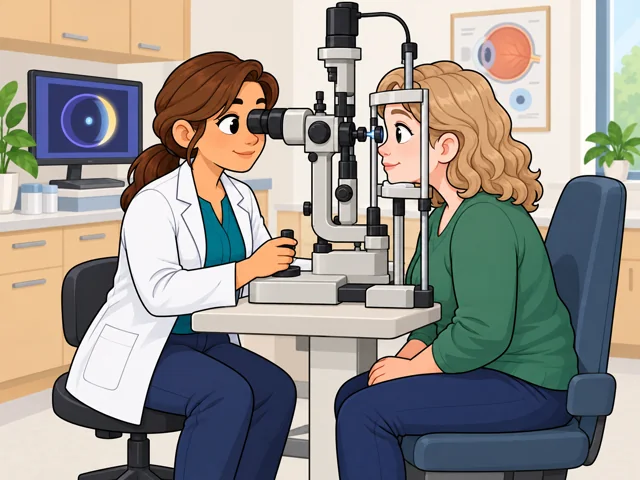
3An optometrist examines a woman's eye at a slit lamp equipped to measure eye pressure, beside a screen displaying abstract test graphics.

Look for signs of eye disease

Examine the eyes for disease, read results like eye pressure, then decide whether to treat or refer.

4A woman explains a contact-lens care routine using a case and solution bottle while the optometrist listens and checks her understanding.

Teach contact lens care

Explain contact lens care, then have the patient restate the steps so you can clear up any confusion.

Quick facts

Preparation

Professional degree + license

United States

Pay

$136,570 median

United States · May 2025

Outlook

9.5% projected growth

United States · 2025–2035

Quick orientation

Preparation, pay & outlook

Preparation

Professional degree + license

A Doctor of Optometry (O.D.) program takes four years after undergraduate preparation. You also need a state license.

Geography
United States
Period
Not applicable

Pay

$136,570 median

National median annual pay for employed optometrists; the hourly equivalent is $65.66.

Geography
United States
Period
May 2025

Outlook

9.5% projected growth

About 2,000 openings per year are projected nationwide, on average.

Geography
United States
Period
2025–2035

Fit, tradeoffs & changing tools

Things to weigh

  • Preparation takes years, and some jobs include evening or weekend appointments.
  • You carry responsibility for treatment decisions and conversations about troubling findings.

Where AI may help

Automated instruments can estimate the eye’s focusing power, giving you a measurement to refine.

What people still lead

You connect measurements with symptoms, examine eye health, and explain the plan.

What we can’t predict yet

How much of an examination will become automated remains uncertain; measuring focus is only one part of the visit.

Pay in context

Earnings

Use these employee wages as a benchmark. They exclude self-employed practice owners.

The median and the spread

The median was $136,570 a year, or $65.66 an hour. The 10th and 90th percentiles were $74,870 and $202,180 annually. These describe the wage distribution, not starting and senior salaries.

Geography
United States
Period
May 2025
Pay basis
Gross wage-and-salary earnings; national annual and hourly medians and annual wage percentiles.

Workplace type matters

Annual medians were $129,250 in optometrists’ offices, $145,630 in physicians’ offices, $159,250 in retail, and $207,030 in outpatient care centers. These are group comparisons, not promised offers.

Geography
United States
Period
May 2025
Pay basis
Industry-specific median annual employee wages for optometrists.

Openings include replacements

Employment is projected to grow 9.5%, with about 2,000 openings annually. Openings include replacing people who leave the occupation as well as adding jobs.

Geography
United States
Period
2025–2035
Pay basis
Employment projections, not compensation or current vacancies.

Getting started

Finish college, then study optometry

What the route involves
Complete a bachelor’s degree and the school’s prerequisite courses, then enter an O.D. program combining classroom study with supervised patient care.
What it can lead to
Completing the professional program earns the O.D. degree needed for the licensing path.

Apply through an early-admission route

What the route involves
Indiana University allows applications before a bachelor’s degree with at least 90 college credits, required coursework, a cumulative grade point average of 3.6 or higher, and the Optometry Admission Test.
What it can lead to
If admitted, you can begin the four-year O.D. program after three undergraduate years.
What to check
This is a school-specific option. Meeting its minimum requirements does not guarantee admission.

Both routes lead to the same professional degree. You must also pass qualifying licensing exams and meet your state’s additional requirements. States set which medicines and procedures you may use.

After entry

Career paths

This starts where the entry routes leave off: early work, growing capability, and advancement or specialization.

  1. Get established

    Build a reliable routine for exams and records, and coordinate appointments and patient handoffs with clinic staff.

  2. Deepen your clinical skills

    An optional postdoctoral residency can build experience managing eye disease and discussing cases with other medical professionals.

  3. Lead or pursue advanced training

    Owning a practice adds hiring, staff leadership, and financial decisions to your clinical work.

    • After residency, a fellowship can offer further clinical and research training.

Where you can work

Your own optometry practice

Patient appointments share your attention with staff decisions and business finances. You may handle hiring, borrowing, and cash flow as well as examinations.

  • Indoors
  • Office

A Veterans Affairs teaching clinic

Eye care connects with other medical services. In residency settings, you manage eye disease, discuss care across disciplines, and learn through medical rotations and case discussions.

  • Indoors
  • Office

Try it

See whether the job clicks before you commit to the path.

Read the American Optometric Association’s comprehensive eye-exam overview. On paper, pair a patient-history question with a test it could help explain. Notice whether connecting a person’s story with measurements interests you.

Stay safe: Keep this a paper exercise; do not test someone’s eyesight or suggest treatment.

Explore more careers

Sources

  1. U.S. Bureau of Labor Statistics. Optometrists — Occupational Outlook Handbook. Accessed 2026-10-04.
  2. O*NET OnLine. 29-1041.00 — Optometrists. Accessed 2026-10-04.
  3. O*NET OnLine / U.S. Bureau of Labor Statistics. National Wages: Optometrists. Accessed 2026-10-04.
  4. U.S. Bureau of Labor Statistics. Occupational projections and worker characteristics. Accessed 2026-10-04.
  5. Indiana University School of Optometry. Apply to the Doctor of Optometry program. Accessed 2026-10-04.
  6. Indiana University School of Optometry. Doctor of Optometry. Accessed 2026-10-04.
  7. American Optometric Association. Comprehensive eye exams. Accessed 2026-10-04.
  8. U.S. Department of Veterans Affairs. Optometry — Education and Training. Accessed 2026-10-04.
  9. American Optometric Association. Managing Practice Finances. Accessed 2026-10-04.
  10. American Optometric Association. Managing Personnel. Accessed 2026-10-04.

Your message goes to the Great Jobs team. How we use your information