
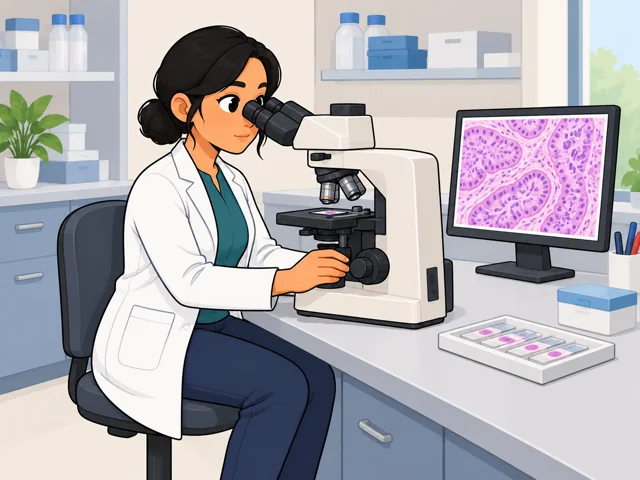
Scan a tissue slide for changes
Put a tissue slide under the microscope and search for cell changes hinting at which illness is present.
Career profile
Pathologists diagnose illness from evidence in tissue samples, cells, and lab results.
From a patient sample, you reach a medical finding. It suits people who like both fine detail and showing how evidence leads to a conclusion.
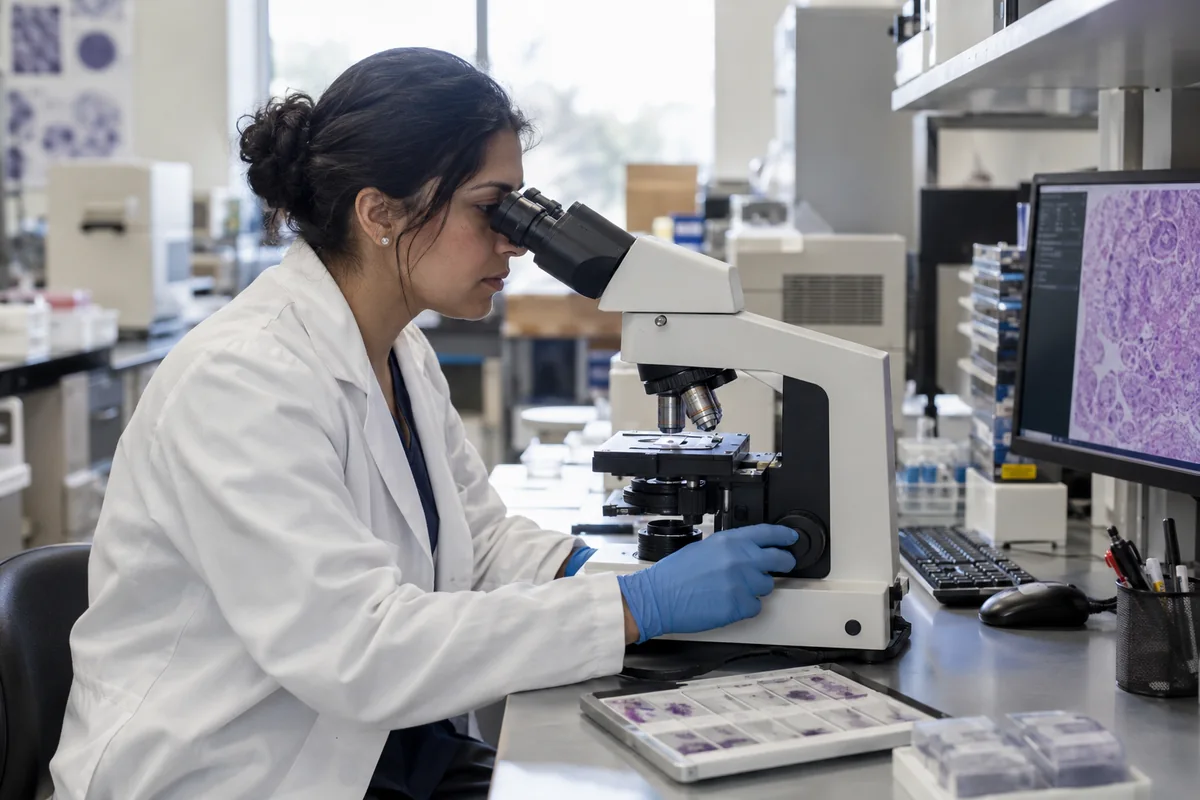
Put a tissue slide under the microscope and search for cell changes hinting at which illness is present.

Talk an odd lab result over with lab staff and the patient's doctor to see how it fits.
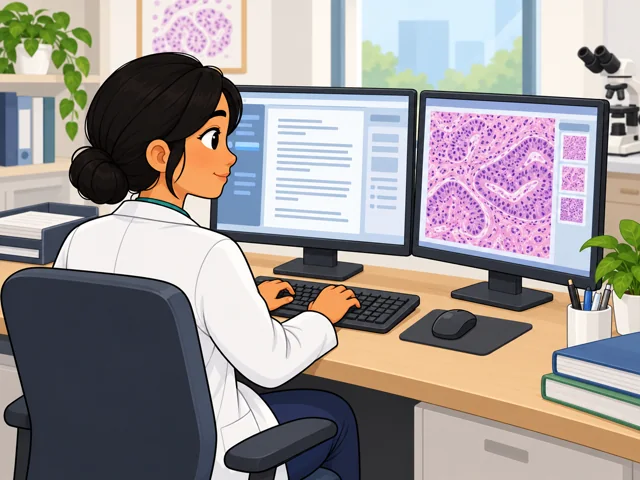
Write your observations and diagnosis into a report the patient's physician relies on to choose treatment.
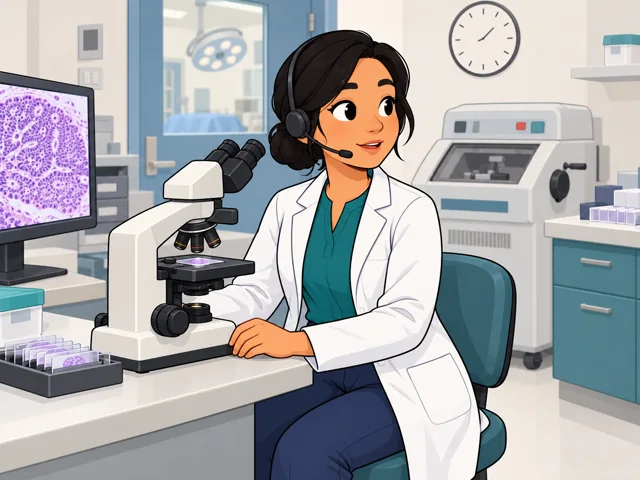
In certain surgical pathology roles, you check a fast-frozen sample mid-surgery and answer the surgeon's question.
United States
United States · May 2025
United States · 2025–2035
Quick orientation
Usually college, medical school, then three or four years of pathology residency.
Annual national wage for physician pathologists; hourly equivalent: $150.19.
About 300 openings per year nationally, including growth and replacement needs.
Software can flag suspicious areas in scanned tissue images. One authorized artificial intelligence tool does this for prostate biopsies after a pathologist's initial review.
For that tool, you still evaluate the slide and make the diagnosis; its flag is an additional clue.
How much image review software will take over remains uncertain, especially beyond narrowly defined specimen types.
Pay in context
The national median is high, but it is not a starting salary or a promise about a particular offer.
Physician pathologists had a median annual wage of $312,400, with an hourly equivalent of $150.19.
The 10th-percentile annual wage was $92,540 and the 90th-percentile wage was $449,970. These describe the wage distribution, not beginner and senior pay levels.
Employment is projected to grow 4.8%, with about 300 openings annually on average. Openings include replacing people who leave the occupation.
The usual route has two connected steps: medical school, then pathology residency. A Doctor of Medicine (MD) or Doctor of Osteopathic Medicine (DO) degree can lead to this specialty.
After entry
This starts where the entry routes leave off: early work, growing capability, and advancement or specialization.
Learn your laboratory's reporting routines and build a habit of discussing difficult cases with colleagues.
Take on more challenging interpretations and help investigate test-quality problems that affect the answers clinicians receive.
Further training in surgical pathology can deepen your work on complex specimens and add teaching and oversight of specimen examination.
Diagnostic work shares time with resident teaching and case conferences. You work across specialty teams, and surgical services may need an answer during an operation.
Forensic pathologists investigate deaths rather than an ongoing course of treatment. Autopsies involve technical staff, such as mortuary and imaging technicians, and lead to findings about cause and manner of death.
Try it
Use two labeled tissue images from a biology textbook. Write what you can actually see, then what you would need to know before explaining the difference. Notice whether close observation and separating evidence from guesses hold your interest.
Stay safe: Use educational images only; this is an observation exercise, not a way to diagnose yourself or someone else.