
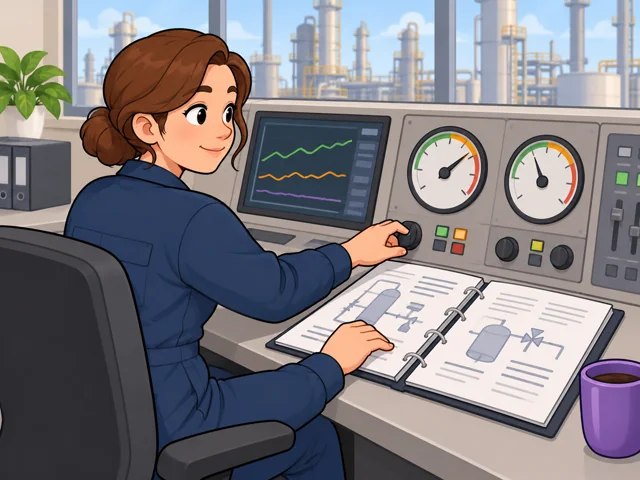
Respond to a drifting gauge
Keep watching temperature and pressure gauges, and if one drifts, consult the written procedure, then adjust controls.
Career profile
Refinery operators run the equipment that treats petroleum and moves it through pipes and tanks.
Every number on the gauges tells you something about how a valve or pump is behaving.

Keep watching temperature and pressure gauges, and if one drifts, consult the written procedure, then adjust controls.
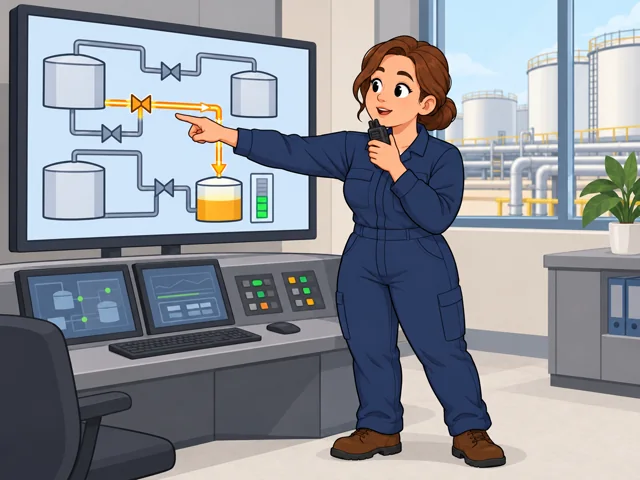
Trace the oil's planned route, coordinate valve switches by radio, then confirm it passes the correct meter.
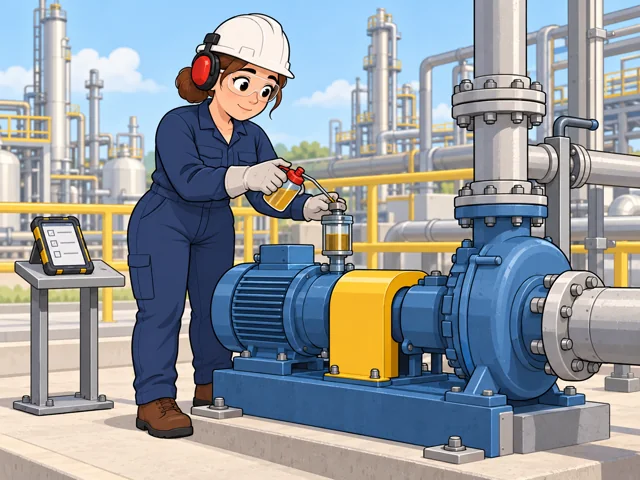
Walk the unit, inspect running pumps, refill a low lubricator, and write faults plainly in a maintenance request.
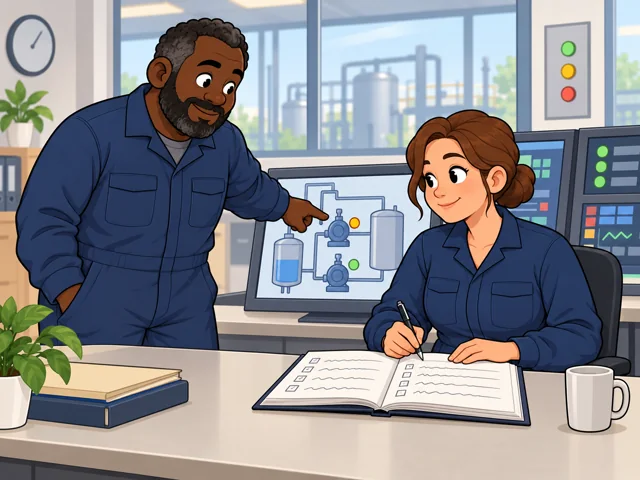
Write the unit's current state in the turnover log so the incoming operator sees which machines need care.
United States · 2025
United States · May 2025
United States · 2025–2035
Quick orientation
A diploma or equivalent is the typical starting education. Employers may add experience or technical-school requirements.
Median pay was $46.50 an hour for petroleum pump system operators, refinery operators, and gaugers combined.
About 2,700 openings a year are projected nationally for the combined occupation, despite declining employment.
Computer controls already help regulate flow and display operating readings.
You investigate equipment problems and communicate what needs attention.
How much troubleshooting becomes automated will depend on the equipment and the reliability of its measurements.
Pay in context
The national median is $96,710 a year, or $46.50 an hour. These figures combine petroleum pump operators, refinery operators and gaugers.
The lowest-paid 10% earned $57,110 or less; the highest-paid 10% earned $115,880 or more. Those are wage percentiles, not starting and senior pay rates.
The wage survey excludes overtime pay and extra pay for particular shifts. Ask for the base rate, shift premium and overtime expectations separately.
Employment is projected to fall 1.9% from 2025 to 2035, with about 2,700 openings per year across the combined occupation. Openings do not mean the workforce is growing.
Start with a high school diploma or equivalent. You can pursue employer training or build process skills in college first; check the hiring requirements before choosing.
After entry
This starts where the entry routes leave off: early work, growing capability, and advancement or specialization.
After hire, learn the equipment layout and operating procedures while completing the employer's operator training.
Build enough equipment knowledge to explain why a pump or valve is behaving differently and write a useful repair request.
Develop toward board-operator work, coordinating controls across processing equipment. Progression depends on the plant.
You work with a crew around furnaces, pumps and compressors that process crude oil. Some jobs combine rotating shifts with climbing to elevated equipment.
The focus is receiving, blending and shipping petroleum products. Depending on the site, transfers connect tanks with pipelines, trucks or barges.
Try it
Draw two imaginary oil tanks linked by a pump. Give each tank a starting amount, then record what happens when 20 units move between them. Write a two-sentence handoff for the next operator. Notice whether tracking the movement and explaining it clearly holds your interest.
Stay safe: Keep this a paper exercise; do not operate pumps or handle fuel.