

Career profile

Photographer

Photographers make pictures by choosing the light, the framing, and the right moment to shoot.

Small choices can change a whole photo. When a shadow crosses someone's face, the photographer moves a light, checks the camera and shoots again.

A photographer takes a photo with a camera.
Clem Onojeghuo clemono2 / CC0

A day in the life

1A photographer and a client discuss sample portraits and a courtyard location, with selected camera equipment beside them.

Plan the shoot with a client

Agree with the client on what the photos should show, then pick a location and gear to pack.

2The photographer tilts a reflector to brighten the shaded side of a seated client's face before another portrait.

Reshape shadows on a portrait

See where shadows land on someone's face and shift the flash or a reflector before shooting again.

3The photographer checks a blurred running photograph and adjusts the camera's shutter-speed dial as the runner returns for another attempt.

Freeze a moving subject

If a moving subject comes out blurred, change the shutter speed and then check the next frame.
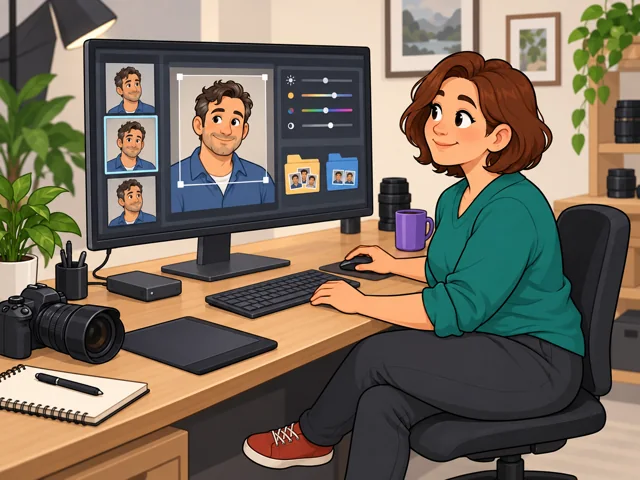
4The photographer compares portraits, refines the selected image's crop, and organizes photographs into folders at her editing desk.

Compare frames side by side

Keep the best shots, adjust their color or crop, and organize the files to deliver and find later.

Quick facts

Preparation

High school diploma typically

United States

Pay

$21.47/hour median

United States · May 2025

Outlook

1% employment decline

United States · 2025–2035

Quick orientation

Preparation, pay & outlook

Preparation

High school diploma typically

Practice and a portfolio matter; further education depends on the job.

Geography
United States
Period
Not applicable

Pay

$21.47/hour median

$44,660 annual equivalent; employee wages exclude self-employment.

Geography
United States
Period
May 2025

Outlook

1% employment decline

About 10,700 openings yearly, all projected from replacing workers who leave.

Geography
United States
Period
2025–2035

Fit, tradeoffs & changing tools

Things to weigh

  • Shoots can mean weekends, evenings, long stretches standing, and carrying equipment.
  • If you work for yourself, finding clients and handling bills take time too.

Where AI may help

Lightroom can automatically select a person or sky so you can adjust just that area. This uses artificial intelligence (AI) to help with editing.

What people still lead

You decide what to photograph, arrange the shot, and judge which frame works.

What we can’t predict yet

AI-generated images may replace some stock photography. How much commissioned photography shifts to generated images remains uncertain.

Pay in context

Earnings

Employee wages exclude freelance income. Part-time hours and seasonal workloads can change annual earnings.

The national spread

The median was $44,660 annually, equivalent to $21.47 hourly. The 10th and 90th percentiles were $30,820 and $91,810 annually. These describe the wage distribution, not starting and senior salaries.

Geography
United States
Period
May 2025
Pay basis
Employee wages; published annual and hourly equivalents

Pay by workplace industry

Hourly medians: publishing, broadcasting, and content providers, $30.04; photographic services, $18.84; retail, $18.82; arts, entertainment, and recreation, $18.47.

Geography
United States
Period
May 2025
Pay basis
Median hourly employee wages within each industry

Getting started

Assist a professional

What the route involves
Learn on the job while working as a photographer's assistant.
What it can lead to
Gain experience, portfolio material, and contact with potential clients.

Study photography

What the route involves
Take practical classes in camera controls, lighting, composition, and editing, with feedback on your photographs.
What it can lead to
Develop a portfolio you can shape around the clients or photographic work you want to pursue.
What to check
Some employers require or prefer a bachelor's degree; it is not universal.

Build a portfolio: a collection of photographs that shows what you can do.

After entry

Career paths

This starts where the entry routes leave off: early work, growing capability, and advancement or specialization.

  1. Get established

    Make your workflow dependable: check equipment, review frames, and keep delivered files organized.

  2. Develop control

    Practice with natural light and flash until you can deliberately create different effects. Develop a visual style through repeated shoots and feedback.

  3. Build a specialty

    Shape a portfolio for the work you want to attract. If you pursue your own business, develop pricing and marketing skills alongside your photography.

Where you can work

Portrait studios and client locations

Photograph individuals or groups in a studio, or pack equipment for schools and homes.

  • Indoors
  • Travel

Commercial locations

Travel to photograph products or buildings where the subject is located.

  • Field work
  • Travel

News assignments

Developing events can require short-notice travel and uncomfortable surroundings. Video may accompany still photographs.

  • Field work
  • Travel
  • On call

Try it

See whether the job clicks before you commit to the path.

Use a phone or camera you already have to photograph one everyday object. Change the light and viewpoint, then choose three images. Explain what each choice changed. Notice whether you enjoy adjusting the scene as much as seeing the finished picture.

Explore more careers

Sources

  1. U.S. Bureau of Labor Statistics. Photographers — Occupational Outlook Handbook. Accessed 2026-10-03.
  2. O*NET OnLine / U.S. Bureau of Labor Statistics. National Wages: 27-4021.00 — Photographers. Accessed 2026-10-03.
  3. O*NET OnLine. 27-4021.00 — Photographers. Accessed 2026-10-03.
  4. Adobe. Add mask with AI. Accessed 2026-10-03.
  5. New York Institute of Photography. Professional Photography Course Outline. Accessed 2026-10-03.
  6. New York Institute of Photography. Catalog. Accessed 2026-10-03.

Your message goes to the Great Jobs team. How we use your information