

Find what's limiting a patient's movement
You watch the patient walk, test their muscle strength, and match the results to tasks they struggle with.
Career profile
Physiatrists find what limits movement and daily tasks, then lead medical care toward more independence.
Physiatrists, or physical medicine and rehabilitation physicians, link diagnoses to goals like dressing or working, then choose therapies and merge team findings into one plan.
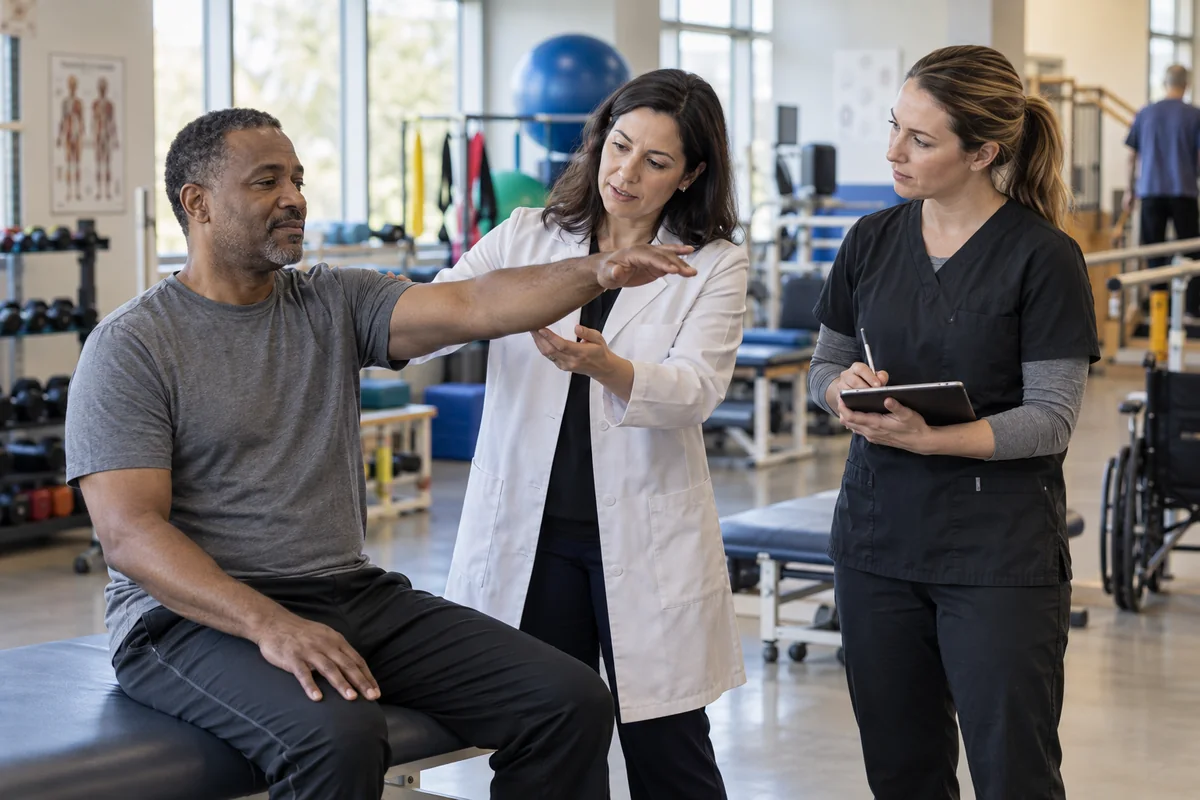
You watch the patient walk, test their muscle strength, and match the results to tasks they struggle with.

Weigh the patient's pain ratings and response to a medication or injection, then decide whether to change course.

Meet with nurses and therapists about progress, barriers and the support the patient needs after leaving rehab.

Depending on your position, you run electromyography and nerve conduction tests, electrical methods that locate the problem.
United States
United States · 2025
Hospital and clinic jobs can combine different patient groups, teaching duties, and call schedules.
Quick orientation
After medical school, the usual specialty training includes one general clinical year and three rehabilitation medicine years.
Annual compensation in a 2025 survey of full-time physicians in this specialty; this is an average, not a median or starting salary.
Hospital and clinic jobs can combine different patient groups, teaching duties, and call schedules.
Emerging software can help draft clinical notes, while remote-monitoring tools can bring information about recovery at home into a visit.
You still need to interpret those observations, examine the patient, and choose goals and treatment with the patient and rehabilitation team.
How much follow-up can move out of the clinic remains unsettled: tools must work for different disabilities, fit clinical systems, and show that they support useful care.
Pay in context
Compare compensation alongside the patient mix, schedule, and benefits. A national survey average and a particular job's salary range answer different questions.
Average annual compensation was $376,234 in the 2025 full-time physician survey. That is about $181 an hour if divided by 2,080 hours, purely for comparison; actual physician hours vary. It is not a median or an entry-level offer.
A mixed inpatient, consultation, and outpatient role lists $230,000–$240,000 for full-time work, excluding incentives and benefits. Actual salary may fall outside the range depending on experience, training, and hospital needs.
A brain injury physiatrist role lists $200,000–$290,000 a year in base plus market pay. Education and length of practice affect pay setting. These job ranges illustrate offers in different settings; they do not establish which workplace type pays more.
Usually, you complete a bachelor's degree and then a Doctor of Medicine (MD) or Doctor of Osteopathic Medicine (DO) degree. The residency options below are supervised physician training after medical school. State licensure also requires qualifying training and national licensing exams: the United States Medical Licensing Examination or Comprehensive Osteopathic Medical Licensing Examination of the United States. Exact state requirements vary.
After entry
This starts where the entry routes leave off: early work, growing capability, and advancement or specialization.
Learn your workplace's handoffs and build a reliable way to follow each patient's goals across medical visits and therapy sessions.
Build experience with a patient group, such as people recovering from stroke or managing spine pain. Use follow-up results to refine your treatment choices.
Brain injury medicine is one option. Board-certified physiatrists with an unrestricted license can pursue a 12-month accredited fellowship; program-director recommendation and passing the subspecialty exam are also required for certification.
Your patients stay in the facility while receiving medical care and intensive rehabilitation. Frequent exchanges with nurses and therapists shape decisions about progress and leaving the hospital.
You see people with spine pain or orthopaedic injuries during appointments and follow their response over time. A shared practice may include surgeons, while your own treatment focuses on nonsurgical care.
Some roles combine brain injury care with general rehabilitation clinics, resident teaching, and coverage for hospitalized patients. A weekday clinic schedule may also include weekend call.
Try it
Choose an everyday goal, such as getting dressed. On paper, imagine someone has difficulty with it after an injury. Write the questions a rehabilitation physician would need answered about symptoms, movement, and home needs before choosing treatment. Mark which questions would need input from a therapist or nurse. Notice whether connecting medical questions with daily life interests you.
Stay safe: Keep this a paper exercise; do not examine someone or recommend treatment.