
Career profile

Podiatrist

Podiatrists diagnose and treat foot problems, from sore joints to trouble caused by diabetes.

When walking hurts, the patient's story and a hands-on exam start the search for a medical cause and for care that might help.
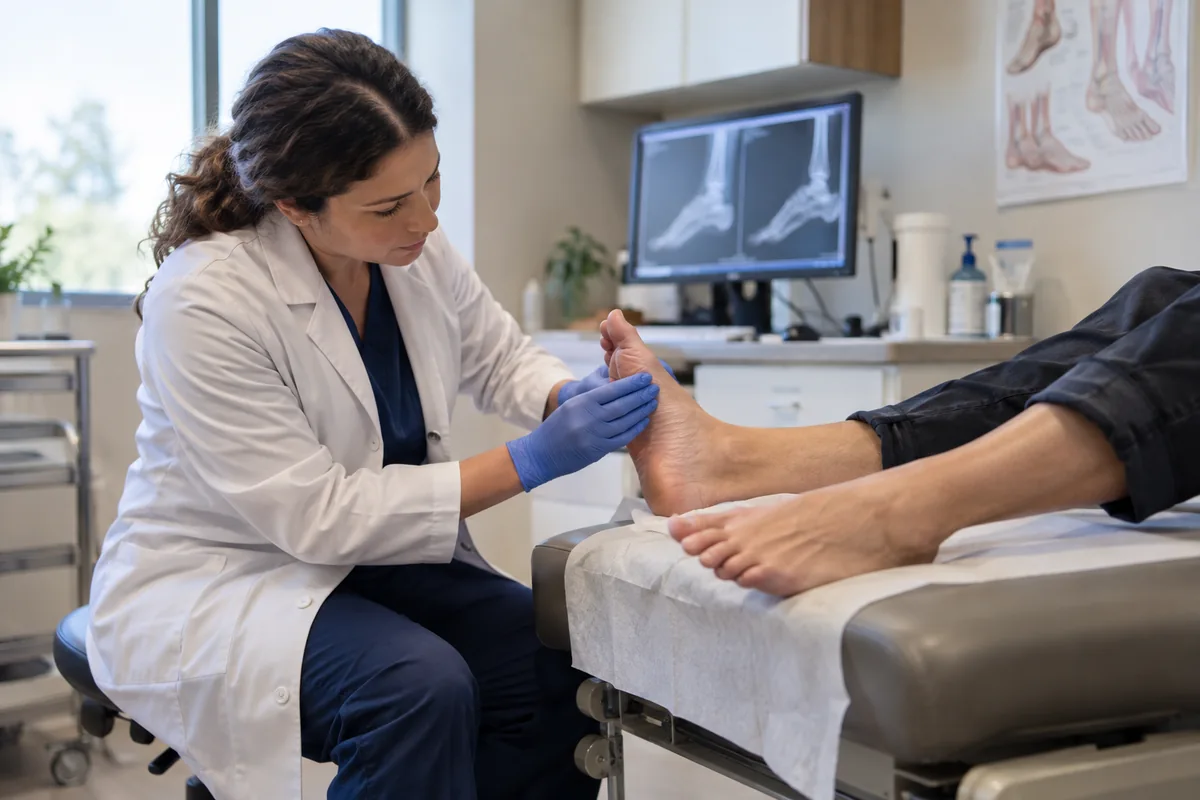
podiatrist examining an adult patient’s foot in a clinic.

A day in the life

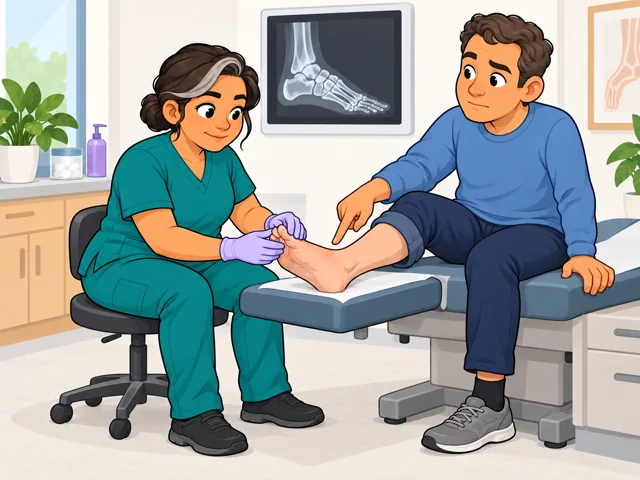
1A podiatrist examines a seated man's forefoot as he indicates the painful area, with a foot X-ray nearby.

Examine a painful foot

Ask when the pain started, look the foot over, and read an X-ray if the case needs one.
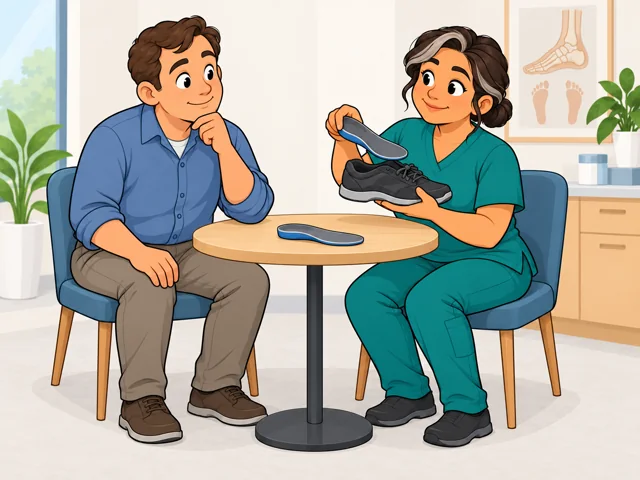
2A podiatrist shows a man how a contoured insert fits into his shoe while explaining a treatment option.

Explain the treatment choice

You walk the patient through whether a shoe insert, medication or other care suits their problem and why.

3A podiatrist and an assistant perform bunion surgery around a patient's draped foot in an operating room.

Correct a painful bunion

In practices that do surgery, you operate on a bunion to fix the misshapen spot that hurts.
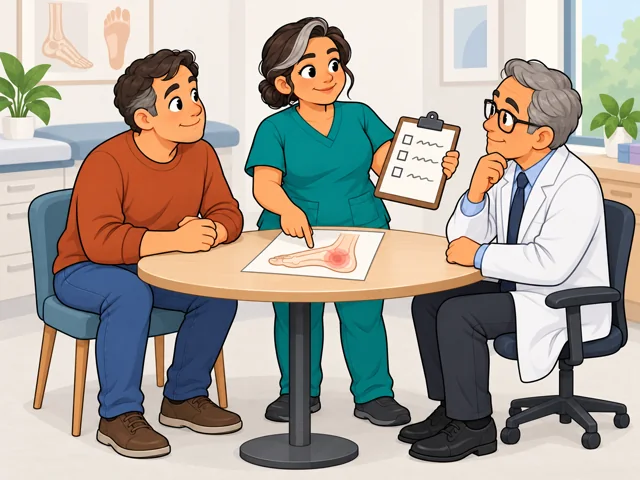
4A podiatrist reviews a foot finding with a patient and another physician while explaining a referral for broader assessment.

Refer patients to another doctor

If the exam points to something like arthritis or diabetes, send the patient on to another doctor.

Quick facts

Preparation

Doctoral or professional degree

United States

Pay

$160,300 median

United States · May 2025

Outlook

2% projected growth

United States · 2025–2035

Quick orientation

Preparation, pay & outlook

Preparation

Doctoral or professional degree

A Doctor of Podiatric Medicine (DPM) degree takes four years after college preparation, followed by residency.

Geography
United States
Period
Not applicable

Pay

$160,300 median

National annual median for podiatrists; the hourly equivalent is $77.07.

Geography
United States
Period
May 2025

Outlook

2% projected growth

About 200 openings per year are projected nationally, including replacement openings.

Geography
United States
Period
2025–2035

Fit, tradeoffs & changing tools

Things to weigh

  • You work close to patients and encounter infections.
  • Some jobs include evenings, weekends or emergency call.
  • College preparation comes before four years of professional school and usually three years of residency.

Where AI may help

Researchers have tested shoe insoles that measure foot temperature and send readings through a phone app. This could help clinicians notice changes between visits in people at risk of diabetic foot wounds.

What people still lead

In that research approach, a clinician interprets persistent alerts and decides how to respond. A temperature reading supplies information for a treatment decision.

What we can’t predict yet

How much monitoring can move home remains uncertain. Reliable readings, patients using the equipment consistently, and clinics responding to alerts all affect whether it changes everyday care.

Pay in context

Earnings

The national figures describe employed podiatrists across experience levels. They are not a starting salary or the take-home income of a practice owner.

The median and spread

The May 2025 median was $160,300 a year, equivalent to $77.07 an hour. The 10th-percentile wage was $66,010 and the 90th-percentile wage was $309,670. Those points describe the national wage distribution, not a beginner-to-expert pay ladder.

Geography
United States
Period
May 2025
Pay basis
Gross employee wages for SOC 29-1081; excludes self-employed income.

A small occupation with replacement openings

Employment is projected to grow 2% from 2025 to 2035, with about 200 openings annually on average. Openings include replacing people who leave the occupation as well as growth.

Geography
United States
Period
2025–2035
Pay basis
Employment projection, not compensation.

Getting started

Complete college preparation and podiatric medical school

What the route involves
Complete at least 90 semester hours of college, including required science labs and English; most entrants have a bachelor's degree. Check each school's admissions test policy, commonly the Medical College Admission Test (MCAT). Then study medical sciences and treat patients in clinical rotations during the four-year DPM program.
What it can lead to
Graduation earns the DPM degree and leads into postgraduate training. The American Podiatric Medical Licensing Examination (APMLE) series separately assesses basic science and clinical competence.

Train in a hospital residency

Usually three years; some programs take four.
What the route involves
After the degree, build medical and surgical skills through supervised inpatient and outpatient care in a podiatric medicine and surgery residency.
What it can lead to
You develop the experience needed for independent clinical work and enter pathways toward specialty board certification.
What to check
Residency may require a training or full license. Check the licensing board in the state where you will train.

These are two linked parts of the training path: professional school first, then residency. You also need a state license to practice.

After entry

Career paths

This starts where the entry routes leave off: early work, growing capability, and advancement or specialization.

  1. Get established

    Build a dependable routine for patient records and follow-up.

  2. Deepen your judgment

    Build experience with patients whose foot problems are complicated by diabetes or other chronic illnesses.

  3. Choose a focus

    Develop a practice focused on sports injuries, children's feet or surgery.

    • Practice ownership adds responsibility for staffing and supplies.

Where you can work

Your own podiatry office

Patient care shares your attention with hiring and ordering supplies. Ownership may give you more control over office hours.

  • Indoors
  • Office

A group medical practice

You work alongside other physicians or specialists, with more of your working relationships inside a shared practice.

  • Indoors
  • Office

An urgent-care facility

Emergency call can interrupt your schedule; some podiatrists must be available when urgent problems arise.

  • Indoors
  • On call

Try it

See whether the job clicks before you commit to the path.

Imagine someone says, “My heel hurts when I walk.” Write five questions you would want to ask before choosing a treatment, then mark what would require an examination or test. Notice whether gathering clues interests you as much as finding an answer.

Stay safe: Keep this a paper exercise; do not diagnose or treat anyone.

Explore more careers

Sources

  1. O*NET OnLine. 29-1081.00 — Podiatrists. Accessed 2026-10-09.
  2. American Podiatric Medical Association. FAQ about Today's Podiatrists. Accessed 2026-10-09.
  3. U.S. Bureau of Labor Statistics. Occupational Outlook Handbook — Podiatrists. Accessed 2026-10-09.
  4. U.S. Bureau of Labor Statistics. May 2025 Occupational Employment and Wage Statistics — National estimates. Accessed 2026-09-29.
  5. U.S. Bureau of Labor Statistics. Employment Projections Table 1.2 — 2025–2035. Accessed 2026-09-29.
  6. American Association of Colleges of Podiatric Medicine. Admissions. Accessed 2026-10-09.
  7. American Association of Colleges of Podiatric Medicine. Podiatric Education. Accessed 2026-10-09.
  8. American Association of Colleges of Podiatric Medicine. Residencies. Accessed 2026-10-09.
  9. National Board of Podiatric Medical Examiners. What Is on the American Podiatric Medical Licensing Examination. Accessed 2026-10-09.
  10. Trials; study authors via PubMed. Study protocol for a randomized controlled trial of sensor-equipped insoles and photo documentation. Accessed 2026-10-09.

Your message goes to the Great Jobs team. How we use your information