
Career profile

Print Binding and Finishing Worker

Bindery workers turn printed sheets into books, booklets and other finished pieces ready to use.

Fold, fasten, trim, then inspect what you made. A loose page or crooked fold is a problem you can hold in your hands and fix.
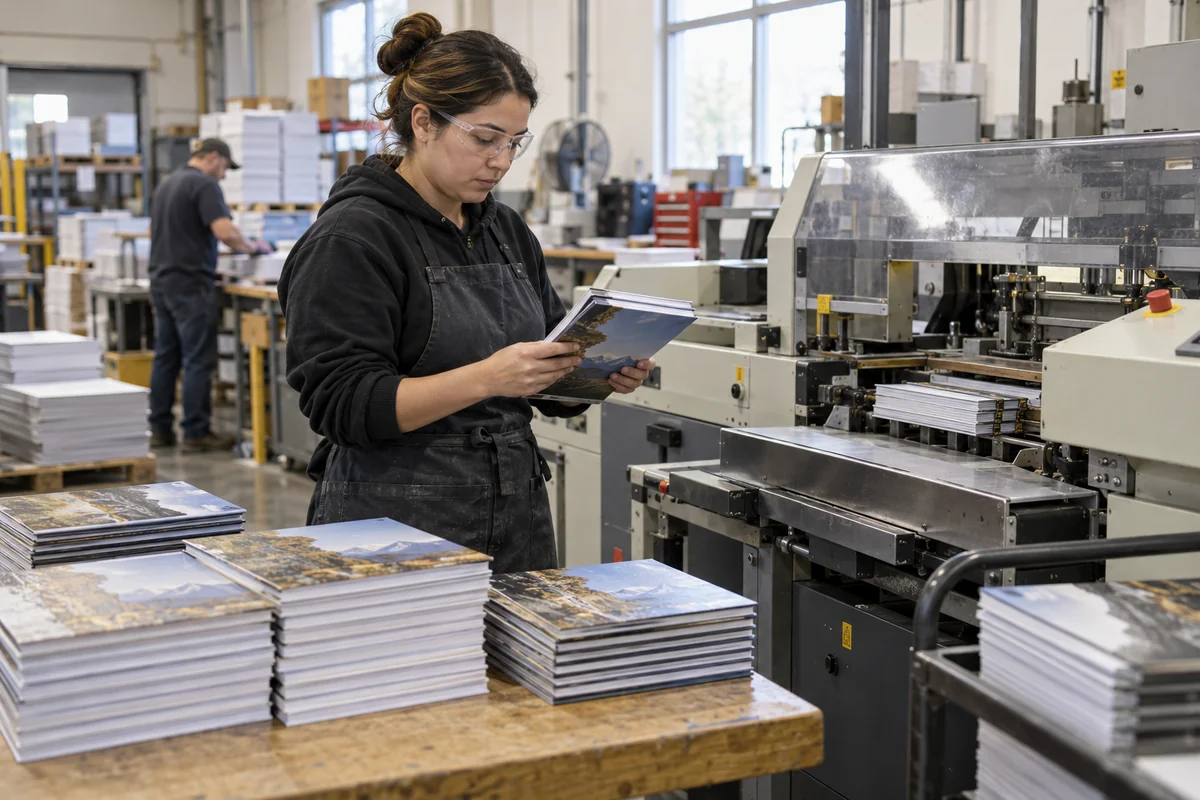
Print binding worker checks finished books beside a binding machine.

A day in the life

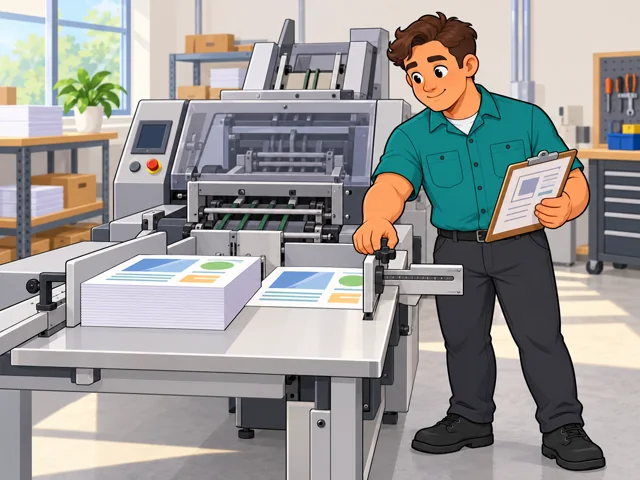
1A print finishing worker checks a work order while adjusting a stopped machine's paper guide against a sample sheet.

Set guides for the page size

You read the coming job's work order, then move the guides to the required page size.
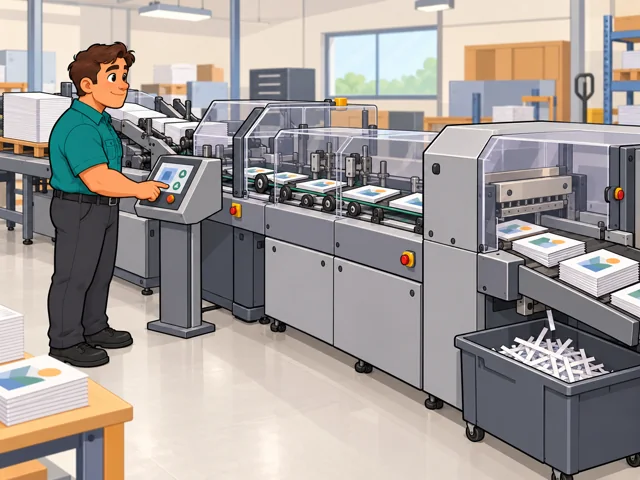
2A worker operates a guarded booklet-making line as printed sheets are folded, bound, and trimmed into finished booklets.

Run the folder and binder

Run the folding and binding machines that turn loose sheets into booklets, then cut their edges even.
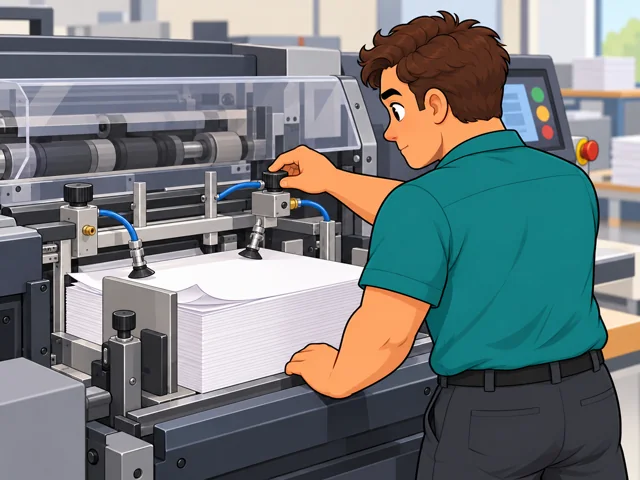
3With the feeder paused, a worker studies curled sheets and adjusts the sheet-separation air control to improve feeding.

Get curled paper feeding again

When curled paper throws off the feed, find the setting that gets sheets running smoothly and evenly again.

4A worker opens a finished booklet and gently checks its pages and binding for looseness, tears, or weak attachment.

Catch flaws in a sample

Examine a finished sample for loose pages, torn sheets and weak bindings before the machine runs more copies.

5A worker packs wrapped books into a carton while a very-light-skinned woman coworker stacks a sealed box on a shipping pallet.

Wrap, box and stack books

Wrap the finished books, box them and stack the boxes so the order is ready to ship.

Quick facts

Preparation

High school + workplace training

United States · 2025

Pay

$42,290 a year

United States · 2025

Outlook

17.5% projected decline

United States · 2025–2035

Quick orientation

Preparation, pay & outlook

Preparation

High school + workplace training

A high school diploma or equivalent is typical, followed by training on the job.

Geography
United States
Period
2025

Pay

$42,290 a year

National median employee pay in 2025, equivalent to $20.33 an hour.

Geography
United States
Period
2025

Outlook

17.5% projected decline

Employment is projected to shrink during 2025–2035, with about 2,300 openings a year.

Geography
United States
Period
2025–2035

Fit, tradeoffs & changing tools

Things to weigh

  • Standing, repeated hand movements, and machine noise can make a shift tiring.
  • Production deadlines add pressure, and some plants run long shifts.

Where AI may help

On compatible equipment, scanning a job ticket can load machine settings. Robotic systems can also move stacks between binding and trimming machines.

What people still lead

Operators troubleshoot paper problems, adjust equipment, and coordinate the crew when production goes off track.

What we can’t predict yet

How much feeding, setup, and checking becomes automatic will depend on the equipment a shop buys and the jobs it handles. Fully linked production lines can change that mix substantially.

Pay in context

Earnings

The national median gives you a reference point for comparing offers, not a promised starting wage.

The middle and the spread

In 2025, median pay was $42,290 a year, or $20.33 an hour. The lowest-paid 10% earned $32,220 or less; the highest-paid 10% earned $59,150 or more. These are wage percentiles, not beginner and experienced pay rates.

Geography
United States
Period
2025
Pay basis
National employee wage median and annual 10th/90th percentiles

Workplace pay differs

For historical context, May 2023 average annual pay was $41,150 in printing and related support businesses, $37,950 with newspaper, periodical, book, and directory publishers, and $31,720 in employment services. These older averages are not current offers.

Geography
United States
Period
May 2023
Pay basis
Industry mean annual employee wages for print binding and finishing workers

Compare the whole offer

Skills, experience, shift, and location can affect an operator's offer. Ask for the base hourly rate and whether overtime or extra shift pay is separate.

Geography
United States
Period
Not stated
Pay basis
Employer-described base-pay factors and possible additional compensation

Openings despite a shrinking workforce

National employment is projected to fall 17.5% from 2025 to 2035. About 2,300 openings a year are still projected across the occupation; that does not mean 2,300 new jobs are being added.

Geography
United States
Period
2025–2035
Pay basis
Employment projection and annual average occupational openings; not compensation

Getting started

Learn in an entry-level bindery job

Paid
What the route involves
Apply for entry-level bindery or cutter-operator work that accepts beginners. Learn to replenish materials, monitor equipment, and record output with an experienced worker.
What it can lead to
You build the operating skills needed to handle production equipment; prior related experience is not typical for entry.
What to check
If you are under 18, federal rules generally bar work with certain powered paper machines, including guillotine cutters. Limited training exceptions exist, and state rules may be stricter; check the actual duties before accepting.

Study hand bookbinding

Two academic years at North Bennet Street School in Boston.
What the route involves
Practice making and repairing cloth, paper, and leather bindings through North Bennet Street School's bench-based program.
What it can lead to
Completion earns a Diploma of Bookbinding and produces a portfolio for pursuing craft-focused bindery work.
What to check
Admission is selective. Requirements include proof of completed high school or equivalent or a completed college degree, two recommendations, an essay, a resume, an information session, interviews, and a portfolio of 6–8 handwork images.

Production work commonly starts with workplace training. Hand bookbinding also has a more intensive school route.

After entry

Career paths

This starts where the entry routes leave off: early work, growing capability, and advancement or specialization.

  1. Get reliable at one station

    Keep materials supplied and production records accurate while learning the station's normal rhythm.

  2. Handle changing paper and jobs

    Learn setups for different paper weights and sizes, then tackle the adjustments that keep difficult stock feeding correctly.

  3. Run a line or specialize

    Develop toward operating a complex binding line and coordinating its crew.

    • Build hand-binding skills for custom leather or cloth books and protective cases.

Where you can work

Commercial production plants

You work around linked machines and a production crew. Output and consistency matter throughout the run; some plants use long shifts to keep equipment working.

  • Indoors
  • Shift work
  • Physical demands
  • Safety-sensitive

Custom hand binderies

Bench work and hand tools shape individual books or small editions. Orders may involve leather covers or fitted cases for collectors and libraries, with more attention to each object's materials and finish.

  • Indoors
  • Physical demands

Try it

See whether the job clicks before you commit to the path.

Fold three sheets of scrap paper into a booklet and number the pages. Unfold it, then make a matching copy. Compare page order, fold alignment, and edges. Notice whether getting the second copy consistent feels satisfying or frustrating.

Stay safe: Use paper and a pencil; no cutter or powered equipment is needed.

Explore more careers

Sources

  1. O*NET OnLine. 51-5113.00 — Print Binding and Finishing Workers. Accessed 2026-10-05.
  2. O*NET OnLine / U.S. Bureau of Labor Statistics. Print Binding and Finishing Workers wages — United States rows. Accessed 2026-10-05.
  3. U.S. Bureau of Labor Statistics. Occupational projections, 2025–35, and worker characteristics, 2025. Accessed 2026-10-05.
  4. U.S. Bureau of Labor Statistics. May 2023 Occupational Employment and Wages — Print Binding and Finishing Workers. Accessed 2026-10-05.
  5. Vericast. Bindery/Cutter Operator — 1st Shift. Accessed 2026-10-05.
  6. RR Donnelley. Bindery Operator 3 — Die Cutter Apprentice. Accessed 2026-10-05.
  7. North Bennet Street School. Bookbinding. Accessed 2026-10-05.
  8. North Bennet Street School. Admissions. Accessed 2026-10-05.
  9. Horizon International. pXnet Bindery Control System brochure. Accessed 2026-10-05.
  10. Horizon International. Horizon Smart Factory 2024 — The Complete Guide. Accessed 2026-10-05.
  11. Harcourt Bindery. Traditional Bookbinding. Accessed 2026-10-05.
  12. U.S. Department of Labor, Wage and Hour Division. Child Labor Bulletin 101 — Nonagricultural Occupations. Accessed 2026-10-05.

Your message goes to the Great Jobs team. How we use your information