

Sort what a witness saw
Question a witness and separate what they saw for themselves from what someone told them.
Career profile
Private investigators dig up facts that matter to the client who hired them.
Documents, interviews and what you saw with your own eyes all go into one account that someone else can check.

Question a witness and separate what they saw for themselves from what someone told them.
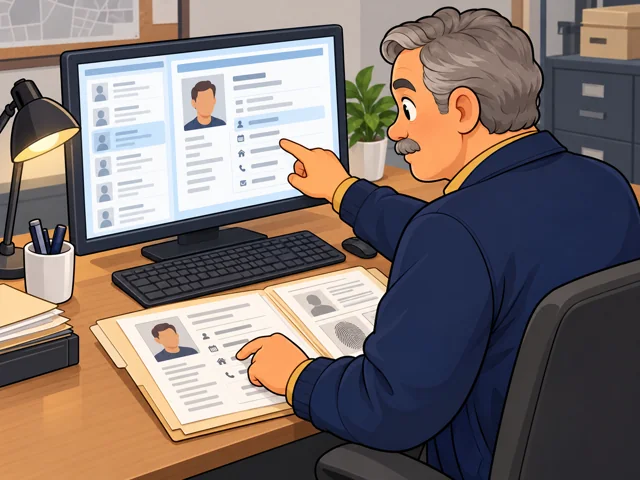
Search court records and databases, and compare identifying details before you accept a hit as your person.

On field cases, you use a camera and running notes to record what a person does.

Tie each finding in your report to its records and notes, and mark what you saw versus inferred.
United States
United States · May 2025
United States · 2025–2035
Quick orientation
Related work experience is typical; most states require licensing.
National employee median: $24.62/hour.
About 3,200 openings annually, including replacement openings.
Searchable databases help you find records.
You judge whether records and interviews support a conclusion.
How much searching becomes automatic, and how much checking it leaves you, remains uncertain.
Pay in context
These employee wages are not starting-pay offers.
The median was $51,220 annually, or $24.62 hourly. The lowest 10% earned below $36,740; the highest 10% earned above $97,630. These are wage percentiles, not career stages.
Annual medians were $41,480 in retail, $50,720 in administrative and support services, and $72,740 in finance and insurance.
Check your state's rules before choosing training. Private investigators have no police authority. These routes illustrate how requirements differ.
After entry
This starts where the entry routes leave off: early work, growing capability, and advancement or specialization. This path also has a credential or licensing boundary; see the requirements and limits.
Make your notes and reports easy to follow.
Compare interviews with records to identify what still needs checking.
Develop a specialty such as tracing stolen funds through financial records.
Client cases can move you between desk research and surveillance outdoors or from a vehicle.
Your cases concern one employer's business, such as employee theft or prospective employees' backgrounds.
Try it
Ask a friend to invent two short witness accounts and a receipt for a fictional missing-package case. Build a timeline, mark contradictions, and write one follow-up question. Notice whether you enjoy checking what the evidence actually supports.
Stay safe: Use fictional people and records; do not follow or investigate a real person.