

Career profile

Psychiatrist

Psychiatrists are medical doctors who care for people with psychiatric conditions.

Diagnosis is medical detective work, and conversation is one clue. You link a patient's story to their medical history, then plan care together.
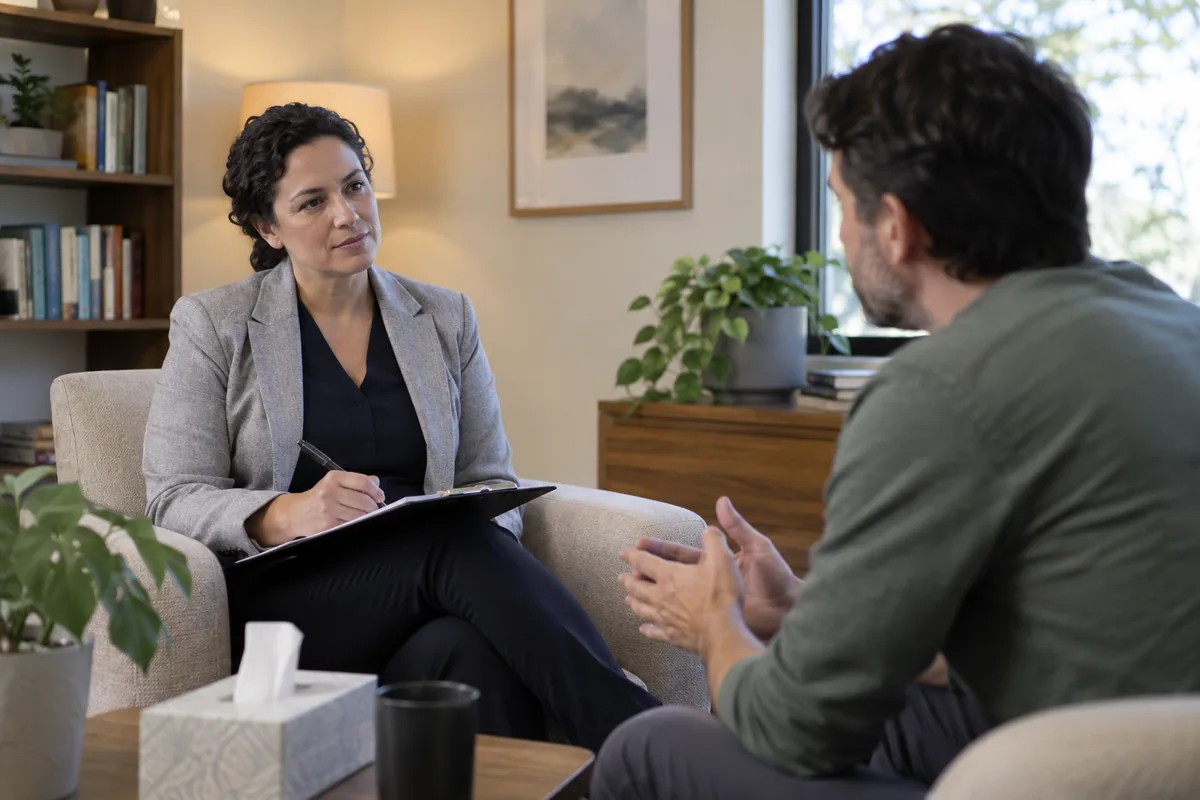
psychiatrist talking with an adult patient in a quiet consultation room.

A day in the life

1A psychiatrist reviews an open medical record while listening to a woman describe when her symptoms began.

Piece the history together

Ask when symptoms began, read their records, and decide if lab or other tests could confirm the diagnosis.

2A psychiatrist listens to a man discuss his response to medication, with a medication container and treatment record on the table.

See if the medication works

Find out if the patient feels better and has side effects, then decide whether to adjust the plan.

3A psychiatrist guides a woman through a conversational role-play as she practices responding differently to a difficult interaction.

Work on a repeating pattern

In psychotherapy roles, you help patients explore experiences and rehearse new habits to replace troublesome ones.

4A psychiatrist compares progress notes with two clinicians and records their agreed plan in an electronic patient chart.

Plan with the care team

Talk over a patient's progress with a nurse or therapist, agree on next steps, and chart the plan.

Quick facts

Preparation

Medical degree + residency

United States

Pay

$281,870/year

United States · May 2025

Outlook

7.2% projected growth

United States · 2025–2035

Quick orientation

Preparation, pay & outlook

Preparation

Medical degree + residency

A professional medical degree is followed by specialty training in psychiatry.

Geography
United States
Period
Not applicable

Pay

$281,870/year

National median for psychiatrists; equivalent to $135.51 an hour.

Geography
United States
Period
May 2025

Outlook

7.2% projected growth

About 900 openings a year on average, including growth and replacement.

Geography
United States
Period
2025–2035

Fit, tradeoffs & changing tools

Things to weigh

  • Appointments and records compete for time; workweeks can extend beyond 40 hours.
  • Hospital coverage can include nights, weekends, and urgent assessments when you are on call.

Where AI may help

Some artificial intelligence (AI) tools can draft visit notes or summarize records. You still need to check what they produce.

What people still lead

You lead the patient evaluation and remain responsible for diagnosis and treatment decisions, including when software suggests an answer.

What we can’t predict yet

How much assessment work can safely move to AI remains unsettled, especially when a patient’s situation does not match patterns in its data.

Pay in context

Earnings

The national figures describe psychiatrists across jobs, not a salary you can expect immediately after training.

The middle of the wage distribution

The median was $281,870 a year, equivalent to $135.51 an hour. Half earned more and half earned less.

Geography
United States
Period
May 2025
Pay basis
National occupational wages for psychiatrists, SOC 29-1223.

A wide national spread

The 10th-percentile annual wage was $84,060; the 90th-percentile wage was $446,520. These are positions in the wage distribution, not beginner and experienced pay rates.

Geography
United States
Period
May 2025
Pay basis
Annual wage percentiles for psychiatrists, SOC 29-1223.

Openings over the coming decade

Employment is projected to grow 7.2%, with about 900 openings annually on average. Openings include replacing people who leave the occupation as well as new positions.

Geography
United States
Period
2025–2035
Pay basis
Employment projection and annual average openings; not compensation.

Getting started

Build the medical foundation

Medical school typically takes four years after college.
What the route involves
Usually, complete a bachelor’s degree and the medical school’s prerequisites, then study medicine through classes and supervised patient rotations.
What it can lead to
A qualifying medical degree lets you pursue admission to psychiatry residency.

Train in a psychiatry residency

The standard general psychiatry residency takes four years.
What the route involves
After medical school, treat patients with faculty supervision while learning general medicine, psychiatric assessment, medication treatment, and psychotherapy.
What it can lead to
Completing the required training and clinical skills evaluations meets the training requirements for the psychiatry board examination.
What to check
Independent practice also requires a state medical license. Licensing examinations and postgraduate-training requirements vary by state; check the board where you plan to practice.

Medical school and residency are consecutive steps. You can enter medical school through either a Doctor of Medicine (MD) or Doctor of Osteopathic Medicine (DO) program.

After entry

Career paths

This starts where the entry routes leave off: early work, growing capability, and advancement or specialization. This path also has a credential or licensing boundary; see the requirements and limits.

  1. Get established

    After residency, build reliable follow-up routines and working relationships with patients’ other clinicians.

  2. Sharpen your treatment decisions

    Review outcomes and use continuing education to improve how you choose and adjust treatments.

  3. Specialize or teach

    Pursue fellowship training in an area such as addiction or geriatric psychiatry.

    • Develop a teaching role with medical students and residents.

Where you can work

Outpatient clinic

You see patients who return for follow-up visits. This setting can support ongoing medication care and psychotherapy over time.

  • Indoors
  • Office

Psychiatric hospital or emergency service

You care for people staying in hospital or arriving for urgent assessment. Coverage can involve overnight and weekend shifts.

  • Indoors
  • Shift work
  • On call

Try it

See whether the job clicks before you commit to the path.

Imagine a fictional adult says, “I’m sleeping poorly and can’t concentrate.” Write five questions you would want answered before drawing conclusions, including questions about physical health and daily life. Notice whether gathering the story interests you as much as finding an explanation.

Stay safe: Keep this fictional; do not diagnose someone you know or suggest medication.

Explore more careers

Sources

  1. O*NET OnLine. 29-1223.00 — Psychiatrists. Accessed 2026-10-09.
  2. U.S. Bureau of Labor Statistics. May 2025 national Occupational Employment and Wage Statistics — pinned SOC 29-1223 values. Accessed 2026-09-29.
  3. U.S. Bureau of Labor Statistics. Employment Projections, Table 1.2, 2025–2035 — pinned SOC 29-1223 values. Accessed 2026-09-29.
  4. American Psychiatric Association. What Is Psychiatry?. Accessed 2026-10-09.
  5. U.S. Bureau of Labor Statistics. Physicians and Surgeons — education and psychiatry-specific task context. Accessed 2026-10-09.
  6. American Board of Psychiatry and Neurology. Psychiatry — Initial Certification Requirements. Accessed 2026-10-09.
  7. American Board of Psychiatry and Neurology. Become Certified — General Requirements. Accessed 2026-10-09.
  8. Federation of State Medical Boards. State-Specific Requirements for Initial Medical Licensure. Accessed 2026-10-09.
  9. Yale School of Medicine. Psychiatry Residency Clinical Curriculum. Accessed 2026-10-09.
  10. American Psychiatric Association. Resource Document on Artificial Intelligence in Psychiatric Care. Accessed 2026-10-09.

Your message goes to the Great Jobs team. How we use your information