
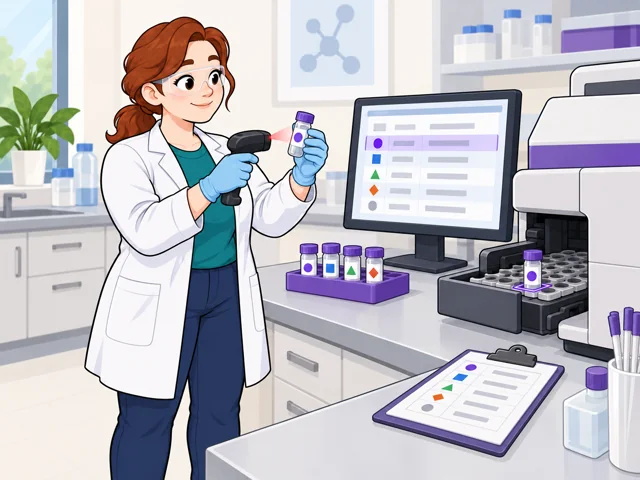
Log a sample and test it
Receive a sample, log it in inventory, then run its required test, keeping results tied to that sample.
Career profile
Quality control analysts test incoming materials and finished products, then compare results with required limits.
A reading outside the allowed range is something to chase. It fits anyone who enjoys precise lab work and finding why numbers look wrong.

Receive a sample, log it in inventory, then run its required test, keeping results tied to that sample.

In labs doing chemistry for medicines, you measure a reference sample and compare it to the expected response.

Compare each result to the product's spec and help a supervisor trace the cause of any surprising reading.

In computer-based drug testing labs, keep raw readings, instrument settings and edit logs a chart does not show.
United States
Compare pay for the specific laboratory, location, and analyst level.
A national growth rate is not available separately for this job.
Quick orientation
Some jobs accept an associate degree; others require a bachelor's degree and specific testing experience.
Compare pay for the specific laboratory, location, and analyst level.
A national growth rate is not available separately for this job.
Computerized instruments produce readings and calculations; electronic records keep the settings and history behind each result.
People still investigate unexpected results, check the method and equipment, and decide what the evidence supports.
In drug manufacturing, monitoring during production can change reliance on separate lab tests. How much this shifts your day toward reviewing data will depend on the product and process.
Pay in context
Pay depends on the position's level, required skills, and location. These advertised ranges give you concrete comparison points.
A pharmaceutical manufacturing laboratory in Walkersville advertises $61,200–$71,400 in annual base pay, roughly $29.42–$34.33 an hour using 2,080 hours. This position requires two years of relevant laboratory experience.
An Analyst II role at the same site advertises $70,200–$81,900 in annual base pay and requires three years of relevant experience. Its work includes investigations and training colleagues; moving up is not automatic.
A cell-therapy laboratory role in Pearland includes extra pay for nights and weekends. Ask whether a quoted offer includes that premium and when it applies.
Match your education to the laboratory work you want. Job titles alone do not tell you whether prior lab experience is required.
After entry
This starts where the entry routes leave off: early work, growing capability, and advancement or specialization.
Learn the lab's test procedures, sample handling, and records. Build consistency before taking on more complex work.
Develop your troubleshooting skills and help investigate results that fall outside the expected range.
An Analyst II role can add training colleagues, helping prove that a test method works reliably, and transferring methods between laboratories.
Your work can take you between the bench and cleanrooms to check products and the manufacturing environment. Testing must fit production timelines, and some teams cover nights.
You work with cell-based tests and specialized instruments such as flow cytometers, which measure characteristics of cells. These teams test material for release and check how products hold up during storage.
Try it
Make a mock quality record: measure the length of five paper strips, label each one, and record the results. Set an acceptable range before checking them. Remeasure one strip and investigate any difference. Notice whether you enjoy keeping the evidence clear as much as taking the measurements.