
Career profile

Radiologic Technologist

Radiologic technologists run X-ray and CT machines for diagnosis, keeping patients positioned, informed and safe.

A usable image depends on precise setup and on steady, calm attention to the person being scanned, who is often hurt or anxious.
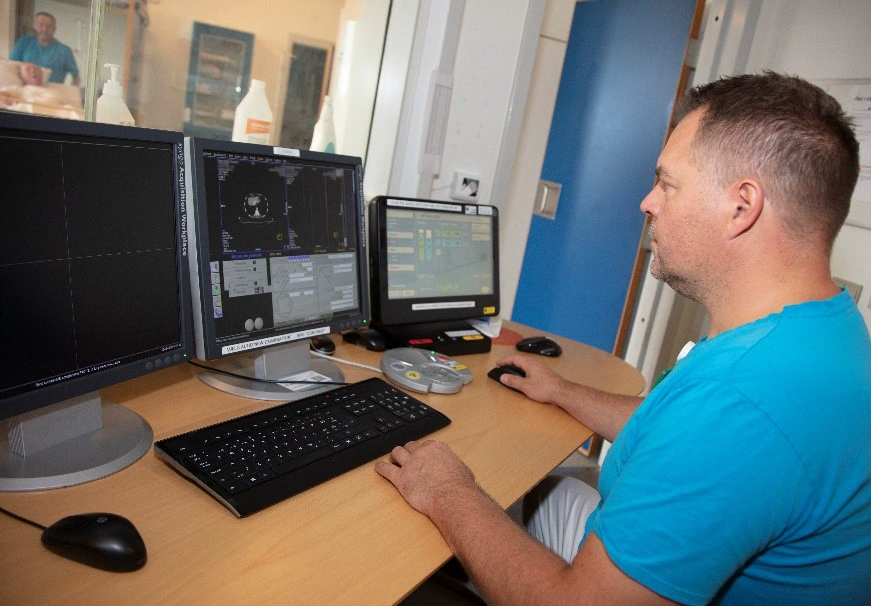
A civilian radiographer checks CT image quality at a hospital workstation.
Lene, Lise-Lotte / CC BY-SA 4.0

A day in the life

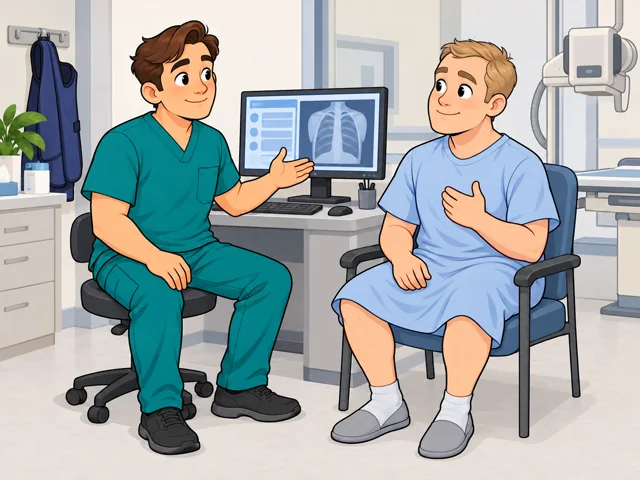
1A radiologic technologist reviews an exam order and listens to a seated patient while explaining a chest X-ray.

Prepare the patient for imaging

Confirm the requested body part, gather relevant history, explain the exam and watch for questions or worry.
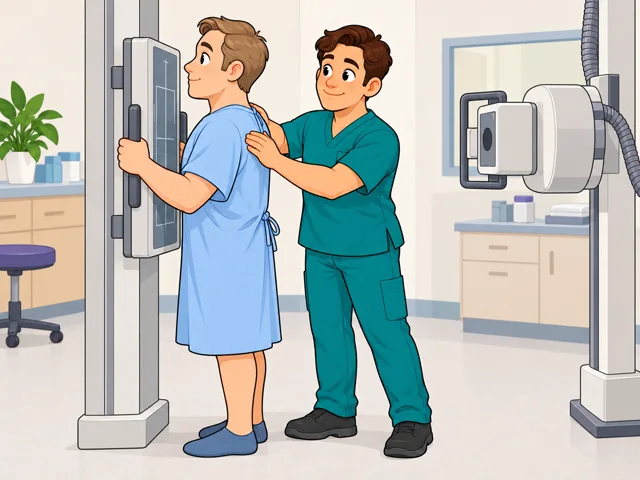
2The technologist gently positions a patient at an upright detector for a chest X-ray.

Get the patient in position

You position the person and align the machine so the requested area shows sharply, avoiding needless retakes.
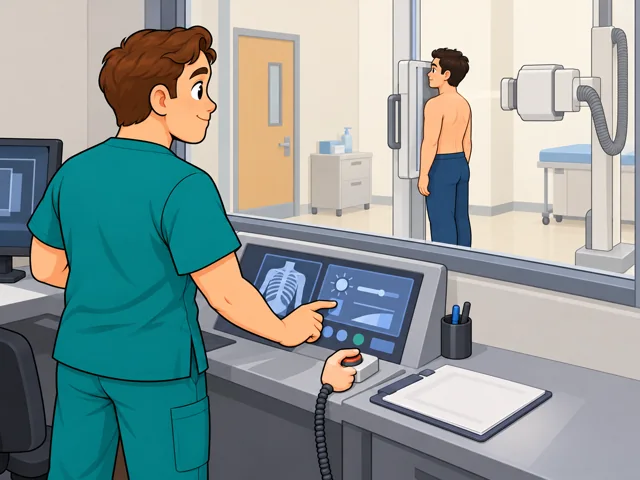
3Behind a protective window, the technologist operates the X-ray console while watching the positioned patient.

Choose settings and take the image

Pick settings from the protocol, take protective measures, then run the computer-controlled X-ray machine or CT scanner.
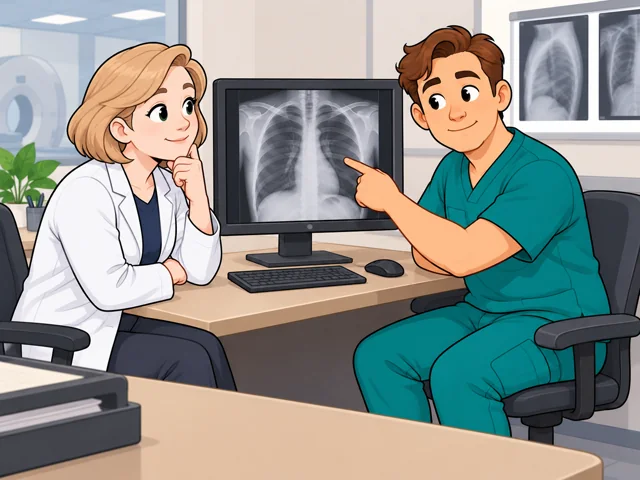
4The technologist and a physician assess a chest radiograph together to determine whether another view is needed.

Judge whether the image works

Decide if the image meets the request, working with a doctor when an extra view may be needed.
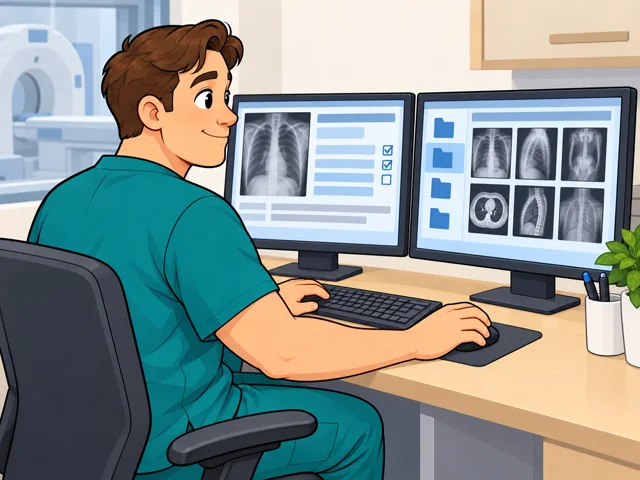
5The technologist checks image details and completes the digital examination record at a workstation.

Label and archive each exam

Write up each exam accurately, and on some shifts take portable images at bedsides or in operating rooms.

Quick facts

Preparation

Associate's degree

United States · Current guidance accessed 2026-09-18

Pay

$80,110 median

United States · May 2025

Outlook

5% growth

United States · 2025–2035

Quick orientation

Preparation, pay & outlook

Preparation

Associate's degree

This is the typical entry-level education. Programs may combine anatomy, patient care, radiation science, image evaluation, and clinical practice.

Geography
United States
Period
Current guidance accessed 2026-09-18

Pay

$80,110 median

National median annual wage for radiologic technologists and technicians; a local or first-job offer may differ.

Geography
United States
Period
May 2025

Outlook

5% growth

Projected employment growth for radiologic technologists and technicians from 2025 to 2035; national projections do not guarantee local openings.

Geography
United States
Period
2025–2035

Fit, tradeoffs & changing tools

Things to weigh

  • Expect substantial time on your feet and some lifting, turning, or transferring of patients who cannot move easily.
  • Hospital imaging may include evenings, weekends, or overnight work because emergencies do not follow office hours.
  • The work involves infection precautions and ionizing-radiation controls, including shielding, restricted areas, training, and monitoring where applicable.
  • Accuracy matters under time pressure: a poor position, wrong setting, or incomplete check may mean another image or delayed care.

Where AI may help

Digital imaging systems capture and archive images, manage records, and provide protocol or dose-reduction tools that support consistent setup.

What people still lead

Technologists still explain the exam, position the patient, monitor reactions, judge image adequacy, and involve a physician when needed.

What we can’t predict yet

New tools may change parts of image capture and review; how far they change staffing, responsibility, entry requirements, or pay remains uncertain.

Pay in context

Earnings

National wage data give a useful reference point, but location, employer, schedule, experience, and responsibility can change an actual offer.

National midpoint

The median was $80,110: half of radiologic technologists and technicians earned more and half earned less. The median hourly wage was $38.52.

Geography
United States
Period
May 2025
Pay basis
OEWS annual wage

Broad wage range

The lowest 10 percent earned less than $55,980, while the highest 10 percent earned more than $118,660. These percentiles are not career stages.

Geography
United States
Period
May 2025
Pay basis
OEWS annual wage percentiles

Setting can matter

Among listed major employers, median wages ranged from $74,540 in physicians' offices to $97,490 in the federal government.

Geography
United States
Period
May 2025
Pay basis
OEWS median annual wage by industry

Getting started

Integrated associate radiography program

Usually a postsecondary degree program with classroom, laboratory, and clinical requirements.Part of a program
What the route involves
Complete an associate-level radiography program that teaches anatomy, patient care, radiation protection, positioning, and image evaluation through academic and clinical work.
What it can lead to
If the program is ARRT-approved, completing it and the degree can satisfy the education component of ARRT's primary radiography pathway.
What to check
ARRT candidates must also meet ethics and examination requirements, and state licensing or employer rules may add separate requirements.

Radiography certificate plus a separate degree

Requires both the radiography program and an associate or higher degree, which may be completed before or after the program.Part of a program
What the route involves
Complete a certificate-format radiography program and separately earn an associate or higher degree from a recognized institution.
What it can lead to
This combination can meet ARRT's education requirement when the radiography program is ARRT-approved and all same-discipline competencies are completed.
What to check
Programmatic accreditation, ARRT program approval, certification eligibility, and state licensing are related but distinct; verify each before enrolling.

Entry usually begins with radiography education that includes clinical practice. ARRT certification, state permission to work, and employer requirements are separate checks.

After entry

Career paths

This starts where the entry routes leave off: early work, growing capability, and advancement or specialization. This path also has a credential or licensing boundary; see the requirements and limits.

  1. Get established

    Complete employer onboarding and any state requirements, then learn the facility's equipment, positioning routines, exposure protocols, and image-review workflow.

  2. Build range

    Become reliable across routine exams, difficult positioning, patient transfers, mobile imaging, and quality checks while reducing avoidable repeats.

  3. Specialize or lead

    With the required experience and credentials, pursue areas such as CT, mammography, or interventional radiography, or move toward training and supervision.

Where you can work

Hospitals

About 60% worked here in 2025. Expect coordination with emergency, operating-room, inpatient, and outpatient teams; some roles include nights or weekends.

  • Indoors
  • Shift work
  • Physical demands
  • Safety-sensitive

Physicians' offices and clinics

Imaging may be one part of a broader visit. A current urgent-care role combines diagnostic X-rays with room setup, vital signs, EKGs, lab work, and assisting providers.

  • Indoors
  • Office
  • Physical demands
  • Safety-sensitive

Imaging labs and outpatient centers

These sites center the day on exams in a dedicated imaging location rather than bedside, emergency, or operating-room work. One current role lists daytime weekday shifts with a Saturday rotation and emphasizes exams, patient reassurance, and physician questions.

  • Indoors
  • Lab
  • Physical demands
  • Safety-sensitive

Try it

See whether the job clicks before you commit to the path.

Choose one radiography program and read its clinical-course descriptions. Note where students practice positioning, radiation protection, and image evaluation, then ask admissions whether it offers an approved observation option. This can show whether the mix of anatomy, equipment, precision, and patient contact holds your interest.

Stay safe: Observe only through a program-approved activity. Do not enter controlled imaging areas, handle equipment, or take part in patient care without authorization and supervision.

Explore more careers

Sources

  1. U.S. Bureau of Labor Statistics. Radiologic and MRI Technologists. Accessed 2026-09-18.
  2. O*NET OnLine. 29-2034.00 — Radiologic Technologists and Technicians. Accessed 2026-09-18.
  3. American Registry of Radiologic Technologists. Initial Requirements for Earning ARRT Credentials. Accessed 2026-09-18.
  4. American Registry of Radiologic Technologists. Education Requirements — Primary Eligibility Pathway. Accessed 2026-09-18.
  5. American Registry of Radiologic Technologists. State Licensing. Accessed 2026-09-18.
  6. Joint Review Committee on Education in Radiologic Technology. About JRCERT. Accessed 2026-09-18.
  7. U.S. Food and Drug Administration. Medical X-ray Imaging. Accessed 2026-09-18.
  8. Occupational Safety and Health Administration. 1910.1096 — Ionizing Radiation. Accessed 2026-09-18.
  9. UnitedHealth Group. Radiologic Technologist Xray — Urgent Care. Accessed 2026-09-18.
  10. RadNet. Radiology Technologist — Lutherville, Maryland. Accessed 2026-09-18.

Your message goes to the Great Jobs team. How we use your information