
Career profile

Radiologist

Radiologists read scans and other body images to work out what might explain someone's condition.

A scan holds clues, not the whole answer. You add health history, write a diagnostic report, and help the treating doctor choose further tests.
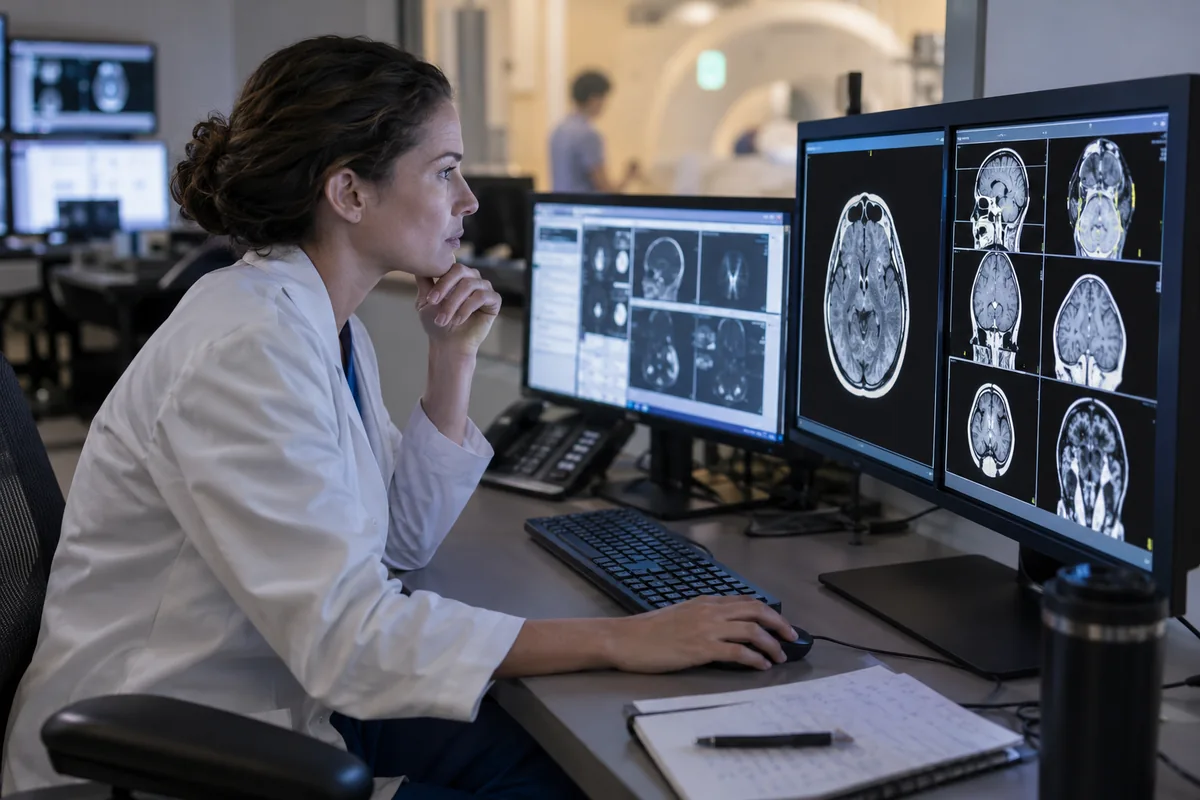
radiologist studying medical scans on a diagnostic workstation in a hospital reading room.

A day in the life

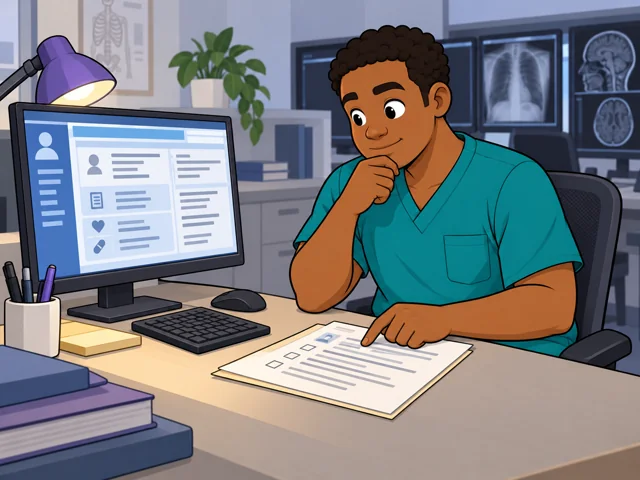
1A radiologist checks an imaging request against a patient's medical record to understand the question behind the scan.

Find out what's being asked

Open the imaging request and chart to see which symptoms or earlier findings the treating doctor wants explained.
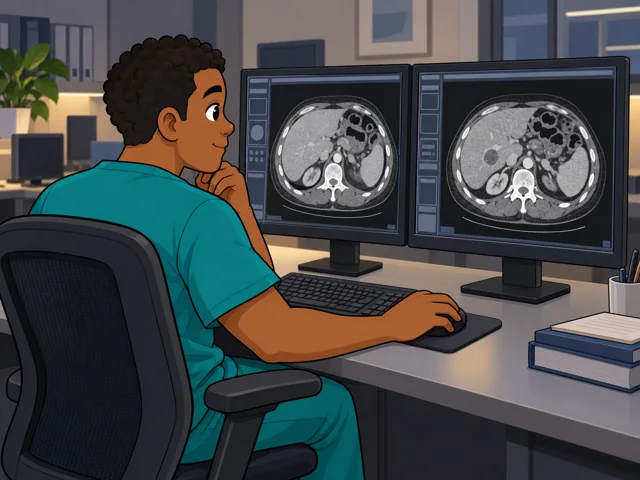
2The radiologist compares matching CT views on two monitors, checking the current study against earlier images.

Scroll through a body scan

At your workstation, you compare CT or MRI views and any older images to judge what has changed.
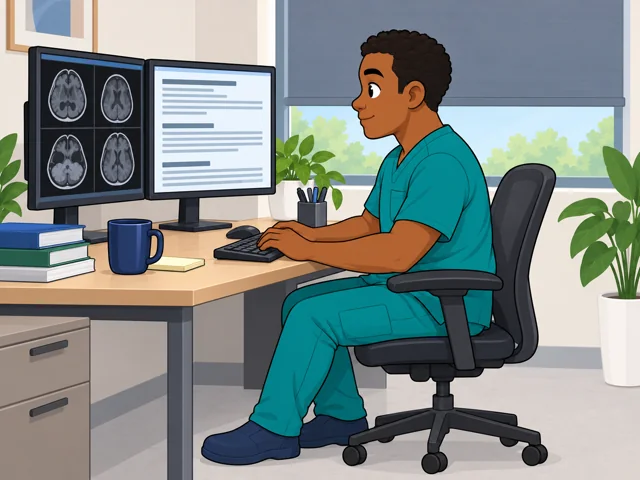
3The radiologist writes a diagnostic report while referring back to the scan images.

Write the diagnostic report

Turn what you saw into a probable meaning, and note whether another exam might settle an open question.
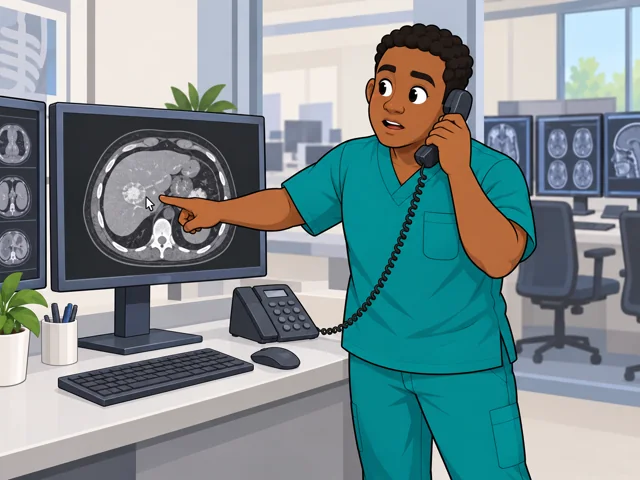
4The radiologist calls the treating doctor while indicating a concerning finding on the scan.

Call about an urgent finding

If something on an image looks urgent, you phone the treating clinician directly so it can shape treatment.
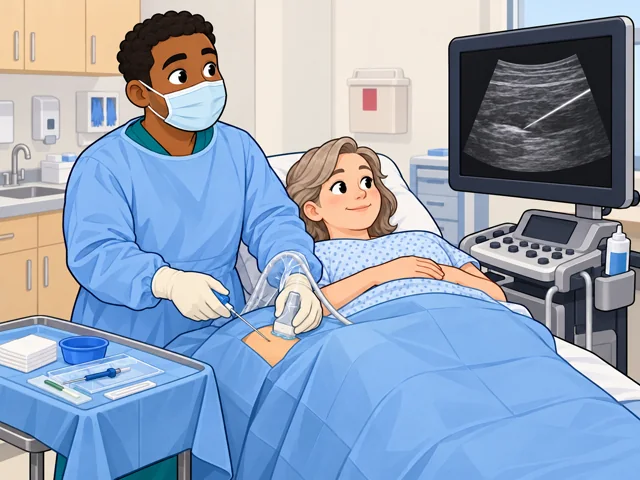
5The radiologist uses live ultrasound to guide a biopsy needle while an adult woman rests calmly on the examination bed.

Take a tissue sample by needle

In some roles, you explain the procedure, then use ultrasound or other imaging to steer the needle.

Quick facts

Preparation

Medical degree + residency

United States

Pay

$420,860/year

United States · May 2025

Outlook

3.4% growth

United States · 2025–2035

Quick orientation

Preparation, pay & outlook

Preparation

Medical degree + residency

Doctoral or professional education: medical school followed by years of clinical and radiology training.

Geography
United States
Period
Not applicable

Pay

$420,860/year

National median for radiologists; hourly equivalent $202.34.

Geography
United States
Period
May 2025

Outlook

3.4% growth

Projected national employment growth, with about 700 openings per year on average.

Geography
United States
Period
2025–2035

Fit, tradeoffs & changing tools

Things to weigh

  • You need careful attention even when examinations are waiting. A missed or misinterpreted finding can affect treatment.
  • Some jobs include long shifts, nights, weekends, or being on call. The schedule matters when choosing a practice.
  • The preparation is a long commitment: college, medical school, and specialty training come before an established radiology career.

Where AI may help

Some emergency radiology practices use artificial intelligence (AI) to draft the conclusion of a report. This can assist writing, but the draft still needs clinical review.

What people still lead

You connect the images with the patient's history and discuss their meaning with other doctors. Practices also need people to test AI tools and monitor mistakes after installation.

What we can’t predict yet

How much interpretation and report writing can safely move to software remains unsettled. Performance can change across patient groups and over time, adding checking work as well as potential time savings.

Pay in context

Earnings

The national median wage for radiologists was $420,860 in May 2025, equivalent to $202.34 an hour. This is an occupation-wide figure, not a starting offer.

The national spread is wide

The 10th-percentile annual wage was $89,010 and the 90th-percentile wage was $594,410. These mark positions in the wage distribution, not expected earnings at particular career stages.

Geography
United States
Period
May 2025
Pay basis
BLS employee wage estimates for radiologists, SOC 29-1224; not total compensation or self-employed practice income.

Compare the actual position

In an academic breast-imaging practice, specialty, experience, and how much of a full-time schedule you work can affect an offer. Compare duties and hours alongside the salary.

Geography
Rochester, Minnesota
Period
Posting dated June 23, 2025; accessed October 9, 2026
Pay basis
Employer-described factors affecting base compensation; no national pay effect is implied.

Openings include replacement needs

Radiologist employment is projected to grow 3.4% from 2025 to 2035, with about 700 openings annually on average. Openings include replacing people who leave the occupation, not just newly created jobs.

Geography
United States
Period
2025–2035
Pay basis
Employment projection for radiologists, SOC 29-1224; not a compensation measure.

Getting started

Earn a medical degree

What the route involves
Complete medical school for a Doctor of Medicine (MD) or Doctor of Osteopathic Medicine (DO) degree, studying medicine and gaining clinical experience.
What it can lead to
A medical degree prepares you to enter postgraduate physician training, where you can pursue radiology.

Train in diagnostic radiology

What the route involves
After medical school, complete a clinical year and a four-year accredited diagnostic-radiology residency, caring for patients and interpreting examinations under supervision.
What it can lead to
This develops specialty expertise and meets the standard training component for diagnostic-radiology board certification.
What to check
Completing residency does not itself award board certification; the board also requires examinations and other eligibility conditions.

The usual U.S. path has two connected steps below. Start with college coursework that meets medical-school admissions requirements; you do not need to choose a radiology specialty in high school.

After entry

Career paths

This starts where the entry routes leave off: early work, growing capability, and advancement or specialization. This path also has a credential or licensing boundary; see the requirements and limits.

  1. Get established

    Build reliable habits for reading examinations, finishing clear reports, and reaching the treating clinician when a finding needs discussion.

  2. Sharpen your judgment

    Review difficult cases and errors with colleagues. Use continuing education to improve how you recognize less familiar findings.

  3. Specialize or teach

    Pursue fellowship training in an area such as breast imaging or neuroradiology, which focuses on the brain, spine, and nervous system.

    • In an academic practice, develop a teaching role with residents and fellows.

Where you can work

Hospital emergency imaging

The work centers on injuries and acute illness. You help emergency and hospital doctors answer questions that can change medical or surgical decisions.

  • Indoors
  • Safety-sensitive

Academic breast-imaging service

Screening and diagnostic examinations mix with image-guided biopsies. You discuss care with surgeons, cancer specialists, and pathologists, alongside teaching responsibilities.

  • Indoors
  • Safety-sensitive

Try it

See whether the job clicks before you commit to the path.

Choose a labeled teaching X-ray from an anatomy resource. Cover the labels, describe three visible structures, then check your observations. Write one question you would need the patient's history to answer. Notice whether you enjoy both close looking and explaining what remains uncertain.

Stay safe: Use educational material, not someone's private scans. This explores your interest; it is not practice diagnosing a person.

Explore more careers

Sources

  1. O*NET OnLine. Radiologists — 29-1224.00. Accessed 2026-10-09.
  2. U.S. Bureau of Labor Statistics. May 2025 Occupational Employment and Wage Statistics, national estimates — Radiologists. Accessed 2026-09-29.
  3. U.S. Bureau of Labor Statistics. Employment Projections Table 1.2, 2025–2035 — Radiologists. Accessed 2026-09-29.
  4. American College of Radiology and Radiological Society of North America. Professions in Diagnostic Radiology. Accessed 2026-10-09.
  5. U.S. Bureau of Labor Statistics. Physicians and Surgeons — Occupational Outlook Handbook. Accessed 2026-10-09.
  6. American Board of Radiology. Get Certified in Diagnostic Radiology. Accessed 2026-10-09.
  7. Federation of State Medical Boards. About Physician Licensure. Accessed 2026-10-09.
  8. American College of Radiology. American College of Radiology Approves First Ever Practice Parameter for Imaging Artificial Intelligence. Accessed 2026-10-09.
  9. Mayo Clinic. Alex G. Boutselis, M.D. — Biographical summary. Accessed 2026-10-09.
  10. Mayo Clinic. Breast Imaging Radiologist — Job ID 361414. Accessed 2026-10-09.

Your message goes to the Great Jobs team. How we use your information