
Career profile

Rail Car Repairer

Rail car repairers find worn-out parts and fix cars that carry freight and passengers.

Spot damage near a wheel, swap a worn part, then test your fix. The appeal is figuring out what broke and getting it moving again.
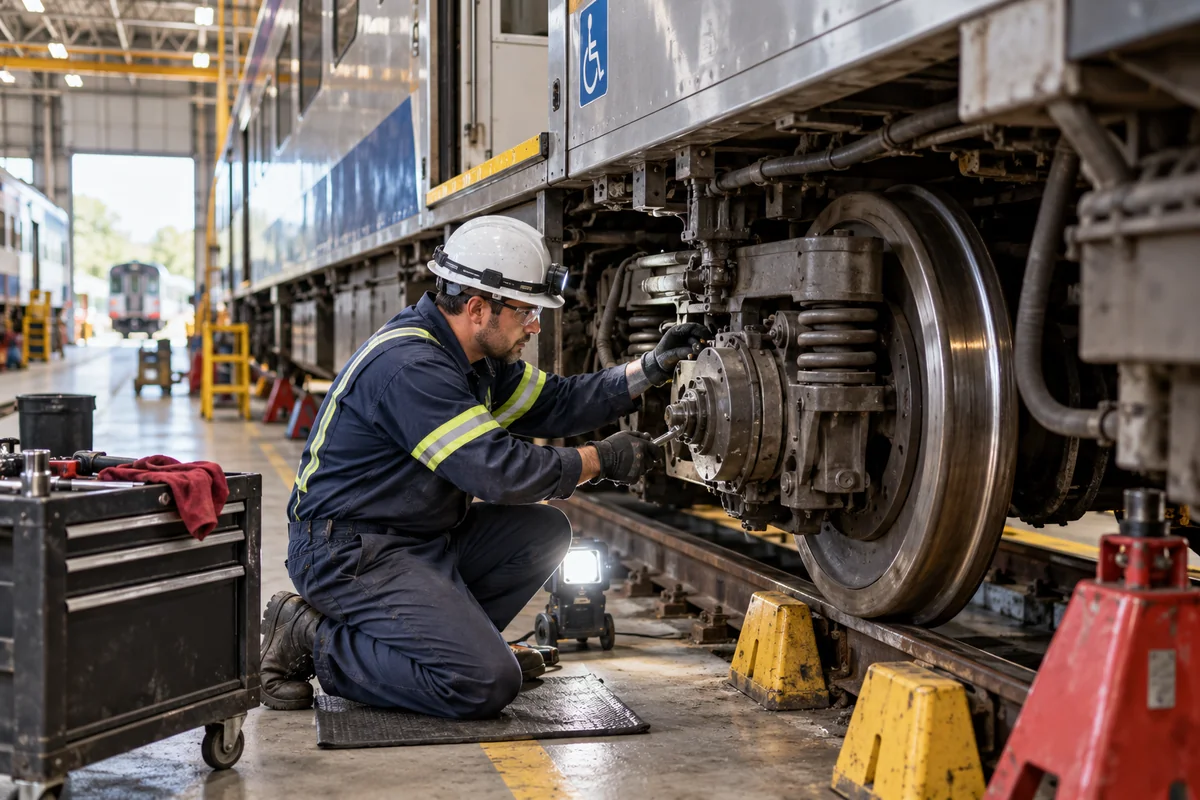
Rail car repairer inspects a train wheel assembly.

A day in the life

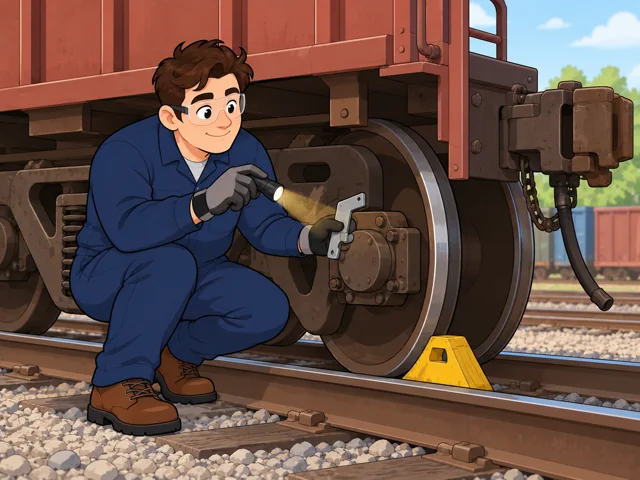
1A rail car repairer crouches beside a secured freight car and checks a wheel flange with a gauge and flashlight.

Inspect wheels, bearings and couplers

Look closely at bearings, wheels and the couplers between cars for any wear or damage needing repair.
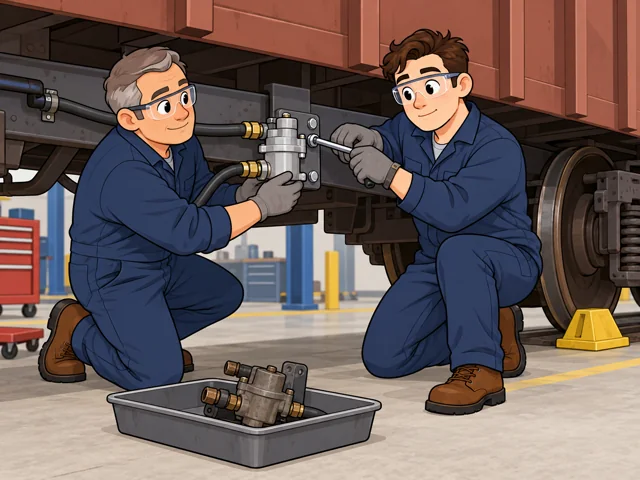
2A rail car repairer and a coworker fit a replacement air-brake valve beneath a stationary freight car.

Fix freight brakes and metal

On freight cars, you replace faulty air-brake parts or repair damaged metal with welding and cutting gear.
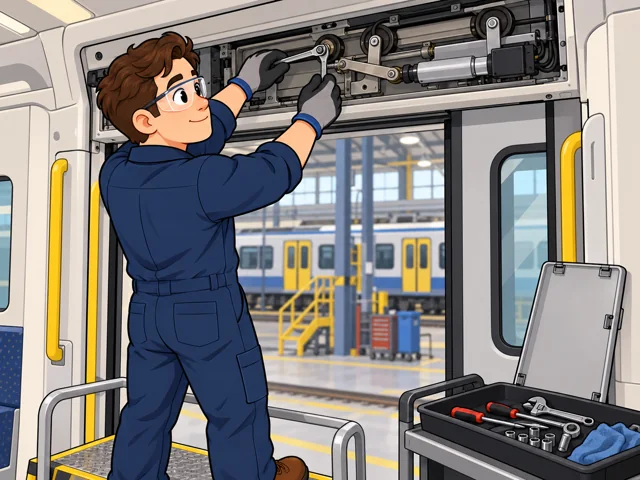
3A rail car repairer adjusts an exposed passenger-door linkage from a low work platform.

Fix failing passenger car doors

For passenger cars, you find why doors fail and fix them, plus air conditioning, brakes and wheel motors.
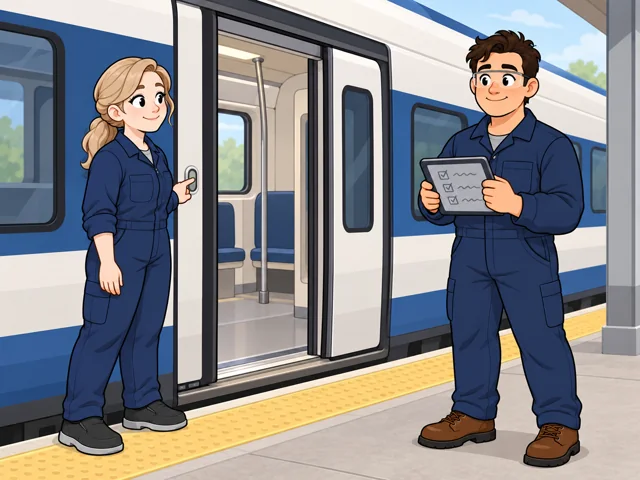
4A rail car repairer records the completed work on a tablet while a coworker tests the passenger door.

Test the unit and log it

Run the repaired unit, adjust it if it still runs poorly, then record what you found and changed.

Quick facts

Preparation

High school + workplace training

United States · 2025–2035

Pay

$67,530 median

United States · 2025

Outlook

2.6% projected growth

United States · 2025–2035

Quick orientation

Preparation, pay & outlook

Preparation

High school + workplace training

Typical entry preparation is a high school diploma or equivalent, followed by long-term on-the-job training.

Geography
United States
Period
2025–2035

Pay

$67,530 median

National annual median for rail car repairers in 2025.

Geography
United States
Period
2025

Outlook

2.6% projected growth

About 1,600 openings a year are projected over 2025–2035, including replacement openings.

Geography
United States
Period
2025–2035

Fit, tradeoffs & changing tools

Things to weigh

  • Expect standing, bending and awkward positions, along with noise and protective equipment.
  • Some freight shops run around the clock. Seniority can affect your shift, so a daytime schedule may take time to obtain.

Where AI may help

Some freight railroads use cameras and artificial intelligence to scan passing cars and flag possible defects for expert review.

What people still lead

People assess the flagged problems and carry out physical repairs and tests.

What we can’t predict yet

How much inspection shifts from walking beside cars to reviewing images will depend on the equipment, its reliability and how railroads adopt it.

Pay in context

Earnings

The national median is a useful reference, but it is not a starting-pay promise.

The middle and the spread

The 2025 median was $67,530 a year—about $32.47 an hour using 2,080 hours. The 10th and 90th percentiles were $46,800 and $95,100. Those mark the wage distribution, not beginner and veteran rates.

Geography
United States
Period
2025
Pay basis
Annual employee wages; calculated hourly equivalent

Railroad employers

Within rail transportation, rail car repairers had a median of $80,320 annually, or $38.62 hourly. That industry figure is higher than the occupation's all-workplace median.

Geography
United States
Period
2025
Pay basis
Industry-specific median annual and hourly wages

An experienced transit role

Bay Area Rapid Transit lists $90,632.05–$118,473.47 annually for Transit Vehicle Mechanics. This is an experienced classification in California, not a national transit average or an entry-level offer.

Geography
San Francisco Bay Area, California
Period
Listed as of 2026-10-04
Pay basis
Employer classification annual salary range

Openings exceed new job growth

Employment is projected to grow 2.6% from 2025 to 2035, with about 1,600 openings annually. Openings include replacing workers who leave the occupation, not just newly created positions.

Geography
United States
Period
2025–2035
Pay basis
Employment projection; not compensation

Getting started

Learn in a railcar training job

Paid
What the route involves
Finish high school or an equivalent credential, then seek railcar repair employment that includes instruction and supervised practice in inspection and repair.
What it can lead to
You build rail-specific skills while employed; some freight employers provide paid on-the-job training.

Bring mechanical trade experience

What the route involves
For Bay Area Rapid Transit, complete a mechanical apprenticeship and one year of relevant journey-level work. Three additional years of that experience can replace the apprenticeship.
What it can lead to
This meets the experience requirement for its Transit Vehicle Mechanic classification.
What to check
A high school diploma or equivalent is also required. Employer selection and physical requirements still apply.

Look closely at the experience requirement: a training job and an experienced mechanic job can have similar titles.

After entry

Career paths

This starts where the entry routes leave off: early work, growing capability, and advancement or specialization.

  1. Get established

    Learn your employer's safe work routines and car designs. Build consistency in inspections and routine repairs.

  2. Solve harder faults

    Learn how the car's systems interact. On passenger fleets, that can mean moving between doors, brakes and air conditioning, with other mechanics helping on difficult problems.

  3. Move toward shop leadership

    Mechanical supervisor roles add responsibility for repair crews and work priorities. Build leadership experience alongside mechanical skill; employers select and train supervisors separately.

Where you can work

Freight yards and repair shops

Work around heavy moving equipment and outdoor weather. Air brakes and steel repairs are central, with welding equipment and mobile cranes among the tools nearby.

  • Indoors
  • Outdoors
  • Shift work
  • Physical demands
  • Safety-sensitive

Passenger transit maintenance shops

Passenger doors and comfort systems join the mechanical workload. You work with electronics technicians, and shop crews position cars for maintenance.

  • Indoors
  • Vehicle
  • Physical demands
  • Safety-sensitive

Try it

See whether the job clicks before you commit to the path.

Find a clear online photo of a freight car's wheels and coupler. Sketch the visible parts, then write a short inspection note separating what you can see from what you would need to measure or test. Notice whether careful observation interests you.

Stay safe: Use photos for this exercise; do not enter a rail yard or climb on equipment.

Explore more careers

Sources

  1. O*NET OnLine. Rail Car Repairers — 49-3043.00. Accessed 2026-10-04.
  2. O*NET OnLine / U.S. Bureau of Labor Statistics. Rail Car Repairers wages — United States row. Accessed 2026-10-04.
  3. U.S. Bureau of Labor Statistics. Occupational projections and worker characteristics. Accessed 2026-10-04.
  4. U.S. Bureau of Labor Statistics. Rail Transportation: Earnings by Occupation. Accessed 2026-10-04.
  5. BNSF Railway. Railcar Repair (Carman) — Los Angeles. Accessed 2026-10-04.
  6. Bay Area Rapid Transit. Transit Vehicle Mechanic — Classification Specification. Accessed 2026-10-04.
  7. Bay Area Rapid Transit. Roll With Us: Train Car Mechanics keep BART trains on the go. Accessed 2026-10-04.
  8. Norfolk Southern. Algorithms in Action. Accessed 2026-10-04.
  9. Norfolk Southern. 2027 A1 Mechanical Supervisor Trainee. Accessed 2026-10-04.

Your message goes to the Great Jobs team. How we use your information