

Career profile

Rehabilitation Counselor

Rehabilitation counselors help disabled clients prepare for work and live more independently.

A job goal becomes workable once a counselor works out the training, transportation and support the person needs to pursue it.

A rehabilitation counselor discussing a work return plan with an adult client at a small office table.

A day in the life

1A rehabilitation counselor listens to a woman using a wheelchair while comparing her account with open records on an accessible desk.

Ask what work a client wants

Discuss past jobs, interests and obstacles, check them against school and medical records, and see what help fits.

2A client chooses among illustrated training and support options while her rehabilitation counselor records their shared employment plan.

Agree on a job goal

Afterward, work out needed training and services, explain each option, and write a plan the client can use.
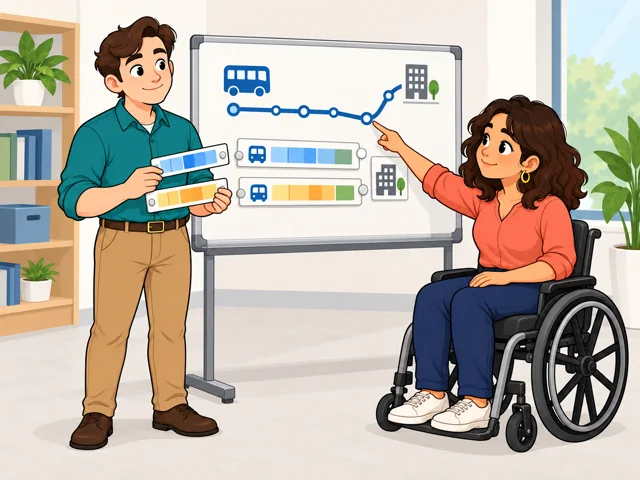
3A rehabilitation counselor and client compare a bus route with possible work schedules to resolve a transportation barrier.

Help a client get to work

If work starts before the bus comes, explore other commutes or schedules and arrange job coaching if useful.

4At a workplace follow-up, a client describes a training difficulty while her rehabilitation counselor records progress and revisits her support plan.

Check in during training or work

Ask about problems, note progress in the case file, and revise the plan if the placement doesn't fit.

Quick facts

Preparation

Usually a master's degree

United States

Pay

$46,850/year

United States · May 2025

Outlook

2% projected growth

United States · 2025–2035

Quick orientation

Preparation, pay & outlook

Preparation

Usually a master's degree

Some jobs accept a related bachelor's degree.

Geography
United States
Period
Not applicable

Pay

$46,850/year

National median; about $22.52/hour.

Geography
United States
Period
May 2025

Outlook

2% projected growth

About 8,200 openings annually, including replacement needs.

Geography
United States
Period
2025–2035

Fit, tradeoffs & changing tools

Things to weigh

  • Case notes and service arrangements take time alongside counseling conversations.
  • In public vocational programs, you may also decide eligibility and manage service spending—decisions that can make conversations difficult.

Where AI may help

Tools that generate text—artificial intelligence (AI)—can help draft materials or summarize information. Using client information requires approved tools and privacy safeguards.

What people still lead

You remain responsible for checking accuracy, recognizing bias, and making professional judgments with the client.

What we can’t predict yet

How much drafting and job matching can safely move to AI remains uncertain, especially when a tool overlooks disability-related needs or a client's preferences.

Pay in context

Earnings

Use the national median as a reference point when comparing actual offers.

The middle of the pay range

The median was $46,850 annually, equivalent to about $22.52 an hour over 2,080 hours. This isn't a starting-pay estimate.

Geography
United States
Period
May 2025
Pay basis
Annual employee wage median; calculated hourly equivalent

The national spread

The lowest-paid 10% earned below $35,060; the highest-paid 10% earned above $77,170 annually.

Geography
United States
Period
May 2025
Pay basis
Annual employee wage distribution

Workplace type matters

Annual medians were $66,510 in state government, $58,280 in local government, and $44,920 in vocational rehabilitation services. Government figures exclude education and hospitals.

Geography
United States
Period
May 2025
Pay basis
Industry-specific annual employee wage medians for rehabilitation counselors

Openings include replacement hiring

Employment is projected to grow 2%, with about 8,200 openings a year on average. Openings include replacing people who leave the occupation; they aren't all newly created jobs.

Geography
United States
Period
2025–2035
Pay basis
Employment projections, not compensation or current vacancies

Getting started

Complete graduate preparation

What the route involves
Earn a master's in rehabilitation counseling or a related field, typically including a supervised internship.
What it can lead to
Meet the education level many employers require or prefer.
What to check
Counseling licensure depends on state and services. It typically requires a master's, supervised experience, and an accepted exam; vocational-only services may be exempt. Check the state board before choosing a program.

Target jobs accepting a bachelor's

What the route involves
Earn a related bachelor's degree, such as psychology, health, or social sciences.
What it can lead to
Qualify educationally for some employers' rehabilitation positions.
What to check
These workers typically provide a narrower range of services than master's-trained counselors.

Choose education around the services you want to provide and the jobs you intend to apply for.

After entry

Career paths

This starts where the entry routes leave off: early work, growing capability, and advancement or specialization.

  1. Get established

    Learn your agency's referral network and case procedures. Make records clear enough to track what the client needs next.

  2. Handle more complex cases

    Build skill interpreting assessments and coordinating plans for people with different or multiple disabilities.

  3. Guide other counselors

    A lead role can add advising colleagues on counseling and placement decisions. Requirements and titles depend on the employer.

Where you can work

State vocational rehabilitation agencies

Client planning sits alongside eligibility decisions and service budgets. You also work with employers and community agencies to arrange a workable route into employment.

  • Office

Veterans Benefits Administration

You work with veterans whose disabilities affect employment or independence. Medical and vocational evaluations inform plans, and the role includes deciding eligibility and entitlement to rehabilitation services.

  • Office

Try it

See whether the job clicks before you commit to the path.

Imagine a client wants a job whose shift starts before their bus arrives. Write three questions you would ask before suggesting a solution, then sketch two options to discuss. Notice whether you enjoy working through barriers while leaving the choice with the client.

Explore more careers

Sources

  1. U.S. Bureau of Labor Statistics. Rehabilitation Counselors. Accessed 2026-10-03.
  2. U.S. Bureau of Labor Statistics. Occupational projections and worker characteristics. Accessed 2026-10-03.
  3. O*NET OnLine. 21-1015.00 — Rehabilitation Counselors. Accessed 2026-10-03.
  4. California Department of Human Resources. Senior Vocational Rehabilitation Counselor (9806). Accessed 2026-10-03.
  5. U.S. Department of Veterans Affairs. Vocational Rehabilitation Counselor Qualification Standard. Accessed 2026-10-03.
  6. Commission on Rehabilitation Counselor Certification. Frequently Asked Questions and Guiding Statements for Using Artificial Intelligence. Accessed 2026-10-03.

Your message goes to the Great Jobs team. How we use your information