
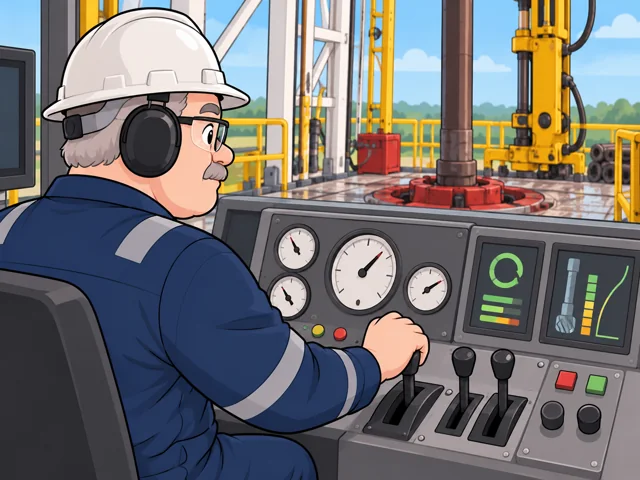
Adjust bit speed and pressure
Watch the pressure gauges and change how fast the bit turns and how hard it pushes down.
Career profile
Rotary drill operators work the controls and direct the rig crew while drilling a well.
A shifting pressure gauge can mean the control settings need a change, and you have to notice it while watching your crew.

Watch the pressure gauges and change how fast the bit turns and how hard it pushes down.
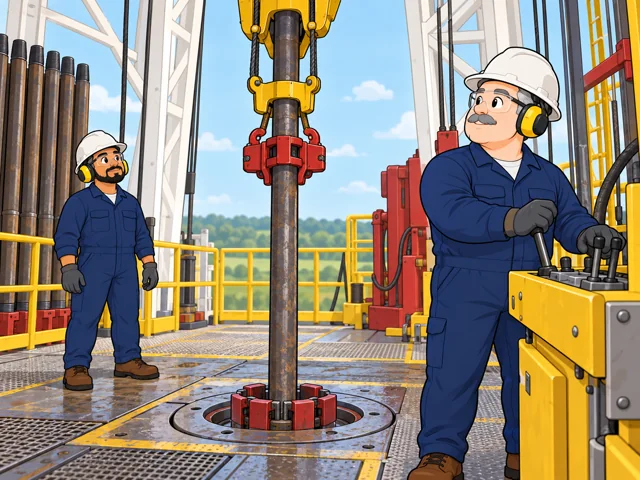
You run the hoist while crew members pull pipe for a bit swap, then lower it back in.
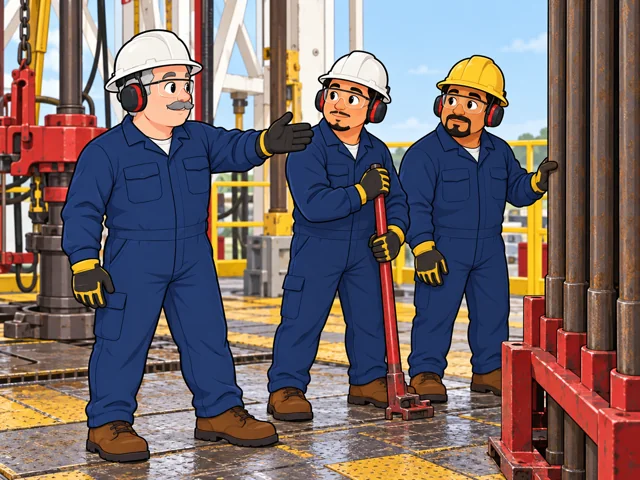
Tell the roustabouts and derrick operators what to do next, then check their work as drilling continues.
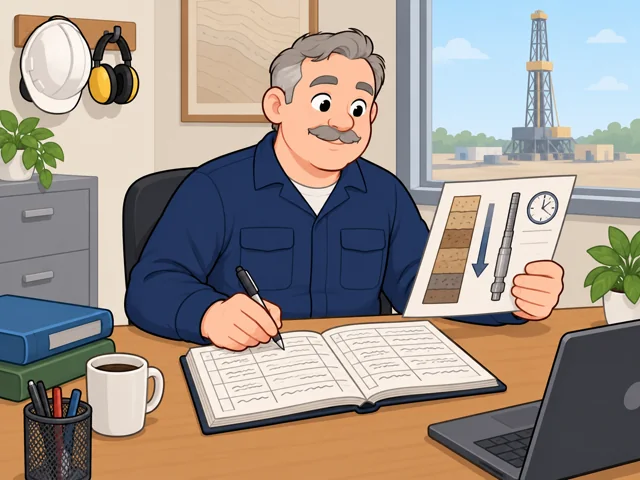
Write down the depth drilled, the rock layers you hit, the tools used and how long it took.
United States · 2025–2035
United States · May 2025
United States · 2025–2035
Quick orientation
No formal educational credential is the typical entry category. Employers may still require a high school diploma and related experience.
National median for rotary drill operators, oil and gas; equivalent to $32.64 an hour.
Employment is projected to grow 0.8% from 2025 to 2035.
On rigs equipped for it, software can run programmed drilling sequences, including steps around pipe connections.
You still need to understand the rig’s controls, communicate with the crew, and lead people through the work.
How much of a shift becomes overseeing automated sequences will depend on the rig’s equipment and which operations can be automated reliably.
Pay in context
The national median was $67,890 a year, or $32.64 an hour, in May 2025. That is the midpoint for employed rotary drill operators, not a starting offer.
The 10th-percentile annual wage was $47,010 and the 90th-percentile wage was $101,860. These mark the lower and upper ends of the middle 80% of wages, not beginner and experienced pay grades.
About 1,100 openings a year are projected on average during 2025–2035, alongside 0.8% employment growth. Openings include replacement needs, so they are not all newly created jobs.
Rig experience usually comes before the driller’s controls. Your starting point depends on whether you have worked on a crew before.
After entry
This starts where the entry routes leave off: early work, growing capability, and advancement or specialization.
Learn your rig’s controls and operating procedures, including how its equipment differs from rigs you already know.
Build your technical judgment alongside the communication skills needed to explain each operation to the crew.
A possible next step is rig manager, with broader responsibility for the rig and its crew. Employer development may include leadership and technical training.
You work at outdoor well sites. Rigs periodically move, and remote locations can add travel to the job.
Work is organized around a rig at sea, with supplies loaded aboard. Some crews work long shifts for weeks before a block of time off.
Try it
Open the [Occupational Safety and Health Administration’s drilling guide](https://www.osha.gov/etools/oil-and-gas/drilling) and follow the section on removing and replacing drill pipe. Sketch the pipe’s movement and mark where the driller’s controls and crew coordination matter. Notice whether keeping track of that sequence interests you.
Stay safe: Keep this a desk exercise; it does not prepare you to operate a rig.