
Career profile

Security and Fire Alarm Installer

Alarm installers connect sensors, wiring and control panels so fire and security alarms work together.

A satisfying part of the job can be tracing why a sensor won't respond, then fixing it until it works again.
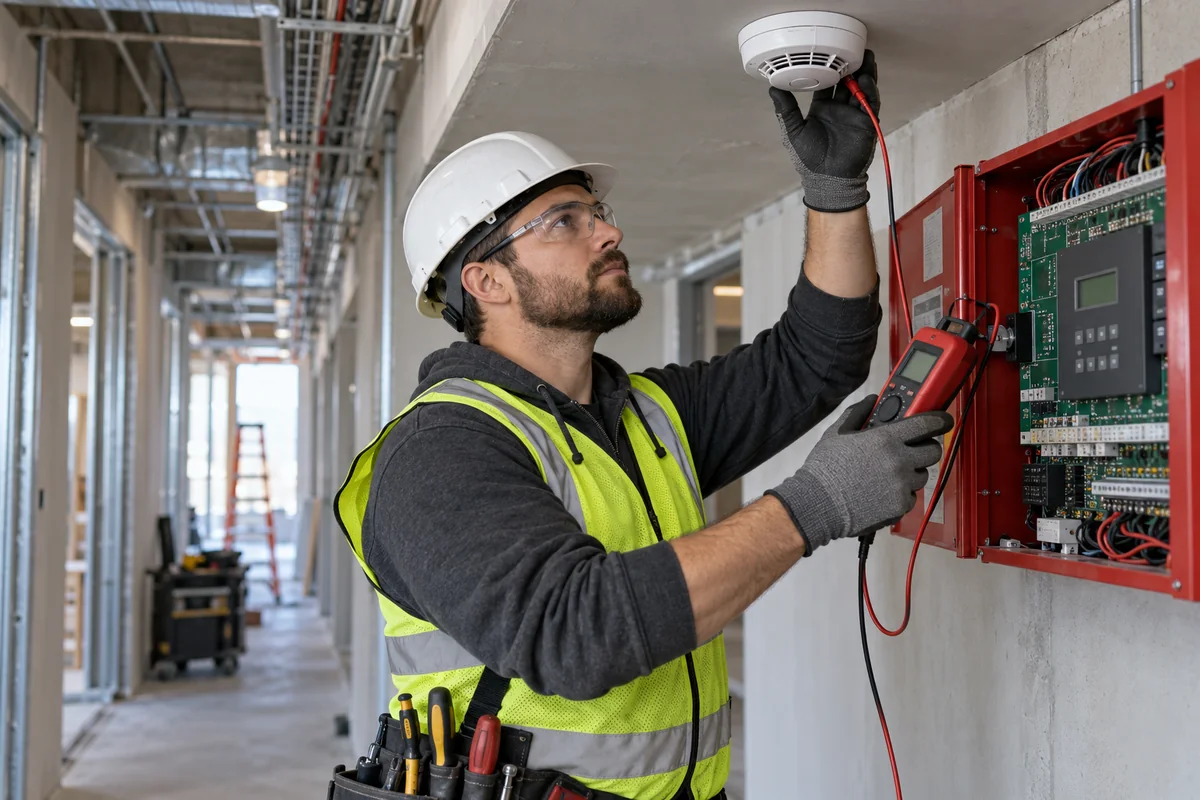
An adult security and fire alarm installer mounting a smoke detector and testing the wired alarm control panel in an unfinished commercial hallway.

A day in the life

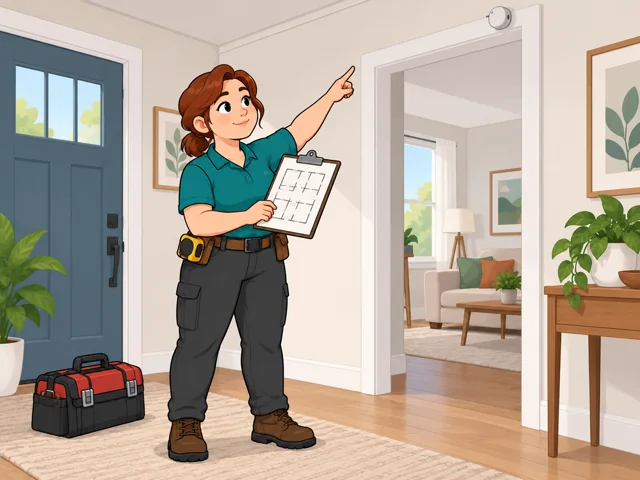
1An installer compares a room plan with a customer's hallway and points toward a possible cable route above a doorway.

Map the cable path first

You compare the job details with the customer's actual rooms and settle the cable path before drilling.
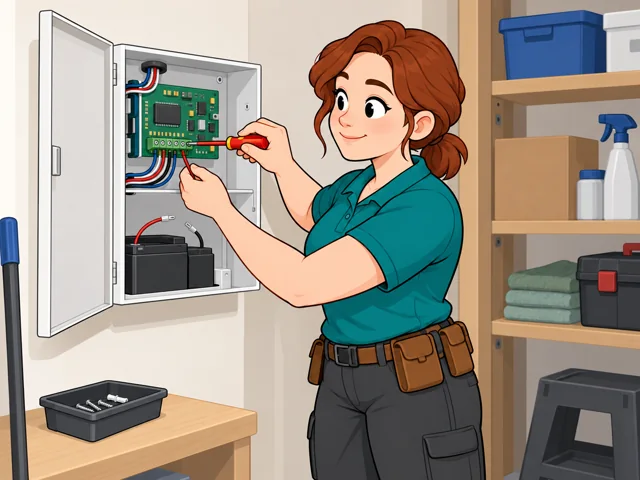
2An installer secures a low-voltage wire inside a wall-mounted alarm control cabinet.

Mount panels, then wire them

Fasten the control panels and sensors in place, then hook up their wires.
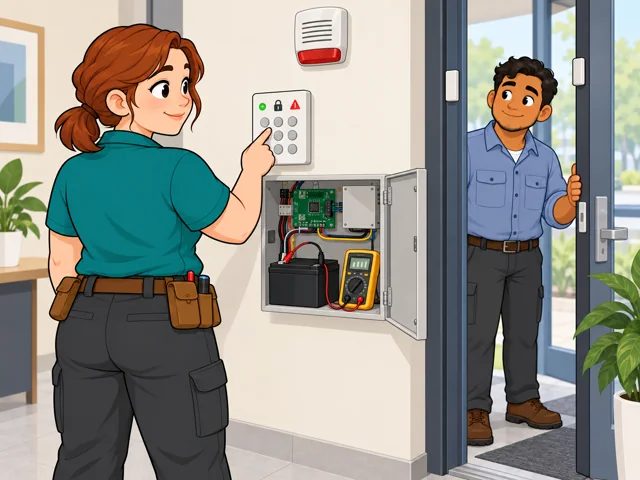
3An installer checks the alarm keypad while a coworker opens a protected door, with battery-testing equipment beside the open control cabinet.

Program the keypad and test

Set up the keypad and test the sirens, sensors and backup batteries so you know the setup works.
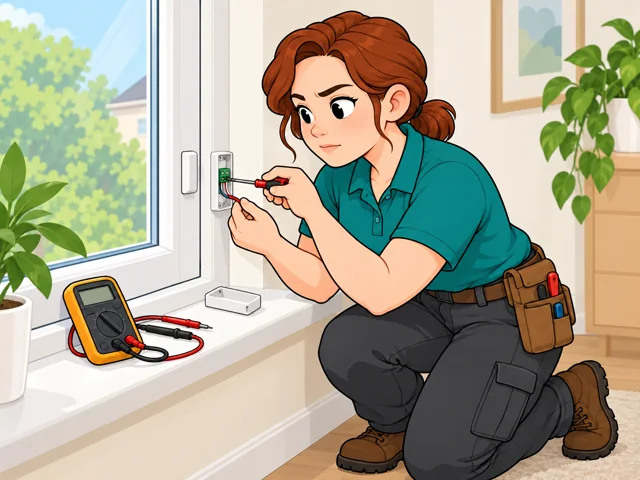
4An installer inspects a loose wire connection inside an opened window sensor.

Find why a sensor failed

When a sensor fails its test, look over its circuit for loose connections or damaged insulation.
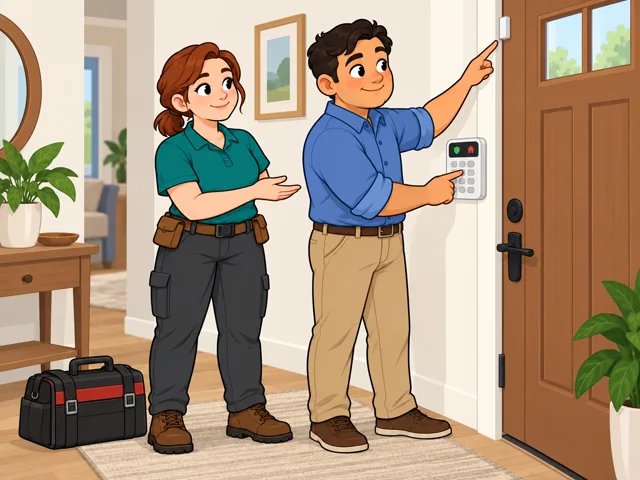
5An installer guides a customer through the alarm keypad and points out the front-door sensor while explaining false alarms.

Teach the customer the system

Show the customer how to use the system and explain what might set off a false alarm.

Quick facts

Preparation

High school + workplace training

United States · 2025

Pay

$60,070/year

United States · May 2025

Outlook

6.8% projected growth

United States · 2025–2035

Quick orientation

Preparation, pay & outlook

Preparation

High school + workplace training

Typical entry preparation is a high school diploma or equivalent, followed by moderate-term on-the-job training.

Geography
United States
Period
2025

Pay

$60,070/year

National median pay was $28.88 an hour in May 2025.

Geography
United States
Period
May 2025

Outlook

6.8% projected growth

About 8,500 openings a year are projected across the country over 2025–35.

Geography
United States
Period
2025–2035

Fit, tradeoffs & changing tools

Things to weigh

  • Installation can mean ladders, cramped spaces, and overhead work. Some projects require evening or weekend shifts.
  • Some home-security installation jobs also carry sales targets. Ask how much of the role involves selling equipment.

Where AI may help

On compatible connected fire systems, software can show alarm histories and let technicians investigate panel problems remotely. Siemens Fire Manager is one such tool.

What people still lead

You still bring equipment into the building, run cable, and make the physical connections.

What we can’t predict yet

How many service visits remote tools can replace will depend on the installed equipment, the fault, and local rules. A panel message may help locate a problem without fixing it.

Pay in context

Earnings

Use the national median as a comparison point when reading job offers, not as a starting-pay promise.

The national middle and spread

Median pay was $60,070 a year, or $28.88 an hour, in May 2025. The lowest-paid 10% earned $38,800 or less; the highest-paid 10% earned $81,150 or more. These are wage percentiles, not beginner and senior rates.

Geography
United States
Period
May 2025
Pay basis
Gross occupational wages; annual and hourly median, annual 10th and 90th percentiles

Employer type can matter

For this occupation in May 2023, average annual wages were $56,360 in investigation and security services and $60,230 at building equipment contractors. These older industry averages show a workplace difference; they are not current offers.

Geography
United States
Period
May 2023
Pay basis
Annual mean wages by employer industry

Openings include replacement hiring

Employment is projected to grow 6.8% over 2025–35, with about 8,500 openings annually from growth and workers leaving the occupation. That national total does not tell you how many employers are hiring nearby.

Geography
United States
Period
2025–2035
Pay basis
Employment projection and average annual occupational openings; not compensation

Getting started

Join an employer's installation team

What the route involves
Look for trainee or apprentice roles where you learn by helping an experienced crew install wiring and devices and record completed work.
What it can lead to
You build practical installation experience while learning the employer's equipment and work procedures.
What to check
An apprentice title does not always mean no prior training: some employers require trade-school preparation, a driver's license, and background and drug screening.

Enter a registered apprenticeship

Three years in the Northern California program.Paid
What the route involves
The Northern California Sound and Communication apprenticeship combines paid job training with Foothill College coursework. You learn fire alarms and security systems alongside other communication equipment.
What it can lead to
Completion makes you eligible for a college Certificate of Achievement and apprenticeship completion credentials, with preparation for sound and communication installer work.
What to check
This program requires age 18 at selection, a high school diploma or accepted equivalent, a driver's license, and qualifying algebra preparation. Selection includes an aptitude test, interview, ranked list, and substance screening; you must meet its physical and travel requirements.

Workplace learning is central to entry. Compare an employer's trainee role with a structured apprenticeship, and check the actual admission requirements.

After entry

Career paths

This starts where the entry routes leave off: early work, growing capability, and advancement or specialization. This path also has a credential or licensing boundary; see the requirements and limits.

  1. Get dependable at installations

    Learn to match project drawings to the work in front of you and leave clear records of what you installed.

  2. Handle harder faults

    Build confidence tracing circuit problems and adjusting panel settings.

  3. Lead an installation crew

    In sound and communication contracting, foreman or supervisor can be a next step. Your responsibility expands from your own installation work to coordinating other installers.

Where you can work

Customers' homes

Residential security work brings you into occupied rooms. You work out cable routes, patch drill holes, clean up, and check that signals reach the receiving center.

  • Indoors
  • Field work
  • Travel

Building installation projects

You work with a crew from project drawings, sometimes above ceilings or in crawl spaces. Customer schedules can push installation into alternative shifts or weekends.

  • Field work
  • Physical demands
  • Shift work
  • Safety-sensitive

Try it

See whether the job clicks before you commit to the path.

Draw a fictional hallway with four labeled alarm devices. Make a matching list of device labels and locations, then ask someone to change one label. Trace the mismatch. Notice whether you enjoy making a physical layout and its records agree.

Stay safe: Keep this on paper. Do not open, disconnect, or trigger a real alarm system.

Explore more careers

Sources

  1. O*NET OnLine. Security and Fire Alarm Systems Installers. Accessed 2026-10-03.
  2. O*NET OnLine / Bureau of Labor Statistics. National Wages: Security and Fire Alarm Systems Installers. Accessed 2026-10-03.
  3. U.S. Bureau of Labor Statistics. Table 1.2: Occupational projections, 2025–35, and worker characteristics. Accessed 2026-10-03.
  4. U.S. Bureau of Labor Statistics. May 2023 Occupational Employment and Wage Estimates: Security and Fire Alarm Systems Installers. Accessed 2026-10-03.
  5. Johnson Controls. Fire Alarm Apprentice — Reno, Nevada. Accessed 2026-10-03.
  6. ADT. Installation Technician — Lancaster, Pennsylvania. Accessed 2026-10-03.
  7. Foothill College. 2026–2027 Catalog: Apprenticeship — Sound and Communication. Accessed 2026-10-03.
  8. Northern California Sound and Communication Joint Apprenticeship Training Committee. Apply Online To Become An Apprentice. Accessed 2026-10-03.
  9. Siemens. Building X Fire Manager Data Sheet. Accessed 2026-10-03.
  10. Texas Department of Insurance. Fire alarm registration, license, and test information. Accessed 2026-10-03.
  11. Texas Legislature. Insurance Code Chapter 6002: Fire Detection and Alarm Device Installation. Accessed 2026-10-03.

Your message goes to the Great Jobs team. How we use your information