
Career profile

Solar Photovoltaic Installer

Solar photovoltaic installers turn drawings and loose parts into working rooftop or ground arrays.

From the first site measurement to the test that shows the finished system runs safely, you build the frame, set panels and seal every hole.
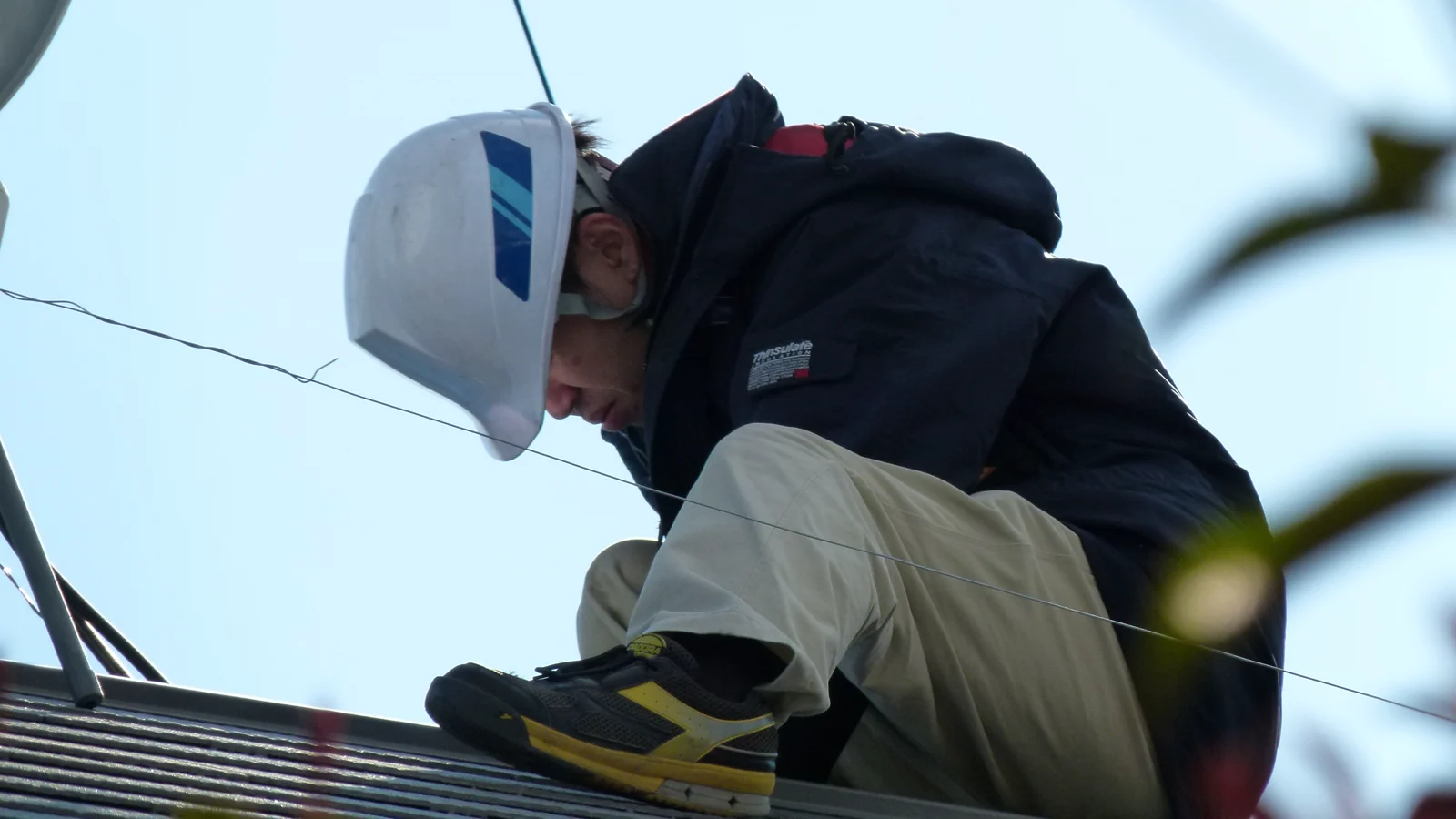
A solar installation technician wearing a hard hat works on a rooftop.
CoCreatr / CC BY-SA 2.0

A day in the life

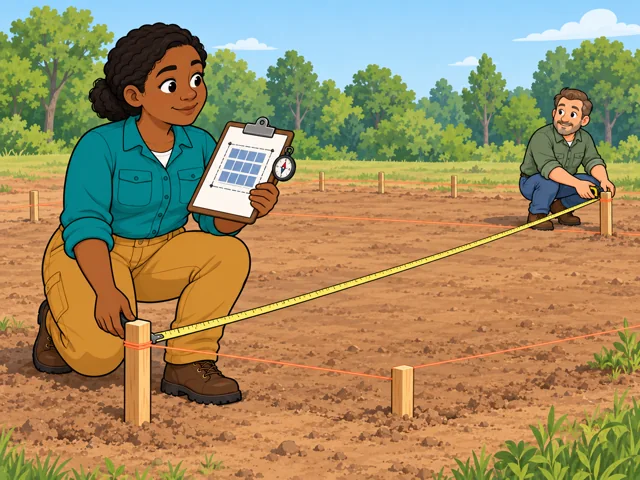
1A solar installer and coworker measure a staked ground site and compare its layout with a drawing, with nearby trees visible beyond the footprint.

Size up the site

Recheck measurements, roof or ground condition, array direction and sunlight, and match equipment spots to the drawings.
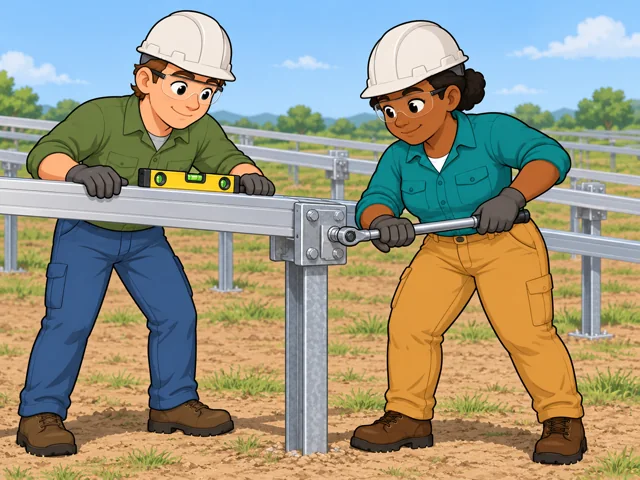
2The installer tightens a mounting-rail bracket while a coworker steadies the rail and checks that the support structure is level.

Build the racking first

Measure, cut and assemble the racking or other support frame, and attach it before any module goes on.
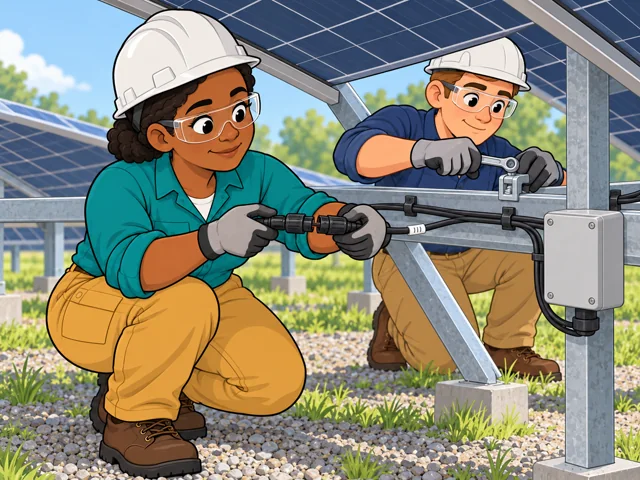
3Crouched behind a solar panel, the installer connects and supports its cable while a coworker tightens a module clamp beside a sealed cable entry.

Mount, wire and seal modules

Fasten modules, run interconnect wiring, add labels and seal holes, with electrical duties varying by project and state.
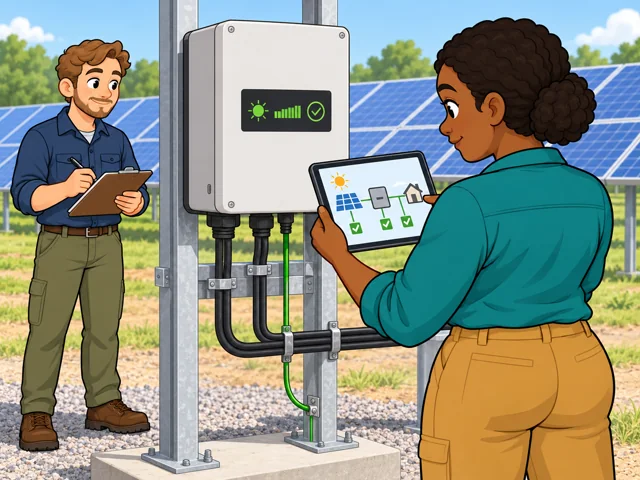
4The installer compares a closed inverter's operating display with the system plan while a coworker records the commissioning observations.

Power up and prove it runs

Switch the system on and check wiring, polarity, grounding, voltage and inverter setup against plan and required standards.
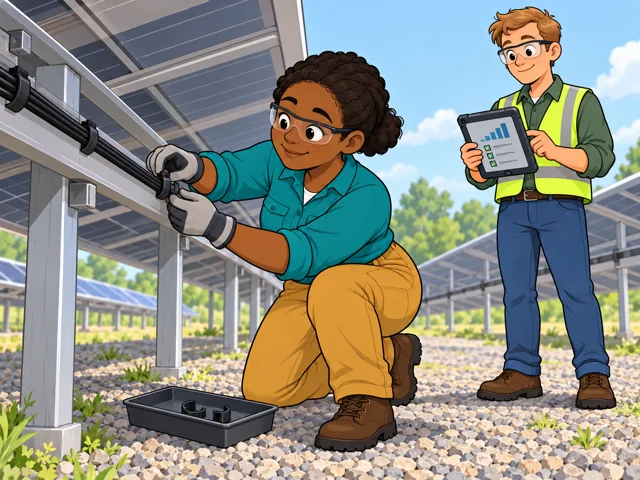
5The installer replaces a loose cable clip beneath the completed array while a coworker records the maintenance work on a tablet.

Service it and log changes

Inspect equipment, track output, fix problems from the install, do routine upkeep and log each change.

Quick facts

Preparation

High school diploma

United States

Pay

$53,140

United States · May 2025

Outlook

37% growth

United States · 2025–2035

Quick orientation

Preparation, pay & outlook

Preparation

High school diploma

A diploma or equivalent is typical. On-the-job training commonly lasts from 1 month to 1 year.

Geography
United States
Period
Not applicable

Pay

$53,140

National median annual wage—not a starting wage or guaranteed offer.

Geography
United States
Period
May 2025

Outlook

37% growth

Projected employment growth from 2025 to 2035, with about 4,200 openings per year on average. Local hiring may differ.

Geography
United States
Period
2025–2035

Fit, tradeoffs & changing tools

Things to weigh

  • Rooftop work can mean ladders, heights, repeated climbing, awkward positions, and carrying equipment.
  • Much of the job is outdoors, and some projects involve heat, cold, bright light, attics, or crawl spaces.
  • Falls, electrical shock, and hot equipment are real hazards, so protective gear and careful procedures are part of the work.

Where AI may help

Scheduling, estimating, drawings, electronic records, and inverter or control interfaces can help crews plan work and check system performance.

What people still lead

People still judge site conditions, spot hazards, handle and align materials, seal the installation, coordinate the crew, and decide whether test results meet requirements.

What we can’t predict yet

Newer tools may change planning and system checks, but how much they will change the installer’s hands-on task mix is uncertain.

Pay in context

Earnings

Use the national figures as context, not as a quote for your first job. Location, industry, experience, overtime, and benefits can change an offer.

National median

The median was $53,140: half of workers in the occupation earned more and half earned less. The median hourly wage was $25.55.

Geography
United States
Period
May 2025
Pay basis
Annual wage for workers covered by BLS Occupational Employment and Wage Statistics; excludes self-employed workers

The national spread

In May 2025, the 10th-percentile annual wage was $41,600 and the 90th-percentile wage was $79,970. These are wage percentiles, not starting and senior salaries.

Geography
United States
Period
May 2025
Pay basis
National annual wage percentiles

Industry medians differ

Among selected major employing industries, medians ranged from $47,100 in temporary help services to $58,570 for electrical contractors and other wiring installation contractors.

Geography
United States
Period
May 2025
Pay basis
Annual median wage within selected major employing industries

Getting started

Learn with an experienced installer

Commonly 1 month to 1 year of on-the-job training
What the route involves
Join an installation crew and learn jobsite safety, tools, mounting methods, system components, and testing procedures from experienced workers.
What it can lead to
You build competency in the employer's equipment and workflow while doing supervised installation work.
What to check
Hiring requirements vary, and employers may require a driver's license because crews travel to jobsites.

Take a technical or community-college course

Often a few days to several months, depending on the course
What the route involves
Study basic safety, photovoltaic equipment, installation practices, and sometimes system design.
What it can lead to
You gain foundational knowledge to bring to installer applications, while employer-specific training still normally follows.
What to check
Completing a course is not a universal license, certification, or promise of employment.

Bring related construction experience

What the route involves
Build skills in roofing, carpentry, construction labor, or electrical work, or add photovoltaic modules within a related apprenticeship.
What it can lead to
Existing construction skills may shorten the training needed for basic jobsite duties.
What to check
Related experience does not make these occupations interchangeable; electrical connections may still require an electrician or another authorized worker.

There is no single national credential sequence. Employers set hiring standards, some states require licenses, and electrical-work boundaries vary by jurisdiction and project.

After entry

Career paths

This starts where the entry routes leave off: early work, growing capability, and advancement or specialization.

  1. Get established

    After entry, learn the employer's safety procedures, tools, components, and installation sequence while working with experienced installers.

  2. Build range

    Take on more of the layout, racking, sealing, testing, maintenance, and documentation while staying within assigned electrical-work limits.

    • Manufacturer training can add product-specific installation knowledge.
  3. Lead projects

    With trade experience, you may coordinate crews and move toward project-supervisor or project-manager work.

    • Installation experience can also support a move into solar sales.

Where you can work

Residential rooftops

Travel between homes, work on sloped or flat roofs, and sometimes enter attics or crawl spaces. Heights, weather, and protecting the building from leaks shape the day.

  • Outdoors
  • Field work
  • Travel
  • Physical demands
  • Safety-sensitive

Ground-mounted solar sites

Build larger arrays outdoors at ground level. The work avoids residential roof height but still involves weather, material handling, precise layout, and crew coordination.

  • Outdoors
  • Field work
  • Travel
  • Physical demands
  • Safety-sensitive

Try it

See whether the job clicks before you commit to the path.

At a table, draw a roof rectangle, arrange paper panel shapes, measure their spacing, number the installation sequence, and make a final checklist for alignment, fasteners, labels, and weather sealing. Notice whether precise measuring and rechecking feel satisfying or tedious.

Stay safe: Keep the exercise on paper or cardboard.

Explore more careers

Sources

  1. U.S. Bureau of Labor Statistics. Occupational Outlook Handbook: Solar Photovoltaic Installers. Accessed 2026-09-18.
  2. O*NET OnLine. 47-2231.00 — Solar Photovoltaic Installers. Accessed 2026-09-18.

Your message goes to the Great Jobs team. How we use your information