
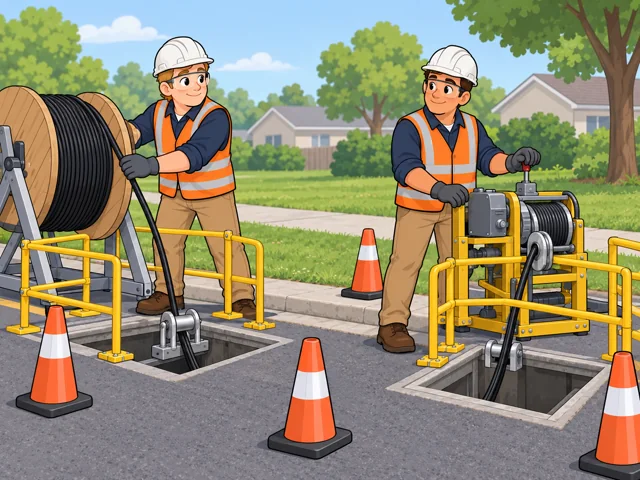
Winch new cable underground
With your crew, feed cable off its reel as a winch draws it into a buried duct.
Career profile
Telecom line installers put in and fix lines bringing television, phone, and internet to people.
Pulling cable through a buried duct, then hunting down what's blocking a signal, shows the range here: hard outdoor labor and careful, step-by-step troubleshooting.
With your crew, feed cable off its reel as a winch draws it into a buried duct.
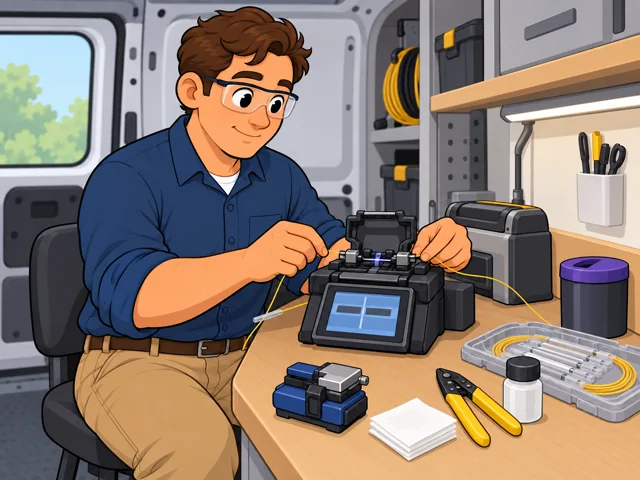
On fiber jobs, prep the ends, fuse them with heat in a fusion splicer, and shield the splice.
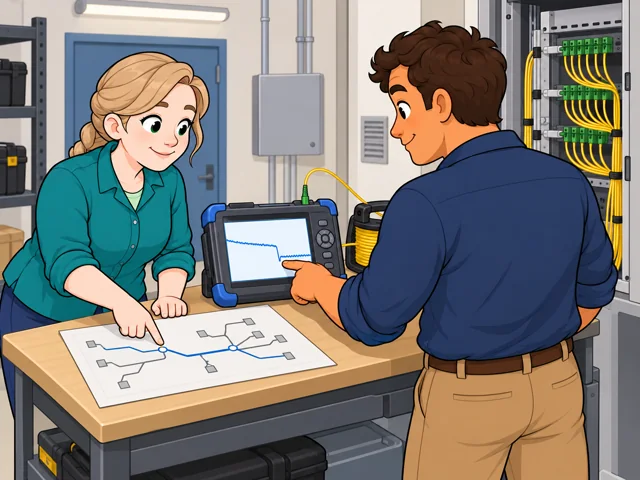
Match the tester's graph to the cable route, and a surprise dip flags a connection or damaged stretch.
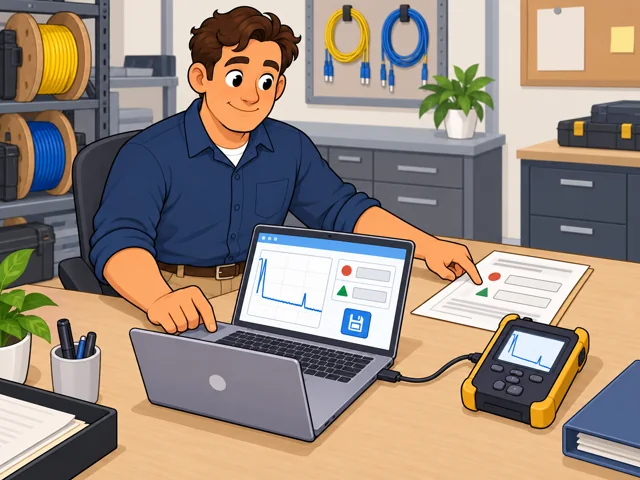
Log results under the fiber and cable IDs so a tech chasing trouble later has readings to compare.
United States · 2025
United States · May 2025
United States · 2025–2035
Quick orientation
A high school diploma or equivalent is typical, followed by long-term training on the job.
National median pay, equivalent to $35.73 an hour.
About 8,000 openings a year are projected nationally despite declining total employment.
On fiber jobs, machines can align and fuse prepared fibers, while test software helps analyze signal loss.
You still prepare clean fiber ends and check whether a test result makes sense for the actual cable route.
How much diagnosis can become automatic remains uncertain: a tester’s automatic analysis can misread features of the cable.
Pay in context
The national median was $74,330 a year, or $35.73 an hour, in May 2025. That is the midpoint across workers, not a starting offer.
The lowest-paid 10% earned $45,310 or less; the highest-paid 10% earned $103,680 or more. These are wage percentiles, not steps on a career ladder.
A historical comparison shows annual mean pay of $76,740 in telecommunications and $53,170 in utility system construction in May 2023. These averages describe groups of workers, not current offers.
Employment is projected to shrink 3.4% from 2025 to 2035, while averaging 8,000 openings annually. Openings and growth measure different things; a shrinking occupation can still need replacement workers.
A high school diploma or equivalent is the typical starting point. Learning the trade continues after you are hired.
After entry
This starts where the entry routes leave off: early work, growing capability, and advancement or specialization.
Learn the crew’s equipment and repair tools until you can explain what each tool checks and when to use it.
Learn to compare fiber test graphs with cable records and spot results that need another check.
Develop deeper skill with splicers and test instruments. Equipment-specific training helps you handle different machines and interpret more difficult results.
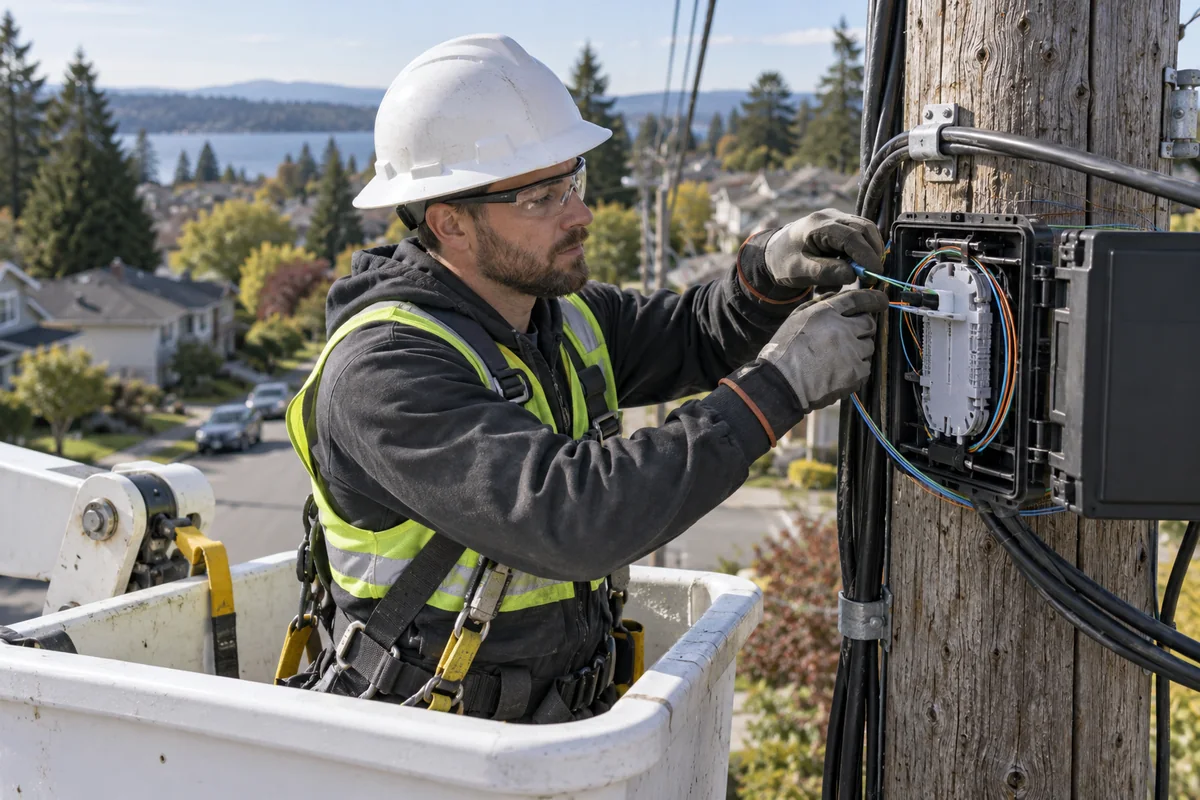
Your worksite moves along poles, trenches, and underground ducts. Crews use different access and pulling equipment as the route changes.
Some cable work moves into a clean mobile workspace at ground level. Here, close-up fiber preparation and joining replace much of the large-scale cable handling.
Try it
Draw a cable route from a street cabinet to four homes, including a shared section and separate branches. Mark two neighboring homes as offline. Circle the section you would investigate first and explain why. Notice whether tracing the shared connection interests you.
Stay safe: Keep this a paper exercise; do not open cabinets, climb poles, or handle utility cables.