

Scan passes at the entrance
Where the venue scans tickets, watch the scanner screen and send any problem passes to the box office.
Career profile
Ushers check tickets, walk guests to their seats, and help a crowd settle in.
Standing at the doors and along the aisles puts you right where people stop with questions. It fits someone who enjoys giving strangers directions.
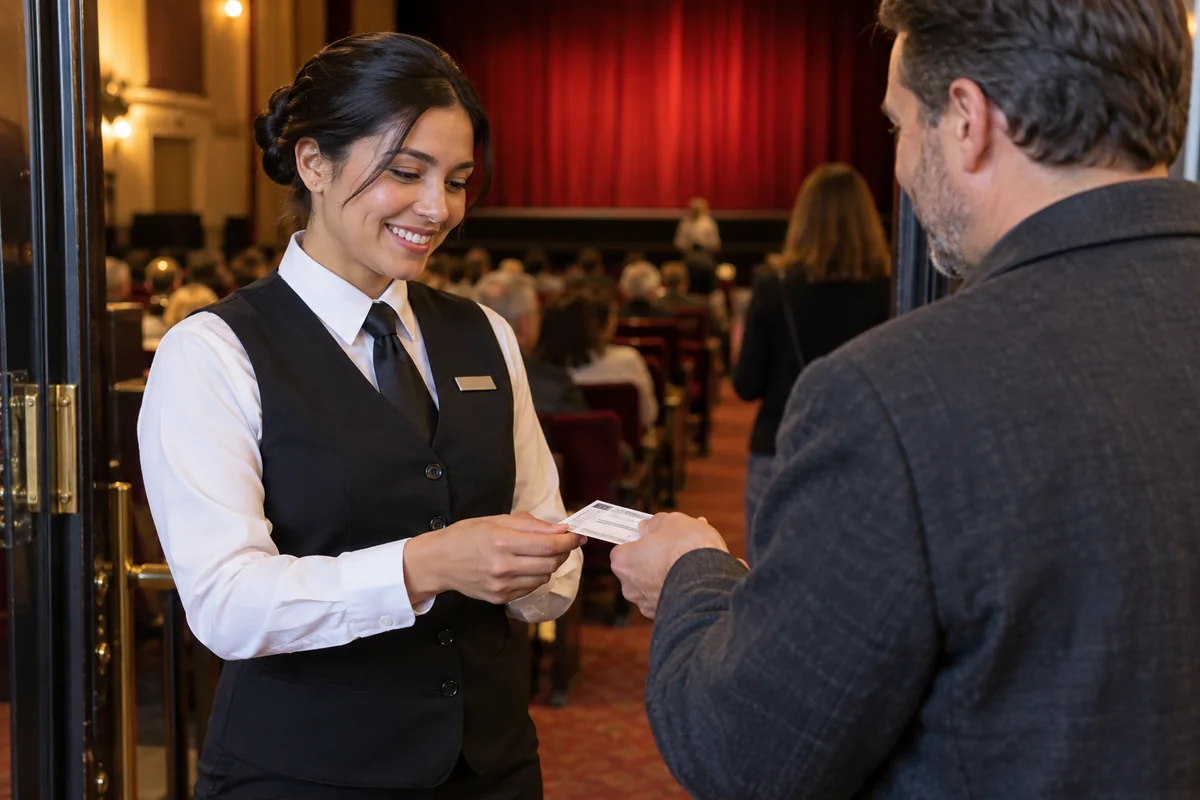
Where the venue scans tickets, watch the scanner screen and send any problem passes to the box office.

Find the seat on a pass and lead the guest there, comparing the two passes if it's taken.

Hold concert latecomers for a suitable break before leading them in, so entry does not disrupt the show.

At movie theaters, pick up left-behind cups and sweep to get the room ready for guests.
United States · 2025
United States · 2025 wage data
United States · 2025–2035
Quick orientation
Typically, no formal educational credential or related experience is needed. Employers provide short-term training.
National median for ushers, lobby attendants, and ticket takers combined; the annual equivalent is $32,910.
Employment is projected to grow 0.9% from 2025 to 2035 for ushers, lobby attendants, and ticket takers combined.
At venues using digital entry tools, scanners check ticket validity and software tracks arrivals to help managers plan entrance staffing.
You still explain where to go and help people resolve seating disagreements.
As entry checks become more automated, your time could shift toward troubleshooting. How much hands-on ticket checking remains will depend on the venue's equipment and guests' needs.
Pay in context
Compare the hourly rate and expected paid hours together. Location, skills, and experience can affect an offer; a part-time schedule changes what you take home over a year.
For ushers, lobby attendants, and ticket takers combined, the median is $15.82 an hour, or $32,910 annually. The 10th and 90th percentiles are $11.33 and $20.42 an hour—not starting and senior rates. Annual figures use 2,080 hours, so they are not a promise of part-time income.
The Chicago Symphony Orchestra Association's usher description, reviewed in January 2025, lists $16.60 an hour for part-time work. Treat that as a dated local rate, not an average for concert halls.
The combined national occupation is projected to have 27,300 openings a year during 2025–2035, alongside 0.9% employment growth. Openings include replacing workers who leave; they are not all newly created jobs.
You can enter through paid venue work and learn on the job. A college program is not the typical requirement, but each employer sets its own hiring conditions.
After entry
This starts where the entry routes leave off: early work, growing capability, and advancement or specialization.
Get comfortable locating seats, restrooms, and exits so you can give directions without guessing.
Build confidence sorting out seating mix-ups and helping guests with access needs.
A cinema crew-leader role adds assigning stations and breaks, helping with guest concerns, and checking closing work. Look for chances to learn those responsibilities.
Some crews rotate among ticket checks, concessions, and cleaning. The work spans several stations, with opening and closing tasks around daily screenings.
The performance sets the rhythm: late seating waits for pauses, and you coordinate guest concerns with house management. Expect sustained standing and movement through the hall.
Try it
Draw a small seating plan and make a few paper tickets. Ask a friend to play a guest, including one whose seat appears occupied. Practice checking the ticket and explaining the route. Notice whether you enjoy staying accurate while someone waits.