
Career profile

Water Resource Specialist

Water resource specialists use water readings to plan a dependable supply and healthier watersheds.

Several changes could get a community more water. You weigh them against each other, then help shape the chosen one into a workable water program.
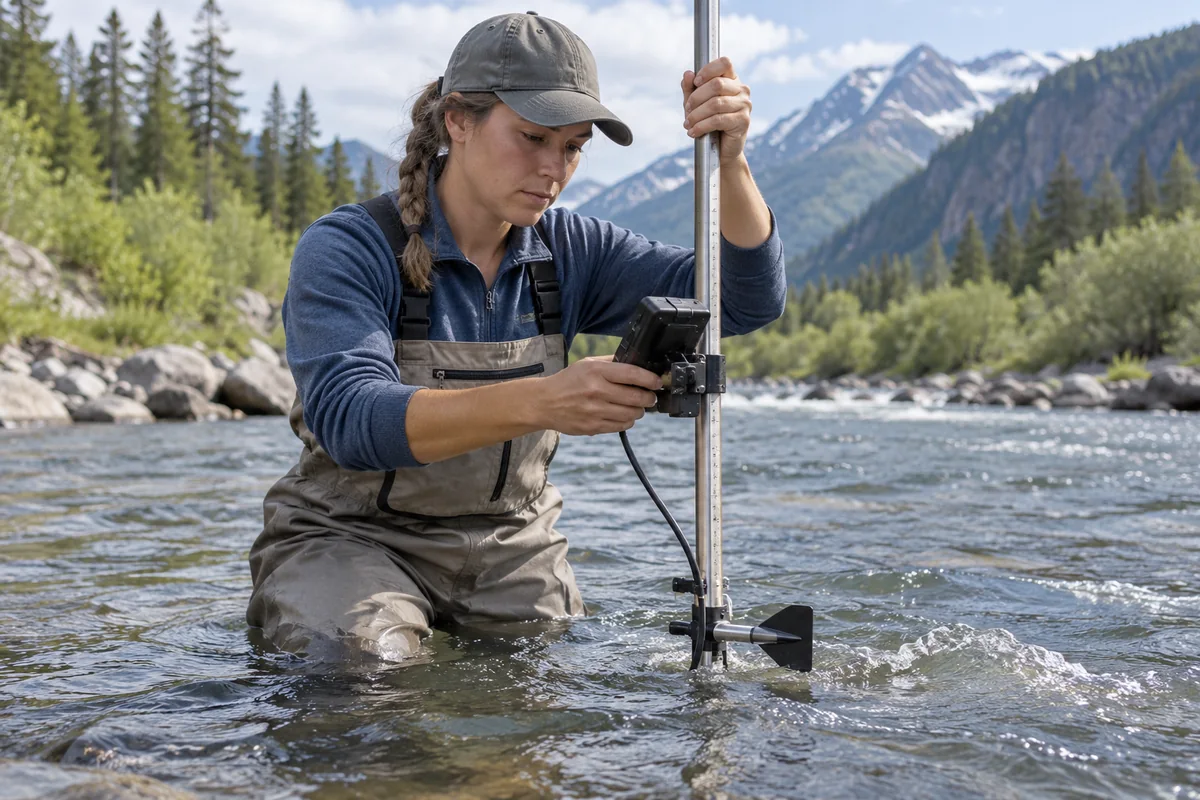
An adult water resource specialist measuring stream flow with field equipment beside a river.

A day in the life

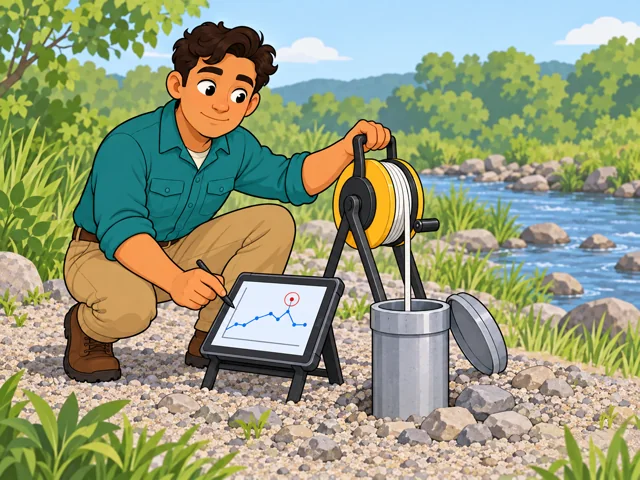
1A water resource specialist checks a water-level meter at a monitoring well and flags an unusual point while comparing it with recorded data.

Take a water-level reading

In field roles, you check water-level meter readings against past data and flag odd ones before planning reports.

2The specialist adjusts a computer-model input and compares river levels under different flow conditions.

Run flow scenarios on a computer

Model river levels across several flow scenarios, then tweak the inputs to see where water might go.
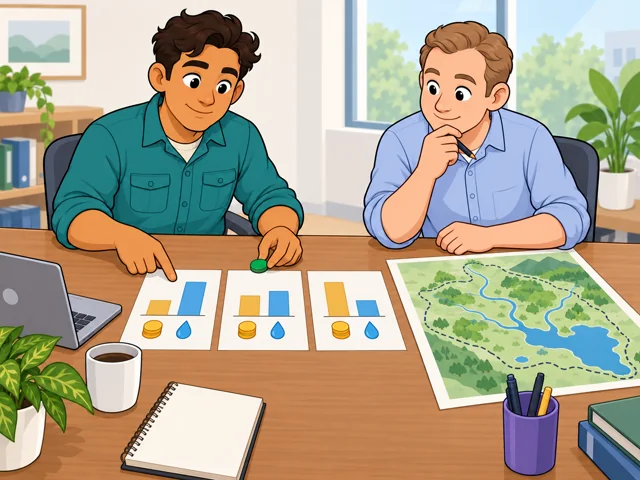
3The specialist compares project costs and expected water benefits with a coworker, indicating an option alongside a watershed map.

Weigh project costs against gains

Put each project's cost next to its expected water gain, then recommend the one fitting the watershed's goals.
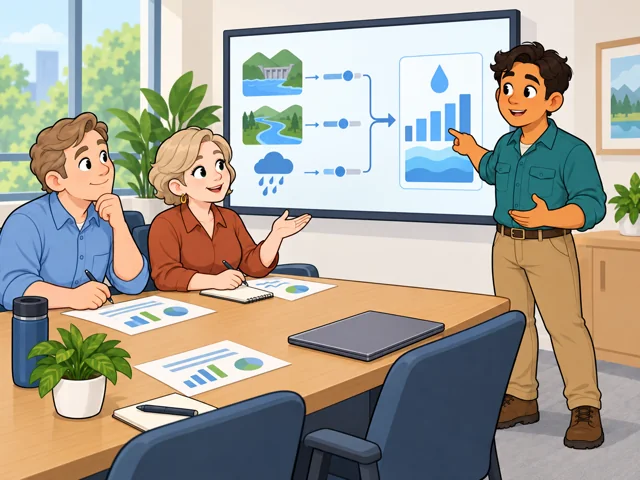
4The specialist explains a water-supply proposal using charts and answers a meeting participant's question about its assumptions.

Defend a plan to partner agencies

Bring charts to a partner-agency meeting, lay out your water supply recommendation and field questions on its assumptions.
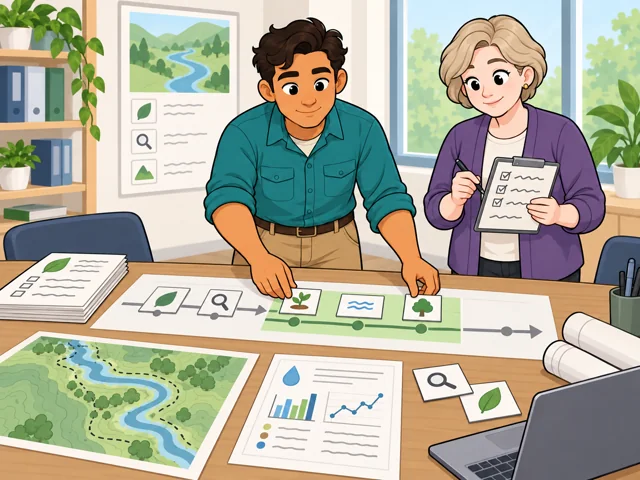
5The specialist and a coworker coordinate sampling results, permit conditions and environmental-review milestones to fit stream work within its allowed window.

Keep stream work inside permit window

In watershed-upkeep roles, you schedule a stream project around sampling results, permit conditions and environmental review dates.

Quick facts

Preparation

Often a bachelor's degree

United States

Pay

Not displayed

Pay depends on the employer and job level; see the dated local ranges below.

Outlook

Not displayed

There is no separate national growth estimate here for water resource specialists.

Quick orientation

Preparation, pay & outlook

Preparation

Often a bachelor's degree

Planning roles commonly call for college preparation. Some field-focused specialist jobs accept a high school diploma.

Geography
United States
Period
Not applicable

Pay

Not displayed

Pay depends on the employer and job level; see the dated local ranges below.

Geography
United States
Period
2025

Outlook

Not displayed

There is no separate national growth estimate here for water resource specialists.

Geography
United States
Period
2024–2034

Fit, tradeoffs & changing tools

Things to weigh

  • Expect substantial desk time for analysis, reports, and meetings.
  • Field assignments can mean rugged ground, heavy equipment, and working in rain; storm monitoring can make weather part of your workload.

Where AI may help

River-modeling software calculates flows, sediment movement, and water-quality changes, letting you compare scenarios before recommending work.

What people still lead

You still have to interpret results and explain which water-management choice they support.

What we can’t predict yet

How much scenario setup and interpretation software will take over remains uncertain, especially when measurements are incomplete or conditions change.

Pay in context

Earnings

Job level and the mix of planning and fieldwork matter when comparing offers. These California ranges are local benchmarks.

Regional water-district planning

In March 2026, Western Municipal Water District advertised $74,841–$129,266 a year ($35.98–$62.15 an hour) across Specialist I and II. This combined range is not a starting-pay promise.

Geography
Riverside, California
Period
March 2026
Pay basis
Advertised full-time salary range across two classification levels; recruitment closed

Technical responsibility changes the range

Ventura County's November 2025 ranges were $27.66–$38.80 an hour for Specialist I and $38.84–$54.50 for Specialist IV. These jobs were eligible for overtime compensation.

Geography
Ventura County, California
Period
November 2025
Pay basis
Advertised hourly classification ranges, excluding overtime; recruitment closed

Getting started

Enter through field monitoring

Paid
What the route involves
At Mojave Water Agency, Specialist I staff learn sampling, instrument care, and data checks with supervision.
What it can lead to
This builds experience supporting groundwater and surface-water planning.
What to check
The classification requires a high school diploma or equivalent, a California Class C driver's license, and current automobile insurance. Related experience is preferred, not required.

Prepare for professional project work

What the route involves
Earn a bachelor's degree in water resources, planning, engineering, earth science, or a related field.
What it can lead to
Valley Water identifies this preparation for Assistant Specialist I work supporting environmental planning and water programs, with no prior experience in its ideal entry-level criteria.
What to check
Its July 2026 recruitment was for a limited-term appointment of up to two years. You needed an appropriate valid California driver's license or the ability to obtain one; applicants unable to meet this requirement because of a disability could be considered for reasonable accommodation case by case. Other employers set different requirements.

The title covers both technical field entry and professional planning work. Match your preparation to the actual duties.

After entry

Career paths

This starts where the entry routes leave off: early work, growing capability, and advancement or specialization.

  1. Build reliable records

    Learn the water database and checking procedures. Make your measurements, tables, and maps dependable enough for others to use.

  2. Own a larger analysis

    Take on cost comparisons and more complex planning reports, then coordinate a program's work and deadlines.

  3. Lead a technical program

    Move toward senior specialist work: plan monitoring, guide junior staff, and help manage equipment and budgets. Groundwater or water quality can become your specialty.

Where you can work

Regional water-supply district

Office analysis connects you with partner agencies and district leaders. Funding applications and regional supply plans can shape your calendar.

  • Office

County watershed program

Move between monitoring sites and office analysis. Stream gauges, water-quality instruments, and storm reports make conditions outside directly relevant to your day.

  • Field work
  • Office
  • Travel

Try it

See whether the job clicks before you commit to the path.

Make a pretend water budget of 100 units for a town, farms, and a river. Reduce the supply to 80. Propose an allocation, explain one tradeoff, and list the measurements you would need before recommending it. Notice whether comparing needs interests you as much as doing the arithmetic.

Explore more careers

Sources

  1. O*NET OnLine / U.S. Department of Labor. Water Resource Specialists — 11-9121.02. Accessed 2026-10-03.
  2. Mojave Water Agency. Water Resources Specialist I — Class Specification. Accessed 2026-10-03.
  3. Western Municipal Water District. Water Resources Specialist I/II — March 2026 Recruitment. Accessed 2026-10-03.
  4. Ventura County. Water Resources Specialist I/II/III/IV — November 2025 Recruitment. Accessed 2026-10-03.
  5. Santa Clara Valley Water District. Assistant Water Resources Specialist I/II (Limited Term) — July 2026 Recruitment. Accessed 2026-10-03.
  6. U.S. Army Corps of Engineers, Hydrologic Engineering Center. River Analysis System. Accessed 2026-10-03.

Your message goes to the Great Jobs team. How we use your information